
How to Get FMLA? Step-by-Step Guide (2026)
 by Anam Moin
 Last updated:
If you are thinking about how to get FMLA, the direct answer is that you first confirm your eligibility, notify your employer of a potentially qualifying need, and submit any certification your employer properly requests.
You do not apply through the government. Your employer reviews eligibility, provides notices, evaluates supporting information, and designates qualifying leave.
This guide walks you through eligibility, notice, forms, deadlines, leave schedules, denials, and return-to-work rights.
As you read, remember that state law, a union agreement, or your employer’s policy may offer benefits beyond the federal minimum.
7 Steps Process to Get FMLA
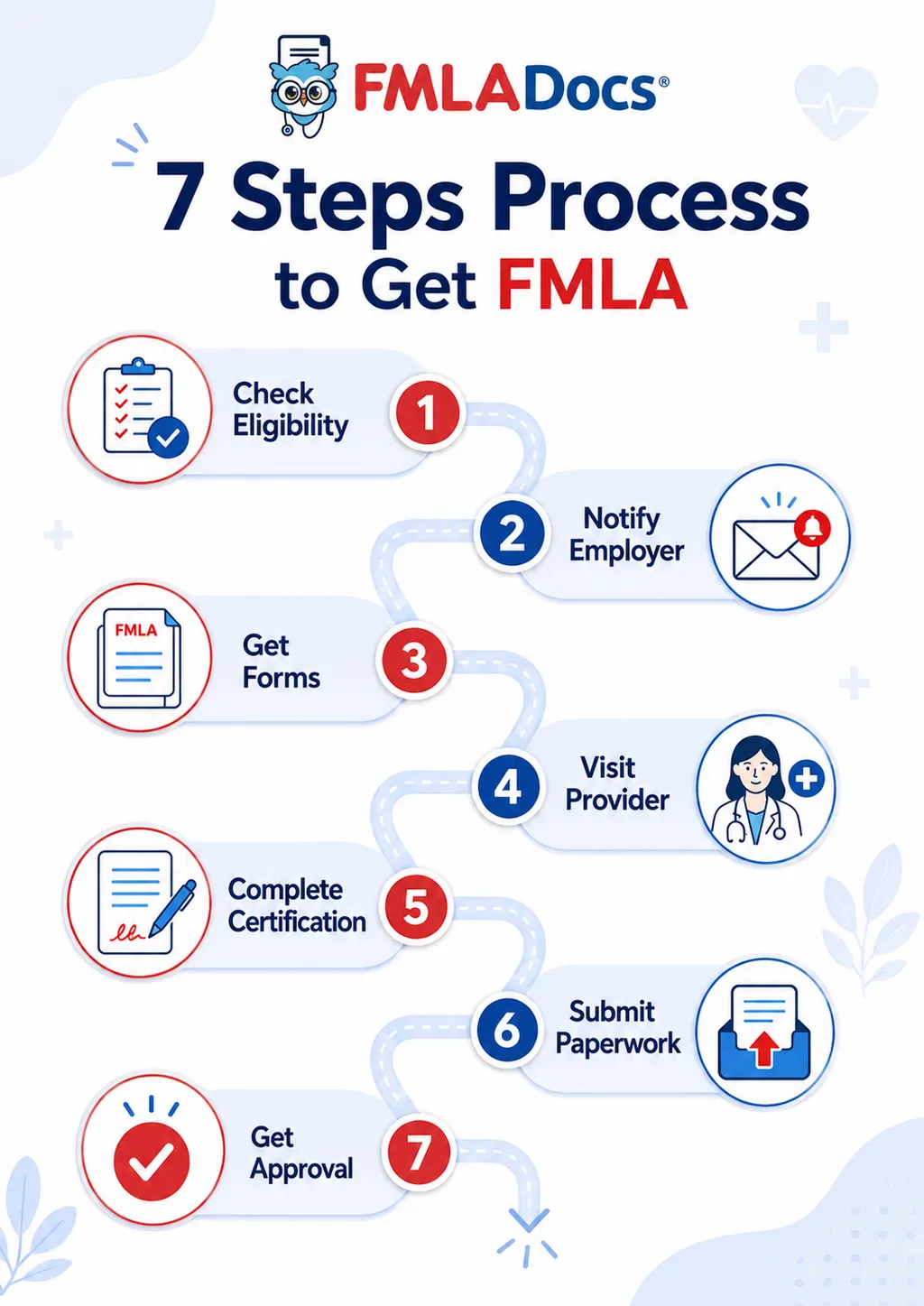
You get FMLA by giving your covered employer timely notice that you need leave for a potentially qualifying reason and by supplying complete certification when the employer requests it. You must also meet the employee eligibility requirements when your FMLA leave begins.
The usual process follows six steps:
-
Step 1: Confirm employer coverage: Check whether the FMLA covers your employer and whether at least 50 employees work within 75 miles of your worksite.
-
Step 2: Check your eligibility: You generally need 12 months of employment, 1,250 hours of service during the previous 12 months, and a qualifying worksite.
-
Step 3: Identify a qualifying reason: Your own serious health condition, family caregiving, childbirth, adoption, foster placement, or certain military-related needs may qualify.
-
Step 4: Notify your employer: Follow your employer’s normal leave procedure, provide enough information about your need, and give at least 30 days’ notice when possible.
-
Step 5: Review your FMLA forms: Check your eligibility notice, rights and responsibilities notice, certification form, deadlines, and designation notice carefully.
-
Step 6: Complete medical certification: Ask your healthcare provider to complete every applicable section and return the certification within the required timeframe, generally 15 calendar days.
-
Step 7: Receive the designation decision: Your employer reviews the information and generally provides a designation decision within five business days after receiving enough information.
Your employer cannot require you to know every legal term before you ask for help. Still, clear information and prompt follow-up make it easier for human resources to recognize and process your request.
Create a timeline of your leave needs, notice, employer responses, and deadlines. Save emails, forms, confirmations, screenshots, and call notes securely.
This record helps you answer questions and distinguish employer coverage, employee eligibility, and whether your absence qualifies.
Do not wait for a final diagnosis when you already know that treatment or incapacity may require leave. Give timely notice based on the facts available, then update your employer when dates or medical estimates change.
Step 1: Does the FMLA Cover Your Employer?
Employer coverage comes before individual eligibility. The standard federal FMLA covers public agencies, public and private elementary and secondary schools, and private-sector employers that employed at least 50 employees for at least 20 workweeks in the current or preceding calendar year.
For an employee of a covered private employer, the worksite test also matters. You generally must report to, or receive assignments from, a location where the employer has at least 50 employees within 75 miles.
What if your company has fewer than 50 employees?
A small private employer may fall outside federal FMLA coverage. Ask human resources whether state law, disability accommodations, paid sick leave, company policy, or a union agreement offers another option.
Step 2: Are You Eligible for FMLA Leave?
For most employees covered by the Department of Labor’s rules, you must satisfy three employee-level tests as of the date your leave starts. Eligibility depends on your actual employment history, not simply whether you hold a full-time title.
You generally need to:
-
Work for the employer for at least 12 months. The months usually do not need to run consecutively, although special rules govern long breaks in service.
-
Complete at least 1,250 hours of service. The employer counts hours you actually worked during the 12 months immediately before leave, using Fair Labor Standards Act principles.
-
Meet the worksite threshold. At least 50 employees must work within 75 miles of your worksite.
Paid time when you performed no work usually does not count toward the 1,250-hour test. If the total seems wrong, ask human resources to explain its calculation.
Private-sector and federal employee eligibility compared
Most private-sector, state, and local employees follow Department of Labor rules. Most civilian federal employees follow different Office of Personnel Management rules.
| Issue | Most private-sector employees | Most Title 5 federal employees |
|---|---|---|
| Governing rules | Title I; 29 CFR Part 825 | Title II; 5 CFR Part 630, Subpart L |
| Service requirement | 12 months with the employer | 12 months of qualifying civilian or military service |
| Hours requirement | Generally 1,250 hours in the prior 12 months | The DOL 1,250-hour test does not apply |
| Main contact | Employer or human resources; DOL for guidance | Employing agency’s human resources office; OPM framework |
| Leave year | Employer chooses a lawful calculation method | Generally measured forward from first use under OPM rules |
If you work for the federal government, ask your agency which FMLA authority covers you.
Step 3: Does Your Reason Qualify?
FMLA protects leave only for reasons recognized by the statute. A difficult personal situation may deserve time away, but it does not automatically create federal FMLA entitlement.
Common qualifying reasons include:
-
The birth of your child and care during the first year after birth.
-
Placement of a child with you for adoption or foster care and care during the first year after placement.
-
Care for your spouse, child, or parent who has a serious health condition.
-
Your own serious health condition when it prevents you from performing one or more essential job functions.
-
A qualifying exigency related to your spouse, child, or parent’s covered military duty.
-
Care for a covered servicemember with a serious injury or illness, which can provide up to 26 workweeks in a single 12-month period.
Federal FMLA does not ordinarily cover care for a parent-in-law, sibling, grandparent, or unmarried partner solely because of that relationship. An in loco parentis relationship may qualify when someone assumed day-to-day care or financial responsibility without a biological or legal parent-child relationship.
What counts as a serious health condition?
A serious health condition generally involves inpatient care or continuing treatment. It can include pregnancy-related incapacity, chronic episodic conditions, long-term conditions, or qualifying periods of incapacity and treatment.
Can anxiety, stress, or another mental health condition qualify?
Anxiety, depression, post-traumatic stress disorder, or another mental health condition may qualify when it meets the serious-health-condition standard and creates incapacity or a medically necessary need for treatment. Ordinary workplace pressure, without a qualifying health condition, does not create FMLA protection by itself.
Describe your symptoms and functional limits honestly so your provider can assess the appropriate leave schedule.
Step 4: How Do You Notify Your Employer?
Start with your employer’s normal procedure for requesting leave or reporting an absence. That may mean contacting a supervisor, calling an attendance line, submitting an HR portal request, or notifying a third-party leave administrator.
When your need is foreseeable, such as scheduled surgery, you generally should give at least 30 days’ notice. If 30 days is not possible, give notice as soon as practicable and explain when you learned about the need.
For an emergency or unexpected flare-up, notify the employer as soon as practicable and follow normal call-off rules.
What should you say when requesting FMLA?
You do not need to disclose your entire medical record or make a legal argument. Give enough information to show that the absence could involve a serious health condition or another qualifying event.
You might write:
I need medical leave beginning around [date] because a health condition requires treatment and prevents me from performing my job duties. Please tell me whether I am eligible for FMLA and send me the required forms and deadlines.
For family care, identify the relationship and need for care. Keep a dated copy of your request and delivery confirmation.
Step 5: What Notices and FMLA Forms Should You Expect?
Once your employer learns that your leave may qualify, it generally must tell you whether you meet the eligibility rules within five business days, absent extenuating circumstances. If you do not qualify, the notice should identify at least one reason.
The rights and responsibilities notice explains certification, health premiums, concurrent paid leave, and any return-to-work requirement.
Common Department of Labor forms include:
| Form | Typical purpose | Usually completed by |
|---|---|---|
| WH-380-E | Certification for your own serious health condition | Health care provider |
| WH-380-F | Certification for a family member’s serious health condition | Health care provider |
| WH-384 | Certification for a military qualifying exigency | Employee and supporting source |
| WH-385 or WH-385-V | Military caregiver certification | Authorized health care provider and other parties |
Employers may use their own forms but cannot demand more than FMLA permits. Read every stated deadline.
Step 6: How Do You Complete Medical Certification?
If your employer requests medical certification, give the correct form to your health care provider promptly. Tell the office about the due date and check whether it charges a form-completion fee, because FMLA does not require the employer to pay that cost.
The provider should answer every applicable question. The certification should describe relevant limitations, duration, and expected frequency of episodes or appointments.
You generally have at least 15 calendar days after the employer requests certification. If you cannot meet the deadline despite diligent, good-faith efforts, notify the leave administrator before it expires, explain the barrier, and provide an expected completion date.
What happens if the certification is incomplete?
An incomplete certification leaves one or more applicable entries unanswered. An insufficient certification contains vague, unclear, or nonresponsive information.
The employer generally must identify the problem in writing and give you at least seven calendar days to cure it, unless seven days is not practicable despite diligent, good-faith efforts. Respond only to the identified gaps and keep proof of resubmission.
Authorized employer representatives may seek limited authentication or clarification, but your direct supervisor may not contact the provider.
Step 7: When Does Your Employer Designate the Leave?
Your employer makes the designation decision; your provider supplies medical facts but does not “approve FMLA.” Once the employer has enough information, it generally must tell you within five business days whether it will designate the leave as FMLA, absent extenuating circumstances.
The designation notice should identify the amount counted when known and any fitness-for-duty requirement. Follow up in writing if you receive no decision.
How Much FMLA Leave Can You Take?
An eligible employee can generally take up to 12 workweeks during the employer’s chosen 12-month period for ordinary qualifying reasons. Military caregiver leave can provide up to 26 workweeks during a single 12-month period, subject to combined limits.
Ask which lawful 12-month calculation method your employer uses because it affects when leave becomes available again.
Continuous, intermittent, and reduced-schedule leave
Continuous leave covers one uninterrupted block of time. Intermittent leave covers separate periods for the same qualifying reason, while a reduced schedule lowers your normal daily or weekly hours.
Medically necessary intermittent leave can cover treatment or unpredictable episodes. Try to schedule planned treatment to limit disruption, subject to medical needs.
For bonding after birth or placement, intermittent leave generally requires employer agreement under the standard DOL rules. The leave must also finish within 12 months after the birth or placement.
Is FMLA Paid, and Can Other Benefits Run at the Same Time?
Federal FMLA itself provides unpaid leave.
However, you or your employer may substitute accrued paid leave under applicable policies, and another benefit may replace part of your income while FMLA supplies job protection.
Programs that may overlap include:
-
Paid sick or vacation leave: Accrued paid time may run concurrently.
-
State paid leave: A state program may replace wages.
-
Short-term disability: Insurance may cover part of your income.
-
Workers’ compensation: A qualifying work injury can trigger both systems.
-
Parental benefits: Paid parental leave may overlap with FMLA.
Overlapping programs do not usually create extra protected weeks. Ask how payroll and leave balances will work.
What Rights Do You Have While on FMLA?
During protected leave, your employer must maintain group health coverage on the same terms, while you pay your normal share.
When you return, the employer generally must restore you to the same job or an equivalent job with equivalent pay, benefits, working conditions, privileges, and status. Limited rules can affect certain highly compensated “key employees,” but the employer must provide specific notice.
Your employer cannot interfere with FMLA rights or retaliate against you. FMLA does not block a job action that would have occurred anyway.
Can your employer replace you during FMLA?
Your employer may arrange temporary coverage, but it cannot deny restoration merely because someone handled your duties. A genuine, unrelated layoff may still affect you if the employer can show the same action would have occurred without leave.
Why Can an FMLA Request Be Denied?
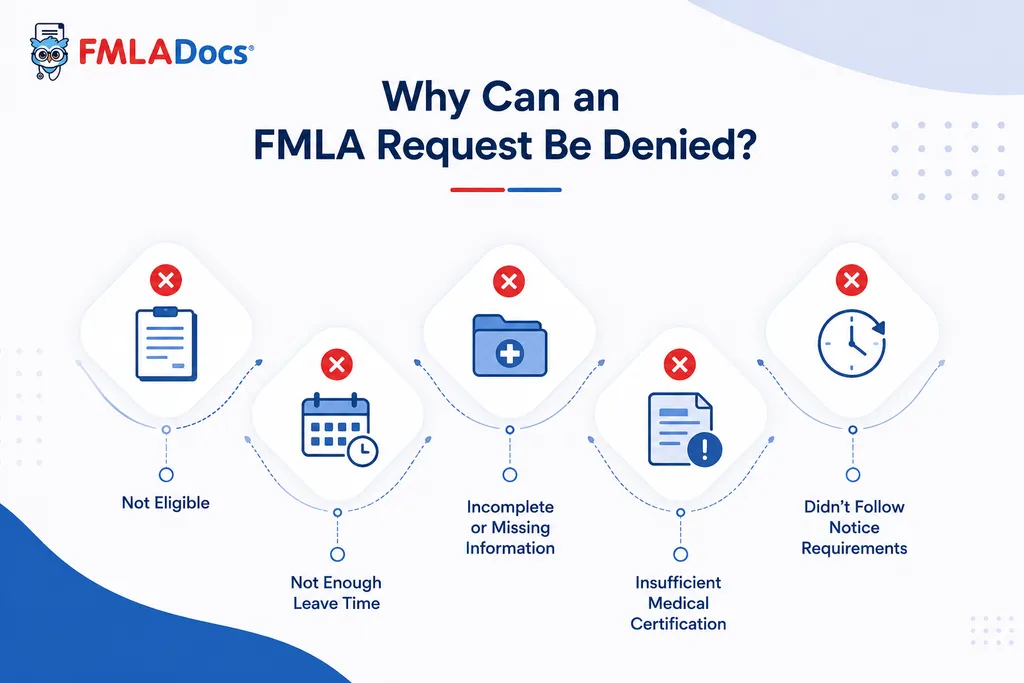
An employer can deny FMLA protection when the law does not cover the employer, you do not meet eligibility requirements, your reason does not qualify, or you fail to satisfy valid notice and certification duties.
A denial should not rest on bias, inconvenience, or punishment for asserting your rights.
Common problems include:
-
You have not completed 12 months or 1,250 hours of qualifying service under Title I.
-
Your worksite does not meet the 50-employees-within-75-miles test.
-
The family relationship or reason falls outside the statute.
-
You miss the certification deadline without communicating diligent, good-faith efforts.
-
The certification remains incomplete after a proper opportunity to cure it.
-
You fail to follow a normal call-off procedure without unusual circumstances.
-
You have exhausted the available entitlement in the applicable 12-month period.
Ask for the reason in writing and compare it with your records before responding.
What should you do after a denial?
Correct factual errors and submit missing information within any cure period. You can also contact the Department of Labor’s Wage and Hour Division or consult an employment attorney.
How Should You Prepare to Return to Work?
Review any fitness-for-duty requirement before leave ends and arrange the appointment early. Keep human resources updated about your expected return date.
If you cannot return after exhausting FMLA, ask whether disability accommodation, state law, or another policy may apply.
Take the Next Step With FMLADocs
Learning how to get FMLA means confirming coverage and eligibility, giving timely notice, and returning complete certification rather than applying directly to the government.
Careful documentation can help you avoid preventable delays, although neither a provider nor a paperwork service can guarantee that your employer will approve leave.
At FMLADocs, we help employees obtain online FMLA medical certification from licensed health care professionals.
Our service lets you submit information remotely, and a licensed physician reviews your medical records and typically completes eligible certification requests within 24 to 48 hours.
If you need help with how to get FMLA anywhere in the United States, FMLADocs can help you get FMLA certified online.
We can help with medical certification, while your employer retains responsibility for eligibility and final FMLA designation.
Frequently Asked Questions
What should you say to get FMLA for anxiety?
Tell your employer that a health condition requires treatment or prevents you from performing essential job functions, and request the leave forms. Tell your provider the truth about symptoms, treatment, incapacity, and expected absences so the provider can determine whether the condition meets certification criteria.
How do you write a letter requesting FMLA?
State that you need leave for a potentially qualifying medical or family reason, give the expected start date and duration if known, and ask for eligibility and certification documents. Keep the medical description limited, follow the normal request procedure, and retain a dated copy.
Is it hard to get FMLA for stress?
Stress alone does not automatically qualify, but a stress-related physical or mental health condition may qualify when it meets the serious-health-condition rules. Complete, specific certification and timely notice matter more than the label you use.
How do you request medical leave?
Contact your supervisor, human resources department, or leave administrator through the employer's required channel. Explain that your condition requires time away, provide approximate dates, request all required forms, and meet the stated deadlines.
Can your employer ask for your diagnosis?
An employer may request a complete medical certification containing allowed medical facts, but a diagnosis is not always required under the DOL's optional certification forms. Your employer must keep FMLA medical records confidential and separate from routine personnel files.
Meet the author
Anam Moin
I'm Anam Moin, and my work at FMLADocs focuses on workplace leave and FMLA education. I cover certification, documentation, employee rights, and leave-related questions to provide readers with useful information when they need it most.
Get Your FMLA Certification Online in Minutes