

Military Family Leave Under FMLA: Qualifying Exigency vs Military Caregiver Leave
 by Nida Hammad
 Last updated:
Military FMLA includes two separate leave options built into the Family and Medical Leave Act to address the unique demands of military service: qualifying exigency leave and military caregiver leave. Understanding which one applies to your situation, and gathering the right documentation from the start, can make a stressful process far more manageable.
Understanding Military FMLA
If you have a family member who has been called to active duty, or you are caring for a service member or veteran with a serious injury or illness, the Family and Medical Leave Act (FMLA) may allow you to take protected leave from work. The challenge is that many employees only discover terms like qualifying exigency leave and military caregiver leave when they are already facing a stressful situation and need answers quickly.
These military-specific FMLA provisions were created because the standard FMLA protections for an employee’s own serious health condition, the birth of a child, or other common family situations do not address the unique demands of military service. A spouse may need time away from work to manage urgent responsibilities after a deployment notice, while a parent or adult child may need extended leave to care for a wounded service member recovering from a serious injury. Recognizing these very different circumstances, Congress established two separate military leave categories, each with its own eligibility rules, leave entitlement, and Department of Labor certification requirements.
This guide explains qualifying exigency leave and military caregiver leave in a clear, side by side comparison. You’ll learn who qualifies, how much leave may be available, the certification forms employers commonly request, and the situations each type of leave covers. When medical certification is required, as it often is for military caregiver leave, complete and accurate documentation from a qualified healthcare provider is essential. FMLADocs offers telehealth certification support for eligible situations, which we discuss later in this guide. First, let’s look at how these two military FMLA leave options differ.
Types of Military FMLA Leave
Before comparing the eligibility rules and paperwork, it helps to understand how these two types of military FMLA leave differ. Although both are protected under the Family and Medical Leave Act, they serve different purposes, cover different family situations, and provide different amounts of leave.
| Qualifying Exigency Leave | Military Caregiver Leave | |
|---|---|---|
| Purpose | Address non-medical responsibilities that arise because of a family member’s covered active duty or call to covered active duty | Care for a covered service member or veteran with a serious injury or illness |
| Maximum Leave | Up to 12 weeks during a 12-month period | Up to 26 weeks during a single 12-month period |
| Eligible Family Members | Spouse, child, or parent of a service member on covered active duty | Spouse, child, parent, or next of kin of a covered service member or veteran |
| Required Forms | DOL Form WH-384 | DOL Form WH-385 for current service member or WH-385-V for covered veteran |
| Medical Certification Required? | No. Exigency leave is generally based on military orders and qualifying events rather than a medical condition. | Yes. A qualifying serious injury or illness must be certified by an authorized health care provider. |
Qualifying exigency leave is designed for practical responsibilities related to a family member’s military service, such as attending deployment briefings, arranging childcare, handling financial or legal matters, or spending time with a service member during qualifying rest and recuperation.
Military caregiver leave is intended for family members who need time off to provide or coordinate care for a covered service member or veteran with a qualifying serious injury or illness. If your leave involves medical treatment, rehabilitation, or ongoing recovery, military caregiver leave is generally the appropriate category.
Military FMLA Qualifying Exigency Leave
Understanding Covered Active Duty
Qualifying exigency leave is available when a covered military family member is on covered active duty or has received notice of an impending call or order to covered active duty. Under U.S. Department of Labor guidelines, this generally refers to deployment to a foreign country. For members of the Reserve components, it also includes deployment to a foreign country under a call or order to active duty in support of a contingency operation.
This distinction is important because not every period of active military service qualifies. A family member’s active duty status alone does not make an employee eligible for qualifying exigency leave. The deployment, or notice of deployment, must meet the Department of Labor’s definition of covered active duty before leave protections apply.
Who Qualifies as an Eligible Family Member
Under the current FMLA military leave rules, qualifying exigency leave is available only to certain family members of a covered military member who is on covered active duty or has been called to covered active duty. Eligible family members include:
- Spouse
- Child, including a biological, adopted, foster, or stepchild, a legal ward, or a child for whom the employee stands in loco parentis
- Parent of the service member, but not a parent-in-law
Broader family relationships are generally not covered. For example, siblings, grandparents, grandchildren, aunts, uncles, and other relatives are not eligible for qualifying exigency leave based solely on their relationship to the service member, even if they play a significant role in providing support during the deployment. Eligibility is determined by the FMLA’s definition of a qualifying family relationship.
Common Qualifying Exigency Reasons
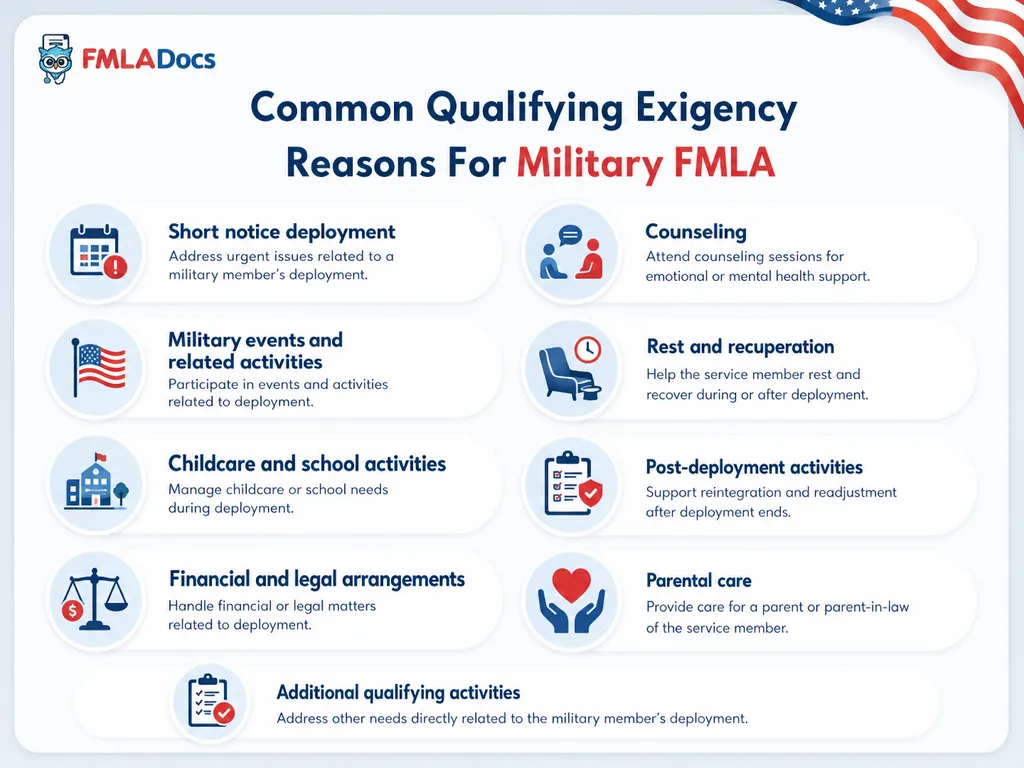
The FMLA recognizes several situations that may qualify for military exigency leave. Depending on the circumstances, you may use leave for one or more of these reasons throughout a service member’s deployment.
- Short notice deployment: Handle urgent matters that arise when the service member receives deployment orders with seven or fewer days notice.
- Military events and related activities: Attend official military ceremonies, deployment briefings, family support programs, or other approved military events.
- Childcare and school activities: Arrange alternative childcare, enroll or transfer a child to a new school, or attend school meetings when the deployment creates the need.
- Financial and legal arrangements: Prepare or update financial and legal documents related to the deployment, including powers of attorney, banking matters, insurance, leases, or other essential affairs.
- Counseling: Attend counseling for yourself, the service member, or the service member’s child when the counseling is directly related to the deployment.
- Rest and recuperation: Spend time with a service member who is on temporary rest and recuperation leave during deployment, subject to the maximum leave period allowed under current FMLA regulations.
- Post-deployment activities: Attend welcome home ceremonies, reintegration programs, or address qualifying matters that arise after the service member returns from deployment within the timeframe allowed by law.
- Parental care: Arrange or provide care for the service member’s parent who is incapable of self-care when the need results from the deployment.
- Additional qualifying activities: Take leave for other deployment-related events when both you and your employer agree that the activity qualifies and approve the timing and duration of the leave.
12 Week Qualifying Exigency Leave Entitlement
Qualifying exigency leave provides up to 12 workweeks of protected leave during a 12 month period, which is the same maximum available under standard FMLA guidelines. If you use FMLA leave for another qualifying reason, such as your own serious health condition, those weeks are counted toward the same 12 week entitlement. Depending on the qualifying exigency and your employer’s policies, the leave may be taken as a continuous block, intermittently, or on a reduced work schedule.
Military FMLA Caregiver Leave
Covered Service Member vs. Covered Veteran: What’s the Difference?
Military caregiver leave is available under two separate categories, depending on the military status of the family member receiving care.
- Covered service member. A current member of the Armed Forces, including the National Guard or Reserves, who has a serious injury or illness that was incurred or aggravated in the line of duty while on active duty.
- Covered veteran. A former member of the Armed Forces who was discharged within the five years before the caregiver leave request and has a qualifying serious injury or illness related to military service.
Understanding which category applies is important because it determines the certification form your employer may require. Leave to care for a current service member is certified using Form WH-385, while leave for a covered veteran requires Form WH-385-V. Although both forms support military caregiver leave requests, each is tailored to the individual’s military status and asks the treating healthcare provider for different information.
The Serious Injury or Illness Standard
For a current service member, a serious injury or illness is generally an injury or illness that was incurred in the line of duty while on active duty and makes the service member medically unfit to perform their military duties. It can also include a condition that existed before military service if active duty aggravated the condition.
For veterans, the definition is broader. A qualifying condition may develop before or after separation from the military, provided it is connected to the veteran’s service and meets the eligibility criteria established by the Department of Labor. This can include a serious injury or illness incurred or aggravated in the line of duty, as well as certain physical or mental health conditions for which the veteran is receiving treatment.
Because military caregiver leave is based on specific legal and medical requirements, the treating health care provider must certify that the condition meets the Department of Labor’s standards. This information is documented on the appropriate certification form, either WH-385 for a current service member or WH-385-V for a veteran.
26 Week Military Caregiver Leave Entitlement
Military caregiver leave provides up to 26 workweeks of protected leave during a single 12 month period, which is more than double the standard 12 week FMLA entitlement. This extended leave recognizes that caring for a covered service member with a serious injury or illness often requires significant time and ongoing support. Unlike standard FMLA leave, the 26 week entitlement applies to a single service member and a single qualifying injury or illness. It does not renew every year, and any other FMLA leave taken during the same 12 month period counts toward the combined 26 week maximum.
How Military Caregiver Leave Differs From Standard Medical FMLA
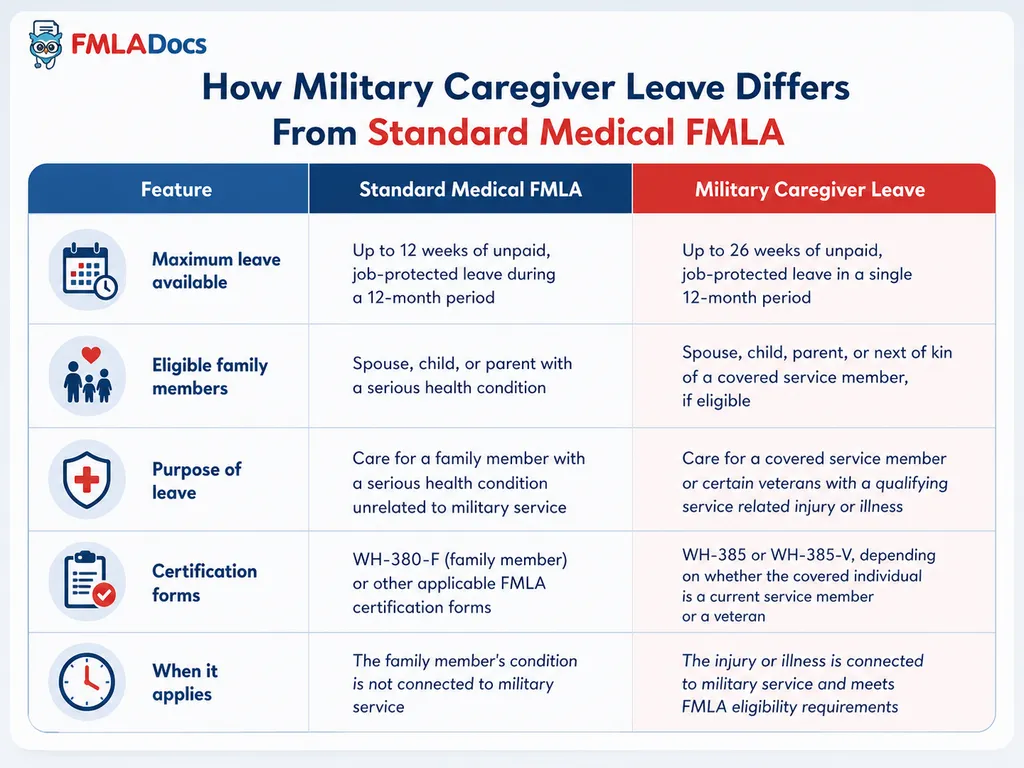
Military caregiver leave is often mistaken for standard FMLA leave used to care for a family member with a serious health condition. While both fall under the Family and Medical Leave Act, they serve different purposes and follow different eligibility rules.
Not sure which type of FMLA leave applies to your situation? FMLADocs can help you understand which certification path best matches your circumstances before you begin the application process.
Military FMLA Forms Required for Exigency and Caregiver Leave
The U.S. Department of Labor provides optional certification forms for military FMLA leave. While employers may use these official forms, they can also accept another certification form as long as it collects the same required information.
| Form | Used For | Who Completes It |
|---|---|---|
| WH-384 | Certification for qualifying exigency leave | Employee, with supporting information related to the military member or military duty, if applicable |
| WH-385 | Certification for military caregiver leave for a current covered service member | Authorized health care provider treating the covered service member |
| WH-385-V | Certification for military caregiver leave for a covered veteran | Authorized health care provider treating the covered veteran |
Important Things to Know Before Submitting Military FMLA Forms
- The Department of Labor periodically updates its forms and revision dates. Always download and submit the most current version available.
- WH-384 typically does not require a health care provider’s signature because qualifying exigency leave is based on military-related events rather than a medical condition.
- WH-385 and WH-385-V require certification from an authorized health care provider. Missing details or incomplete medical documentation can delay the review and approval process.
How to Request Military FMLA From Your Employer
Requesting military FMLA leave is similar to requesting standard FMLA, but it includes additional documentation and military-specific eligibility requirements. Following the correct process can help prevent delays and ensure your leave request is processed as quickly as possible.
- Provide notice as early as possible. If the need for leave is foreseeable, such as a scheduled military deployment, you should generally give your employer at least 30 days’ notice. If advance notice is not possible, notify your employer as soon as it is practical to do so.
- Specify which type of military FMLA leave you need. Tell your employer whether you are requesting qualifying exigency leave or military caregiver leave, as each type has different eligibility rules and certification requirements.
- Submit the required certification form. Your employer may require the appropriate Department of Labor certification, or an equivalent form. Fill out FMLA paperwork correctly to avoid documentation mistakes that delay approval. In most cases, you have at least 15 days to return the completed documentation.
- Explain how you plan to take leave. Let your employer know whether you need continuous leave, intermittent leave, or a reduced work schedule. This helps your employer plan for your absence while ensuring your leave is properly documented.
- Respond quickly if additional information is requested. If your certification is incomplete or missing information, your employer must generally give you an opportunity to correct it. Providing the requested details promptly can help avoid unnecessary delays.
- Keep copies of all documents. Save copies of certification forms, military documentation, emails, and any communication with your employer or leave administrator. Having a complete record can be helpful if questions arise later.
Once you request military FMLA leave, employers are generally required to notify you of your eligibility, rights, and responsibilities within five business days, unless extenuating circumstances apply. If you do not receive a response within that timeframe, it is reasonable to follow up with your HR department or leave administrator.
Military FMLA Leave Options: Continuous, Intermittent, or Reduced Schedule
Military FMLA leave does not always have to be taken as one uninterrupted absence. Depending on the reason for your leave and your employer’s approval where required, you may be able to use your leave in different ways.
- Continuous block leave: One uninterrupted period away from work. This is common during an initial post-deployment reintegration period or when providing full-time care for a covered service member recovering from a serious injury or illness.
- Intermittent leave: Leave taken in separate blocks of time instead of all at once. This option may be appropriate for recurring medical appointments for a covered service member or for handling qualifying exigencies, such as deployment-related meetings or appointments.
- Reduced schedule leave: A temporary reduction in your normal work hours rather than taking full days off. Some military caregivers use this arrangement to attend ongoing medical appointments while continuing to work part time.
If your leave will be taken intermittently or on a reduced schedule, your employer may ask you to schedule it in a way that minimizes disruption to business operations when the timing is reasonably flexible. For example, a routine medical appointment that can be booked at different times may be scheduled to reduce workplace disruption. However, this flexibility does not apply to situations that cannot be planned in advance, such as a sudden flare-up of a covered medical condition.
Common Mistakes That Delay Military FMLA Leave Requests
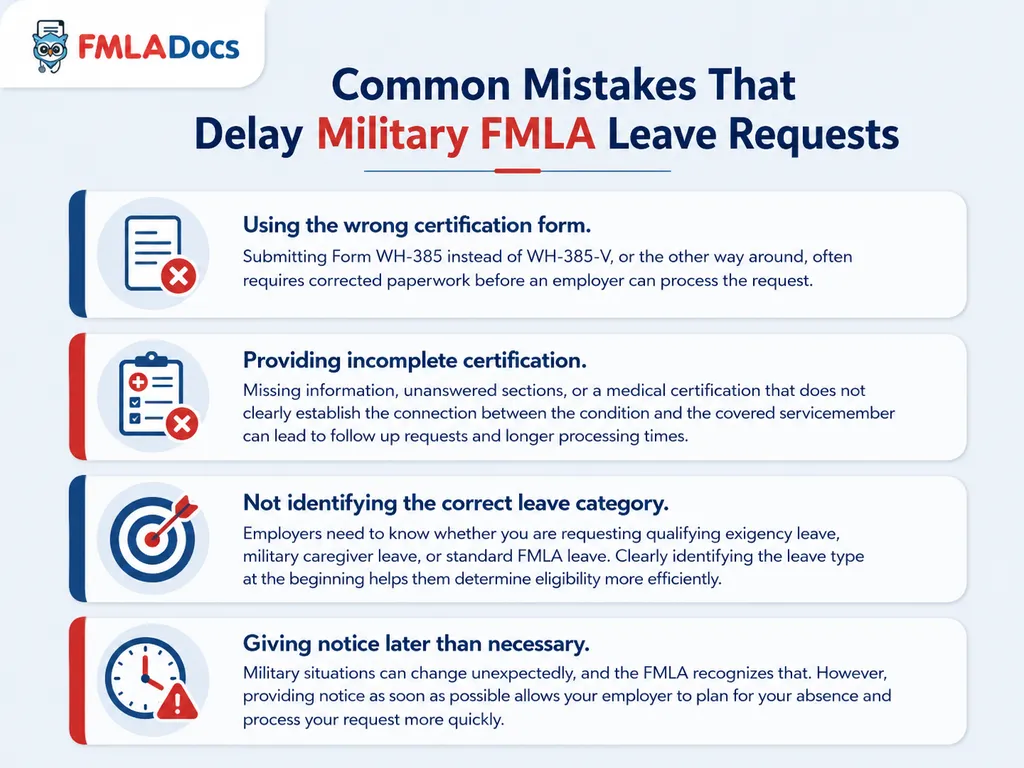
Even when someone qualifies for military FMLA leave, avoidable mistakes can slow the approval process. Understanding these common issues can help you submit a complete request and reduce unnecessary delays.
- Using the wrong certification form. Submitting Form WH-385 instead of WH-385-V, or the other way around, often requires corrected paperwork before an employer can process the request.
- Providing incomplete certification. Missing information, unanswered sections, or a medical certification that does not clearly establish the connection between the condition and the covered servicemember can lead to follow up requests and longer processing times.
- Not identifying the correct leave category. Employers need to know whether you are requesting qualifying exigency leave, military caregiver leave, or standard FMLA leave. Clearly identifying the leave type at the beginning helps them determine eligibility more efficiently.
- Giving notice later than necessary. Military situations can change unexpectedly, and the FMLA recognizes that. However, providing notice as soon as possible allows your employer to plan for your absence and process your request more quickly.
Military FMLA Pay and Benefits: What to Expect
One of the biggest misconceptions about military FMLA is that it guarantees paid time off. It does not. The Family and Medical Leave Act protects your job, not your income. Whether you take qualifying exigency leave or military caregiver leave, FMLA is unpaid unless another benefit applies. During your leave, your employer must continue your health insurance under the same terms and restore you to the same or an equivalent position when you return.
Depending on your circumstances, you may be able to receive income through other programs while using FMLA leave.
- Employer provided paid leave. Many employers allow or require employees to use accrued vacation time, sick leave, or paid time off (PTO) at the same time as FMLA leave. This lets eligible employees continue receiving pay while their FMLA leave runs concurrently.
- Short term disability (STD) insurance. If you have short term disability coverage through your employer or a private policy, you may qualify for partial wage replacement when your own medical condition prevents you from working. This benefit generally does not apply when you take leave solely to care for an injured or ill service member.
- State Paid Family and Medical Leave (PFML) programs. Several states offer paid family leave benefits that may run alongside FMLA. Depending on where you live, these programs may provide partial wage replacement for qualifying caregiving situations, including certain military related circumstances. Eligibility requirements, benefit amounts, and covered family relationships differ by state.
Paid benefits are never automatic. Whether you qualify depends on your employer’s leave policies, your state laws, and any disability or paid leave coverage available to you. Before taking military FMLA leave, speak with your HR department and review your state’s paid leave program so you understand which benefits, if any, may apply.
Military FMLA Certification Support Through FMLADocs
FMLADocs provides telehealth support for the medical certification required under certain types of FMLA leave. For military FMLA, it’s important to understand where that support applies, as qualifying exigency leave and military caregiver leave have different documentation requirements.
- Qualifying exigency leave (WH-384) is generally based on military orders and other supporting documentation rather than a physician’s medical certification. In most cases, the process is handled between the employee, employer, and the appropriate military documentation, so FMLADocs’ certification services are typically not needed.
- Military caregiver leave (WH-385 or WH-385-V) requires certification from an authorized health care provider confirming that the covered servicemember or veteran has a qualifying serious injury or illness related to military service. This is where FMLADocs’ telehealth certification support may be helpful by connecting you with a qualified provider who can evaluate the medical information and complete the required certification forms.
Submitting a complete and accurate caregiver leave certification the first time can help reduce delays and requests for additional documentation from your employer. If you’re unsure whether your situation qualifies for qualifying exigency leave, military caregiver leave, or both, review your circumstances with your HR department or a qualified health care provider. Eligibility depends on the specific facts of your situation and the applicable FMLA requirements.
See if you qualify to find out whether your situation may be eligible for military caregiver leave certification support.
Conclusion
Understanding the difference between military FMLA qualifying exigency leave and military caregiver leave can make the process much less stressful during an already challenging time. The key distinction is straightforward. Qualifying exigency leave is designed to help eligible family members manage the practical responsibilities that come with a covered military deployment, while military caregiver leave allows eligible employees to take time away from work to care for a covered service member or veteran with a qualifying serious injury or illness. Identifying which type of leave applies from the start helps you gather the correct documentation, meet employer requirements, and avoid unnecessary delays.
If you are still unsure which type of military FMLA leave applies to your situation, speak with your employer’s human resources department as early as possible. When medical certification is required, work with the authorized health care provider responsible for completing the necessary forms. Because eligibility depends on your specific relationship, military status, and circumstances, obtaining accurate guidance before submitting your request can help ensure the leave process is completed correctly and with greater confidence.
Frequently Asked Questions
What is qualifying exigency FMLA?
Qualifying exigency FMLA is a category of leave available to the spouse, child, or parent of a service member who is on covered active duty or has been notified of an impending call to covered active duty. It covers practical needs like childcare arrangements, legal and financial planning, and time with the service member during rest and recuperation, and allows up to 12 weeks of leave in a 12-month period.
How much military caregiver leave can I take?
Eligible employees may take up to 26 weeks of military caregiver leave within a single 12-month period to care for a covered service member or veteran with a serious injury or illness. This is a one-time combined total per service member per injury, not an annual allowance that resets every year.
Is military FMLA paid?
No. FMLA, including both qualifying exigency and military caregiver leave, is unpaid under federal law. Some employees may be able to use employer-provided paid leave, short-term disability benefits, or a state Paid Family and Medical Leave program alongside their FMLA leave, depending on eligibility and location.
Who counts as a covered service member?
A covered service member is a current member of the Armed Forces, including the National Guard or Reserves, who has a serious injury or illness incurred or aggravated in the line of duty on active duty that makes them medically unfit to perform their duties. This differs from a "covered veteran," which applies to someone who left service within the preceding five years and has a qualifying service-connected condition.
What's the difference between WH-384 and WH-385?
WH-384 is the DOL certification form used for qualifying exigency leave and generally does not require a physician's signature. WH-385 is used for military caregiver leave involving a current service member and requires certification from an authorized health care provider describing the serious injury or illness.
Can I take both exigency and caregiver leave?
It's possible to use both types of leave if your circumstances genuinely call for each, but they draw from related overall FMLA caps: exigency leave counts toward the standard 12-week limit, while caregiver leave has its own 26-week ceiling that can include other FMLA leave taken in the same period. Discussing the combined timeline with your employer's HR department helps avoid confusion.
How do I prove qualifying exigency?
Employers may request certification using DOL Form WH-384 or an equivalent, along with supporting documentation such as deployment orders, military event notices, or other paperwork relevant to the specific exigency category you're claiming. Because exigency categories are specific, matching your documentation to the correct category can help avoid delays.
Does FMLA cover National Guard or Reserve deployment?
Yes, provided the deployment meets the definition of covered active duty, generally deployment to a foreign country under federal orders, including in support of a contingency operation. State active duty orders alone typically do not meet this definition, so it's worth confirming the type of orders involved.
Meet the author
Nida Hammad
I am a professional writer with over five years of experience creating clear, engaging, and well-researched content. I specialize in healthcare topics, helping readers understand complex information in simple wording. Currently, I write for FMLA DOC, where I focus on producing accurate and trusted guides for people seeking support with FMLA and medical needs.
Get Your FMLA Certification Online in Minutes