

FMLA for New Parents: What You Need to Know
 by Nida Hammad
 Last updated:
Welcoming a new child into your family is one of life’s most precious moments. Whether you’re expecting a baby, preparing for adoption, or awaiting a foster placement, the journey ahead is filled with joy, anticipation, and yes, important decisions about taking time off work. Understanding your rights under the Family and Medical Leave Act can make all the difference in how you experience this life-changing transition.
The good news? The FMLA for new parents provides critical protections that allow you to bond with your child without sacrificing your career. This comprehensive guide walks you through everything you need to know about FMLA leave for pregnancy and childbirth, from determining your eligibility to completing FMLA certification online. By the end, you’ll have a clear roadmap for navigating your parental leave with confidence.
Understanding the Family and Medical Leave Act (FMLA)
The Family and Medical Leave Act, passed in 1993, stands as a cornerstone of employee rights in the United States. This federal law recognizes that life doesn’t stop when you clock in for work. Sometimes, family needs must take priority, and FMLA ensures that employees can address these needs without losing their jobs.
At its core, FMLA for new parents provides up to 12 weeks of unpaid, job-protected leave within any 12-month period. This leave applies to various qualifying events, including the birth of a child, adoption, foster care placement, and pregnancy-related medical conditions. The law doesn’t require employers to pay you during this time, but it does guarantee something equally valuable: your job will be waiting for you when you return.
Think of FMLA as a safety net. It protects your position, maintains your health insurance coverage, and shields you from retaliation. While you’re caring for your newborn or recovering from childbirth, you won’t need to worry about losing your career progress or starting from scratch when you’re ready to return to work.
What makes FMLA different from typical vacation time or sick leave? The key distinction lies in the legal protection it offers. Your employer cannot terminate you, demote you, or punish you for taking FMLA leave. They must hold your position, or an equivalent one, and allow you to return with the same pay, benefits, and working conditions you had before your leave began.
Who Qualifies for FMLA Leave for Pregnancy & Childbirth?

Not every employee automatically qualifies for FMLA protection. Understanding the eligibility requirements helps you plan ahead and know exactly where you stand.
Employer Coverage Requirements
First, your employer must be covered under FMLA. The law applies to private-sector companies with 50 or more employees within a 75-mile radius. If your company has multiple locations, count all employees working within 75 miles of your worksite. Public agencies of any size fall under FMLA coverage, regardless of how many people they employ. This includes federal, state, and local government offices. Additionally, all public and private elementary and secondary schools are covered, with no minimum employee requirement.
To verify whether your employer meets these criteria, check with your human resources department or review your employee handbook. Some companies clearly state their FMLA coverage in onboarding materials or internal policy documents.
Employee Eligibility Criteria
Even if your employer is covered, you must meet specific personal eligibility requirements to use FMLA for new parents. You need to have worked for your employer for at least 12 months. These months don’t have to be consecutive, seasonal workers or those who left and returned can still qualify if they meet the time requirement.
Check out the Complete Guide to FMLA Eligibility
You must have logged at least 1,250 hours of work during the 12 months immediately before your leave begins. This breaks down to roughly 24 hours per week over the year. Both full-time and part-time employees can meet this threshold, making FMLA leave for pregnancy and childbirth accessible to a broader range of workers.
Finally, you must work at a location where your employer has at least 50 employees within a 75-mile radius. If you work remotely, this typically means within 75 miles of your assigned office location.
Special Considerations for New Parents
FMLA leave isn’t gender-specific or limited to biological parents. Both birth parents and non-birth parents have equal rights to take leave for bonding with a new child. Fathers, adoptive parents, and foster parents all qualify for the full 12 weeks of leave, assuming they meet the other eligibility criteria.
There’s one important exception to keep in mind: if you and your spouse both work for the same employer, you may be limited to a combined total of 12 weeks for bonding purposes. However, this restriction only applies to married couples. Unmarried partners working for the same company each receive their own separate 12-week entitlement.
Types of FMLA Leave for New Parents
FMLA for new parents covers multiple scenarios throughout your journey to parenthood. Understanding these different leave types helps you maximize your time with your growing family.
Prenatal Care and Pregnancy Complications
Pregnancy itself can qualify for FMLA leave when medical care is needed. If you’re experiencing pregnancy complications or require regular prenatal appointments, you can use intermittent FMLA leave. This means taking time off in smaller increments, a few hours here, a day there, rather than one continuous block.
Serious health conditions related to pregnancy include gestational diabetes, preeclampsia, hyperemesis gravidarum (severe morning sickness), and conditions requiring bed rest. Your healthcare provider can certify these conditions, allowing you to take the necessary time for treatment and recovery without using up all your bonding time.
Partners can also use FMLA leave during pregnancy if their spouse is incapacitated due to pregnancy-related conditions. This might include taking them to medical appointments, providing care during bed rest, or supporting them through pregnancy complications.
Childbirth and Recovery Leave
When you give birth, FMLA leave for pregnancy and childbirth typically begins on your delivery date. The initial weeks of leave usually cover the period when you’re medically incapacitated, generally six to eight weeks for a typical vaginal delivery, and longer for cesarean sections or complicated deliveries.
Your healthcare provider will certify the expected period of incapacity based on your specific situation. If you deliver earlier or later than expected, don’t worry, FMLA accommodates these variations. Your employer will adjust your leave dates accordingly once you provide proof of birth.
The recovery period counts toward your 12-week entitlement, but it’s an essential component of FMLA for new parents. Your body needs time to heal, and FMLA ensures you have that time without financial penalty beyond the unpaid nature of the leave itself.
Bonding Time with Newborn
Beyond medical recovery, FMLA provides bonding leave to strengthen the parent-child relationship during those crucial early months. You can take bonding leave any time within the first 12 months of your child’s life, offering flexibility for families who want to stagger parental leave or delay bonding time for specific reasons.
For example, one parent might take leave immediately after birth while the other waits several months to extend the family’s overall coverage. As long as the leave occurs within the first year, you’re exercising your FMLA rights appropriately.
Unlike intermittent leave for medical conditions, employers aren’t required to approve intermittent or reduced-schedule leave for bonding purposes. Many employers do offer this flexibility, but they’re within their rights to require that bonding leave be taken in one continuous period. Always discuss your preferences with HR early in your planning process.
Adoption and Foster Care Placement
FMLA for new parents extends beyond biological children to include adoption and foster care placements. The same 12-week entitlement applies, and you can use leave for placement-related activities even before the child officially joins your family.
Qualifying activities include attending required counseling sessions, meeting with attorneys, completing medical examinations, appearing in court, and traveling domestically or internationally to finalize an adoption. These preparations are essential steps in the adoption or foster placement process, and FMLA recognizes their importance.
Foster care placement receives the same protection as adoption, regardless of how long the placement lasts. Even short-term emergency foster placements qualify for FMLA leave. Your entitlement is 12 weeks per year, not per placement, so families who foster multiple children in one year will need to manage their time accordingly or use additional paid time off if available.
The FMLA Certification Process Explained
Navigating the FMLA certification process might seem daunting, but understanding each step makes it manageable. Whether you’re completing FMLA certification online or through traditional paper forms, knowing what to expect helps ensure a smooth approval process.
Understanding FMLA Certification Requirements
FMLA certification serves as documentation verifying your need for leave. For medical conditions, including pregnancy complications and childbirth recovery, your healthcare provider completes a medical certification form attesting to your condition and need for time off.
However, here’s an important distinction: you don’t need medical certification for bonding leave. If you’re taking time off purely to bond with a healthy newborn, adopted child, or foster placement, you only need to provide proof of the family relationship. This typically means submitting a birth certificate, adoption decree, or foster placement documentation.
Medical certification becomes necessary only when you’re taking leave for pregnancy-related medical conditions, childbirth recovery, or caring for a child with a serious health condition. Understanding this distinction prevents unnecessary paperwork and speeds up the approval process.
Check out the step-by-step FMLA Certification Process
Step-by-Step FMLA Certification Process
Step 1: Employee Notification
When you know you’ll need FMLA leave, notify your employer at least 30 days in advance if possible. For planned events like childbirth or scheduled adoption, this advance notice helps everyone prepare. Include basic information: when you expect to need leave, the anticipated duration, and the reason (in general terms, you don’t need to share private medical details at this stage).
Of course, pregnancies don’t always follow perfect timelines. If you go into labor early or experience unexpected complications, notify your employer as soon as practicable. The law recognizes that emergencies happen and won’t penalize you for circumstances beyond your control.
Step 2: Employer Eligibility Notice
Within five business days of learning about your potential need for FMLA leave, your employer must provide an eligibility notice. This document confirms whether you meet the basic requirements: length of service, hours worked, and covered worksite. Think of this as a preliminary assessment, it’s not an approval, just verification that you’re eligible to request FMLA leave.
If the notice indicates you’re ineligible, review it carefully. The explanation should specify which requirement you don’t meet. Sometimes employers make calculation errors, so it’s worth double-checking the math yourself or requesting clarification from HR.
Step 3: Medical Certification Form
For FMLA leave for pregnancy and childbirth that involves medical care, your employer can request certification using Department of Labor Form WH-380-E (for employee’s own serious health condition) or WH-380-F (for family member’s serious health condition). You have 15 calendar days to complete and return the form, though extensions are possible if circumstances prevent timely completion.
The certification asks your healthcare provider to describe your condition, treatment plan, and expected duration of incapacity. Providers can be physicians, nurse practitioners, midwives, or other licensed healthcare professionals. They should be familiar with your medical situation and able to speak to your need for leave.
Many healthcare providers are experienced with FMLA paperwork, but it helps to schedule a specific appointment for completion if you need detailed discussion. Bring the blank form to your appointment and explain that you need it for job-protected leave.
Get your FMLA Medical Certification Today! licensed physicians complete pregnancy and childbirth medical certification online, typically within 24 to 48 hours.
For bonding leave, skip the medical certification entirely. Simply provide documentation proving your relationship to the child: a birth certificate showing you as a parent, adoption papers, or foster placement documents from the appropriate agency.
Step 4: Designation Notice
After receiving your certification or relationship documentation, your employer has five business days to issue a designation notice. This official document states whether your leave is approved as FMLA-protected leave. It should specify how much leave you’re entitled to, whether it counts as continuous or intermittent leave, and any requirements for returning to work.
If your leave is denied, the designation notice must explain why. Common reasons include incomplete certification, failure to meet eligibility requirements, or not qualifying under FMLA’s covered circumstances. Understanding the specific reason helps you address any issues or explore alternative options.
How to Complete FMLA Certification Online
In today’s digital age, many employers offer online platforms for FMLA certification, streamlining what was once a paper-intensive process. Completing FMLA certification online offers several advantages: faster processing, easier tracking, and reduced risk of lost paperwork.
Most companies use third-party leave management platforms or their own HR information systems to handle FMLA requests digitally. Common platforms include Matrix Absence Management, Sedgwick, and integrated systems from providers like ADP or Paychex. Your HR department should provide login credentials and step-by-step instructions for accessing the system.
When completing FMLA certification online, you’ll typically log into the portal, initiate a new leave request, and answer questions about your situation. The system will generate the appropriate certification forms electronically and send them to your healthcare provider. Many systems allow providers to complete and submit forms digitally as well, though some still require printed forms with physical signatures.
Electronic signatures are generally acceptable for FMLA certification online, but confirm your employer’s specific requirements. Some organizations require original ink signatures on certain documents, particularly for sensitive medical information. When in doubt, ask HR about their documentation preferences.
The beauty of completing FMLA certification online is the transparency it provides. You can track the status of your request in real-time, receive automated reminders about pending items, and communicate directly with leave administrators through the platform. This visibility reduces anxiety and helps you stay on top of deadlines.
Remember to save copies of everything you submit through online portals. Take screenshots of confirmation pages, download submitted documents, and keep email confirmations. Having your own records protects you if technical issues arise or if questions emerge later about your submission.
Required Documentation for New Parents
Beyond the certification process, you’ll need to provide additional documentation to prove your relationship to your child. For biological parents, a birth certificate listing you as a parent suffices. Order certified copies shortly after birth, as you’ll need them for various purposes beyond just FMLA.
Adoptive parents should provide the adoption decree or placement order issued by the court. If your adoption isn’t finalized when you need to start leave, temporary placement documentation from your adoption agency may be accepted, with the final decree submitted once available.
Foster parents need documentation from the state child welfare agency showing the official placement of the child in your home. Even for emergency placements that happen quickly, these documents should be available from your caseworker.
Keep in mind that employers can only use this documentation to verify your FMLA eligibility. They must keep it confidential and cannot share details about your leave with unauthorized personnel. Documents should be stored separately from your regular personnel file in a secure, FMLA-specific file with restricted access.
Paid vs. Unpaid Leave: What FMLA for New Parents Actually Covers
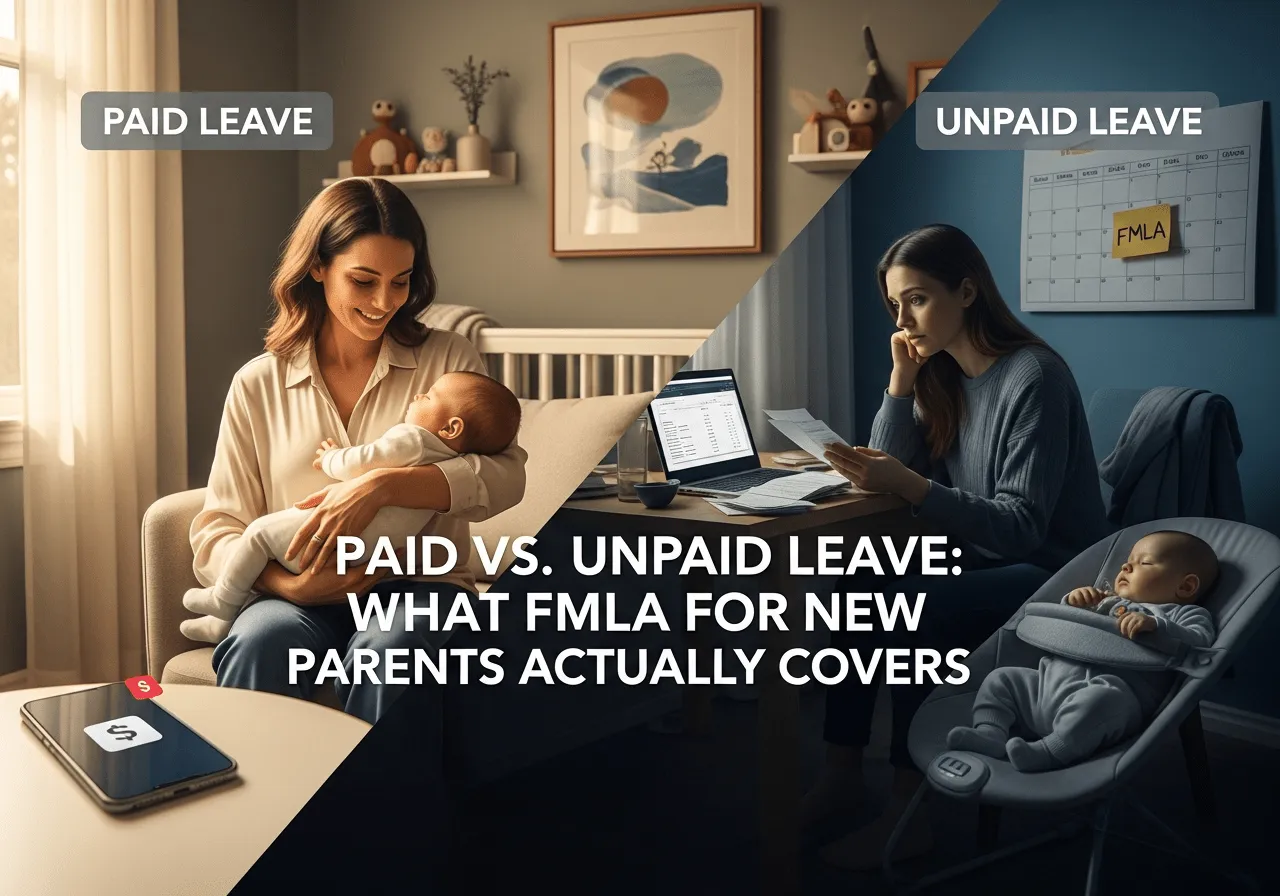
One of the most significant misconceptions about FMLA is that it provides paid time off. Understanding the difference between job protection and wage replacement helps you plan financially for your leave.
FMLA is Unpaid Leave
Federal FMLA law does not require employers to pay you during your leave. The protection it offers is your job itself, the guarantee that your position remains secure while you’re away. This distinction surprises many expectant parents, so it’s crucial to understand early in your planning.
However, FMLA does require employers to maintain your health insurance coverage during your leave under the same terms as if you were actively working. You’ll continue paying your share of premiums (which you can arrange through various payment methods), and your employer continues their contribution.
The unpaid nature of FMLA means you need to plan your finances carefully. Consider your savings, explore income sources during leave, and budget for several weeks without your regular paycheck.
Ways to Receive Payment During FMLA Leave
While FMLA itself is unpaid, several mechanisms can provide income during your leave. Short-term disability insurance, offered by many employers or purchased privately, often covers pregnancy-related disability periods. This typically includes the six to eight weeks following childbirth when you’re medically incapacitated.
Many employers allow or require you to use accrued paid time off concurrently with FMLA leave. This means your sick days, vacation time, and personal days run alongside your FMLA protection. You receive payment through your PTO bank while FMLA ensures your job remains protected. Some companies mandate this approach, while others leave the choice to employees.
If your employer offers paid parental leave as a company benefit, this time usually runs concurrently with FMLA as well. For instance, if your company provides six weeks of paid parental leave and you take 12 weeks of FMLA leave, the first six weeks would be paid, and the remaining six would be unpaid (unless you use additional PTO).
State Paid Family Leave Programs
Several states have implemented their own paid family leave programs that complement federal FMLA protections. These programs typically provide partial wage replacement during your leave, funded through employee payroll deductions or employer contributions.
California’s State Disability Insurance and Paid Family Leave programs offer some of the most comprehensive benefits, providing 60-70% wage replacement for several weeks. New York’s Paid Family Leave provides up to 67% of your average weekly wage for up to 12 weeks. New Jersey, Rhode Island, Washington, Massachusetts, Connecticut, Oregon, Colorado, and the District of Columbia also have paid family leave programs with varying benefit levels.
These state programs run concurrently with federal FMLA when both apply. You receive wage replacement from the state program while FMLA protects your job. If your state offers paid leave, research the application process early, it’s often separate from your employer’s FMLA process and requires its own paperwork and timeline.
Employer Parental Leave Policies
Many forward-thinking companies have recognized that the federal FMLA minimum doesn’t adequately support new parents, and they’ve implemented their own enhanced policies. Tech companies have led this trend, with some offering 16-24 weeks of fully paid parental leave for both birth and non-birth parents.
Banking and finance sectors, healthcare organizations, and even some retail companies have expanded their parental leave offerings to attract and retain talent. These policies vary widely, some provide full salary replacement, others offer partial pay, and terms may differ for birth parents versus non-birth parents.
Even if your employer’s policy is generous, it typically runs concurrently with your FMLA entitlement rather than extending it. For example, if your company offers 16 weeks of paid parental leave, 12 of those weeks would be FMLA-protected. The additional four weeks would be protected only by company policy, not federal law.
How to Use FMLA Leave for Pregnancy & Childbirth
Planning how you’ll use your FMLA leave for pregnancy and childbirth requires strategy and clear communication with your employer. The choices you make can significantly impact your family’s adjustment period and your return to work.
Timing Your Leave
Most employees taking leave for childbirth begin their FMLA leave on their delivery date. This approach preserves your entire 12-week entitlement for recovery and bonding rather than using days before birth. However, if you need to stop working before delivery due to medical complications or bed rest orders, your FMLA leave would begin at that point.
Your due date is an estimate, not a guarantee. Babies arrive on their own schedule, sometimes weeks early or late. When completing initial FMLA paperwork, use your expected due date, but understand that the actual start date will be adjusted to your baby’s actual birth date. Your employer should be flexible about this natural variation.
If you’re adopting or receiving a foster placement, coordinate with your adoption agency or social worker to estimate timing. These processes can sometimes move quickly or face unexpected delays, so maintaining open communication with your employer helps manage expectations on both sides.
Continuous vs. Intermittent Leave Options
For most new parents, taking FMLA leave for pregnancy and childbirth means 12 consecutive weeks away from work. This continuous leave block allows for uninterrupted recovery and bonding time without the stress of coordinating schedules or partial returns to work.
However, FMLA does allow for intermittent leave in specific circumstances. If you have pregnancy complications requiring periodic medical appointments or treatments, you can take intermittent leave, a few hours or days at a time, while continuing to work between appointments. This flexibility helps you maintain some income and connection to your workplace while addressing medical needs.
After your baby arrives, intermittent or reduced-schedule leave for bonding purposes requires your employer’s approval. Unlike medical intermittent leave, which is your right under FMLA, bonding intermittent leave is at your employer’s discretion. Many employers do approve these arrangements, allowing parents to work part-time schedules for extended periods or take specific days off each week.
If you want to use intermittent leave for bonding, propose a specific plan to your employer. For example, you might work three days per week for 24 weeks instead of taking 12 consecutive weeks off. Detail how you’ll handle your responsibilities on this schedule, showing that you’ve thought through the logistics.
Maximizing Your 12 Weeks
Understanding how your employer calculates the 12-month period for FMLA can help you maximize your leave. Employers can choose from four methods: the calendar year, a fixed 12-month period (like your fiscal year), a rolling 12-month period measured backward from when you start leave, or a rolling 12-month period measured forward from your first FMLA leave day.
The rolling backward method is most common and most restrictive, it looks back 12 months from your leave start date and subtracts any FMLA leave you took during that period from your new 12-week entitlement. If you took three weeks of FMLA leave eight months ago, you’d only have nine weeks available for new leave.
Ask your HR department which method your company uses. This information appears in your eligibility notice, but knowing in advance helps you plan. If you’ve taken other FMLA leave recently, calculate your remaining balance before requesting parental leave.
Working with Multiple Leave Types
Coordinating different types of leave can be complex but rewarding. For instance, you might use state disability insurance for the first six weeks after childbirth (when you’re medically recovering), then transition to state paid family leave for bonding time, with FMLA running concurrently throughout to protect your job.
Some employers offer their own short-term disability plans that cover pregnancy-related disability separately from FMLA. These benefits might provide wage replacement during the medical recovery period, while your FMLA clock runs simultaneously to protect your position.
The key is understanding that multiple benefits can run at the same time (concurrently) rather than one after another (consecutively). This is actually advantageous, you receive wage replacement from various sources while your job remains protected under FMLA, and you don’t have to extend your time away from work beyond the 12 weeks.
Track all these moving pieces carefully. Create a spreadsheet showing which benefits apply during which weeks, when you need to submit paperwork for each program, and who to contact with questions about each benefit type. Staying organized prevents gaps in coverage or missed deadlines.
Special Situations for FMLA for New Parents
Every family’s situation is unique, and FMLA for new parents includes provisions for various special circumstances that might affect your leave.
Both Parents Working for Same Employer
When both you and your spouse work for the same company, special rules apply to bonding leave. The law allows employers to limit married couples to a combined total of 12 weeks for bonding purposes. This means you and your spouse together receive 12 weeks, not 12 weeks each.
However, this limitation applies only to bonding leave. If the birth parent needs medical leave for pregnancy complications or postpartum recovery, that time is separate from bonding leave and doesn’t count against the combined limit. Similarly, if one parent needs to take leave to care for the other parent during pregnancy-related medical issues, that caregiving leave is separate.
The practical impact: if you and your spouse work for the same employer and are expecting a baby, the birth parent might take six weeks for medical recovery (their own individual FMLA entitlement) plus six weeks of bonding leave, while the non-birth parent takes six weeks of bonding leave. Together, you’ve used 12 weeks of bonding leave (the combined limit) plus the birth parent’s individual medical leave.
Unmarried partners working for the same employer don’t face this restriction. Each partner receives their full individual 12-week FMLA entitlement regardless of what the other takes. This is one area where FMLA treats married and unmarried couples differently.
Multiple Births or Adoptions
If you’re expecting twins, triplets, or adopting multiple children simultaneously, you still receive 12 weeks of FMLA leave, not 12 weeks per child. The leave entitlement is per qualifying event, not per child involved in that event.
This might seem limiting, but remember that the purpose of bonding leave is to integrate new children into your family, and that process happens simultaneously for multiple children born or adopted together. You’re not dividing your attention between separate bonding periods but rather bonding with your complete new family unit.
Pregnancy Loss and Stillbirth
FMLA for new parents extends to the heartbreaking situations of pregnancy loss and stillbirth. If you experience a miscarriage, stillbirth, or pregnancy termination, you may be entitled to FMLA leave for physical recovery and emotional healing.
The leave qualifies as medical leave for a serious health condition. Your healthcare provider can certify your need for time off to recover physically and emotionally. This ensures you have protected time to heal without worrying about your job security during an already difficult time.
Partners can also take FMLA leave to care for a spouse experiencing pregnancy loss, recognizing that these events affect both parents profoundly. The law’s flexibility in these tragic circumstances provides crucial support when families need it most.
Job Protection and Employee Rights Under FMLA
Understanding your rights under FMLA for new parents empowers you to advocate for yourself and ensures your employer fulfills their legal obligations.
Reinstatement Rights
When you return from FMLA leave, your employer must reinstate you to your same position or an equivalent one. “Equivalent” means a position with the same pay, benefits, working conditions, and substantially similar duties and responsibilities. Your employer cannot demote you, reduce your salary, or assign you to a less desirable position as a result of taking FMLA leave.
The position doesn’t have to be identical. If your specific role no longer exists due to restructuring that would have happened regardless of your leave, your employer must place you in a comparable role. However, they cannot eliminate your position simply because you took FMLA leave.
Location matters too. If you worked at the downtown office before leave, your employer generally cannot reassign you to a suburban location 50 miles away, even if the job duties are similar. The position must be at the same or a geographically proximate location.
Health Insurance Continuation
Throughout your FMLA leave for pregnancy and childbirth, your employer must maintain your group health insurance coverage under the same terms as if you had continued working. This means your employer continues paying their portion of premiums, and you continue paying your share.
Arrange with HR how you’ll pay your premium contributions during unpaid leave. Options might include pre-paying before leave begins, sending checks during leave, or catching up when you return. Some employers are flexible about this; others have specific policies you must follow.
If you decide not to return to work after FMLA leave, your employer can require you to reimburse them for health insurance premiums paid during your leave. However, this only applies if you voluntarily choose not to return. If you cannot return due to circumstances beyond your control, like a serious health condition or your spouse’s job transfer requiring relocation, you typically don’t have to reimburse premiums.
Protection from Retaliation
It’s illegal for employers to retaliate against employees for taking FMLA leave or requesting it. Retaliation can take many forms: termination, demotion, salary reduction, hostile work environment, or denial of promotions or opportunities.
Sometimes retaliation is obvious, you return from leave and find yourself demoted with a pay cut. Other times it’s subtler, suddenly you’re excluded from important meetings, given unfavorable assignments, or subjected to stricter scrutiny than before your leave.
If you suspect retaliation, document everything. Keep emails, write down conversations with dates and times, save performance reviews, and note any changes in how you’re treated. This documentation becomes critical if you need to file a complaint or pursue legal action.
Exceptions to Job Protection
While FMLA provides strong protections, a few exceptions exist. “Key employees”, defined as the highest-paid 10% of employees within 75 miles, can be denied reinstatement if their absence causes substantial economic injury to the employer. However, employers must notify key employees of this status when they request leave and give them the opportunity to return to work early if denial of reinstatement is intended.
Reduction-in-force layoffs can affect employees on FMLA leave if they would have been laid off regardless of their leave status. For example, if your employer eliminates your entire department due to budget cuts while you’re on leave, and you would have been laid off even if you’d been working, FMLA doesn’t protect you from that layoff.
Employees terminated for legitimate reasons before their leave begins don’t have FMLA protection. If your employer was already in the process of firing you for performance issues before you requested leave, FMLA doesn’t shield you from that termination. However, employers must prove the termination decision was made before the leave request and for reasons unrelated to it.
Navigating FMLA with Your Employer
Successfully managing your FMLA leave for pregnancy and childbirth requires clear communication and understanding your employer’s specific processes.
Communication Best Practices
Start conversations about your leave early. While you’re not required to notify your employer until 30 days before foreseeable leave, earlier discussion allows for better planning on both sides. You don’t need to announce your pregnancy the moment you see two lines on a test, but informing your supervisor and HR sometime during your second trimester helps everyone prepare.
Keep communications professional and documented. Follow up verbal conversations with emails summarizing what was discussed and agreed upon. This creates a paper trail protecting both you and your employer if questions arise later about dates, expectations, or requirements.
Designate one person at work as your primary contact for leave-related issues, typically someone in HR who handles FMLA administration. Direct all your questions and paperwork to this person rather than involving multiple people who might give conflicting information.
Common Employer Mistakes to Watch For
Even well-intentioned employers sometimes make FMLA mistakes. Watch for delayed responses to your leave request. Your employer must respond to your eligibility within five business days of learning about your need for leave. Significant delays might indicate they’re not taking their obligations seriously.
Some employers improperly request medical certification for bonding leave or ask for more detailed medical information than necessary. Remember: you don’t need medical certification for bonding with a healthy newborn. If your employer insists on medical documentation for pure bonding leave, politely remind them of this FMLA provision and offer to provide birth certificate documentation instead.
Be alert to any actions that interfere with your leave rights. This includes discouraging you from taking leave, suggesting negative consequences if you take your full entitlement, or creating obstacles to the certification process. These actions violate FMLA and warrant reporting to the Department of Labor’s Wage and Hour Division.
What to Do If Your Request Is Denied
If your employer denies your FMLA request, carefully review the denial notice to understand their reasoning. Common issues include incomplete medical certification, miscalculated eligibility, or confusion about which leave type you’re requesting.
If the problem is incomplete paperwork, work quickly to address deficiencies. Contact your healthcare provider to correct or clarify certification forms. Provide any additional documentation your employer requests, as long as the request is legitimate under FMLA.
For eligibility disputes, gather evidence supporting your position. Pull together time records showing you’ve worked the required hours, documentation of your employment start date, or other proof that you meet eligibility criteria. Present this information to HR with a request to reconsider the decision.
If informal resolution doesn’t work, you can file a complaint with the U.S. Department of Labor’s Wage and Hour Division. They investigate FMLA violations at no cost to you. You can also consult with an employment attorney about your rights and potential legal remedies.
Returning to Work Successfully
As your leave ends, notify your employer of your intended return date. Many employers appreciate a week’s notice, though FMLA doesn’t specifically require this. The courtesy helps them schedule your return and prepare your workspace.
Some employers request fitness-for-duty certification before you return from medical leave (though not for bonding leave). This certification simply confirms you’re able to perform your job duties. It shouldn’t require detailed medical information, just a statement from your healthcare provider that you’re cleared to return to work.
Plan for your transition back to work. If you’re breastfeeding, discuss lactation accommodation needs with your employer before your first day back. Clarify your schedule, important projects you’ll rejoin, and any team changes that occurred during your absence.
Consider a gradual ramp-up if possible. While not required under FMLA, some employers allow you to ease back into full responsibilities over your first week or two. This can be especially helpful if you’re managing sleep deprivation or adjusting to childcare arrangements.
Beyond FMLA: Additional Protections for New Parents
FMLA for new parents is just one piece of the legal protection puzzle. Several other federal and state laws provide additional rights during pregnancy and after childbirth.
The Pregnancy Discrimination Act
The Pregnancy Discrimination Act, passed in 1978, prohibits employment discrimination based on pregnancy, childbirth, or related medical conditions. This law means your employer cannot refuse to hire you, fire you, deny you a promotion, or discriminate against you in any way because you’re pregnant or have recently given birth.
The Act also requires employers to treat pregnancy-related conditions the same as other temporary medical conditions. If your employer provides light duty assignments or modified work schedules for employees with back injuries or other temporary limitations, they must offer the same accommodations for pregnancy-related limitations.
This protection extends to all pregnancy-related issues: prenatal care, morning sickness, gestational diabetes, postpartum depression, and lactation. If you face discrimination related to any of these conditions, you can file a charge with the Equal Employment Opportunity Commission (EEOC).
Pregnant Workers Fairness Act (PWFA)
The Pregnant Workers Fairness Act, which took effect in 2023, fills important gaps left by previous laws. Under PWFA, covered employers must provide reasonable accommodations for known limitations related to pregnancy, childbirth, or related medical conditions.
These accommodations might include more frequent bathroom breaks, permission to drink water at your workstation, modified work schedules, temporary reassignment to less physically demanding tasks, or time off for prenatal appointments.
Unlike the ADA, PWFA doesn’t require that your condition qualify as a disability. Normal pregnancy qualifies for accommodations if you have limitations that affect your ability to perform job duties. This broader protection ensures that pregnant workers receive support even when experiencing typical pregnancy symptoms rather than complications.
Employers must engage in an interactive process with you to identify effective accommodations. They cannot force you to take leave if a reasonable accommodation allows you to continue working. Similarly, they cannot require you to accept an accommodation you don’t want, you have the right to refuse suggested accommodations.
Americans with Disabilities Act (ADA)
While pregnancy itself isn’t considered a disability under the ADA, many pregnancy-related conditions do qualify. Gestational diabetes, preeclampsia, severe morning sickness, perinatal depression, and postpartum conditions can all be disabilities under the ADA if they substantially limit major life activities.
When pregnancy-related conditions qualify as ADA disabilities, you’re entitled to reasonable accommodations and potentially additional leave beyond FMLA’s 12 weeks. This extended leave serves as an accommodation allowing you more recovery time before returning to work.
Postpartum depression and anxiety disorders are particularly important ADA considerations. These conditions often develop or worsen after childbirth, sometimes after you’ve already exhausted FMLA leave. If you’re experiencing mental health challenges that interfere with your ability to work, discuss ADA accommodations with your employer. Treatment, therapy, medication adjustments, and additional leave are all potential accommodations.
Lactation Rights and Workplace Accommodations
Under the Fair Labor Standards Act (FLSA), employers must provide reasonable break time for nursing employees to express breast milk for up to one year after their child’s birth. These breaks must occur whenever you need to pump, typically every three to four hours during the workday.
Employers must also provide a private space, other than a bathroom, for expressing milk. This space must be shielded from view and free from intrusion. It doesn’t need to be a dedicated lactation room (though that’s ideal), but it must be functional and private. A converted office or conference room with a lock works; a bathroom stall does not.
Many states have additional lactation laws providing stronger protections, including requirements for dedicated lactation spaces, longer break times, or extended duration of coverage beyond one year. Check your state’s specific requirements to understand your full rights.
State-Specific FMLA Laws and Enhancements
While federal FMLA sets the baseline, many states have enacted their own family leave laws that provide additional protections and benefits.
States with Expanded Leave Protections
California offers multiple layers of protection beyond federal FMLA. The California Family Rights Act (CFRA) provides similar leave protections but applies to employers with just five or more employees. The state’s Pregnancy Disability Leave law provides up to four months of leave specifically for pregnancy disability, separate from CFRA leave for bonding.
New York’s Paid Family Leave law provides up to 12 weeks of paid leave at 67% of your average weekly wage, funded through employee payroll contributions. This runs concurrently with FMLA if both apply, giving you both wage replacement and job protection.
Washington State’s Paid Family and Medical Leave program offers up to 12 weeks of paid leave for bonding and up to 12 weeks for pregnancy disability, with the possibility of extending to 16 or 18 weeks when combining different leave types. The program provides up to 90% wage replacement for lower earners.
Massachusetts, Connecticut, Oregon, Colorado, Rhode Island, New Jersey, and the District of Columbia all have their own paid family leave programs with varying benefit levels, funding mechanisms, and eligibility requirements.
Lower Employer Thresholds
Some state laws apply to smaller employers than federal FMLA. Oregon’s family leave law covers employers with 25 or more employees. California’s New Parent Leave Act covers employers with 20-49 employees, providing 12 weeks of unpaid, job-protected bonding leave.
These lower thresholds mean you might have state-level protections even if your employer isn’t covered by federal FMLA. Always check both federal and state requirements to understand your full rights.
How to Research Your State’s Laws
Start with your state’s labor department website, which typically has a section dedicated to family and medical leave laws. Many states provide downloadable guides, FAQs, and comparison charts showing how state law interacts with federal FMLA.
If your state has paid family leave, the administering agency (often the unemployment insurance or disability insurance office) will have detailed information about applying for benefits, calculating payment amounts, and understanding eligibility requirements.
Don’t hesitate to call your state labor department with specific questions. These agencies exist to help workers understand their rights and typically offer free telephone assistance or even in-person consultations.
Practical Tips for New Parents Using FMLA
Strategic planning makes your experience with FMLA for new parents smoother and less stressful. These practical tips help you navigate the process successfully, whether you’re a first-time parent learning how to apply for FMLA or an experienced parent planning for another addition to your family.
Before Pregnancy or Adoption
Start researching FMLA and your company’s policies well before you need them. Review your employee handbook, meet with HR to discuss parental leave options, and calculate whether you’ll meet eligibility requirements when your leave would begin. Use an FMLA eligibility checklist to ensure you understand all requirements:
-
Have you worked for your employer for at least 12 months?
-
Have you logged at least 1,250 hours in the past 12 months?
-
Does your employer have 50+ employees within 75 miles?
-
Does your worksite meet coverage requirements?
Create a financial plan for unpaid leave. Calculate your essential expenses during the leave period, explore income sources like short-term disability or state paid leave, and start building savings to cover any income gaps. Research whether you can access FMLA for pregnancy paid benefits through state programs or employer policies.
If your employer doesn’t offer paid parental leave and your state doesn’t have paid family leave, consider supplemental disability insurance. Many insurance companies offer maternity disability policies that you can purchase before pregnancy to provide income during recovery from childbirth.
During Pregnancy
Notify your employer in your second trimester, giving plenty of time for planning. Submit your initial FMLA paperwork well before your due date, don’t wait until the last minute. Most providers complete certification forms within one to two weeks, so factor this timing into your planning.
Keep copies of everything you submit. Create a dedicated folder (physical or digital) for all leave-related documents: forms, emails, notices, certifications, and employer communications. This organization helps if questions arise and provides records for your own reference.
Document your work and create detailed handoff materials for colleagues who’ll cover your responsibilities during leave. This professional approach makes your absence easier on your team and demonstrates your commitment to ensuring continuity.
Preparing for Leave
Confirm all the logistics several weeks before your expected leave start date. Verify how you’ll pay insurance premiums during leave, clarify who to contact with urgent questions, and confirm your expected return date in writing.
Discuss communication expectations with your supervisor. Will you be completely disconnected, or does your employer expect you to check in occasionally? Whatever you agree upon, get it in writing to prevent misunderstandings. Remember, you’re under no obligation to work during FMLA leave unless you voluntarily agree to it.
Set up out-of-office notifications on your email and voicemail directing people to your backup contacts. If your company uses communication platforms like Slack or Teams, update your status to indicate you’re on leave.
While on Leave
Focus on recovery and bonding, that’s what this time is for. Resist the urge to constantly check work email or respond to non-urgent requests. You’re on protected leave, and excessive work undermines the purpose of taking time off.
Keep track of your leave days to ensure accurate records. If you’re using intermittent leave or combining multiple benefit types, maintain your own calendar showing which days or hours count against your FMLA entitlement.
If situations change and you need to extend, reduce, or otherwise modify your leave, notify your employer promptly and submit any required updated certification. Changes happen, babies have health issues, recovery takes longer than expected, or personal circumstances shift. Most employers can accommodate reasonable changes if you communicate proactively.
Returning to Work
Give your employer reasonable notice of your return date, typically one week is sufficient, though check your company’s specific policy. If you’re returning earlier or later than originally planned, provide as much advance notice as possible.
Prepare for the reality of returning to work as a new parent. Arrange reliable childcare, have backup plans for sick days, and accept that the adjustment takes time. Be patient with yourself during this transition.
Request any necessary accommodations before your return. If you’re breastfeeding and need lactation breaks and space, submit this request in writing to HR before your first day back. If you need schedule modifications or other accommodations under ADA or PWFA, initiate those discussions early.
Consider your long-term career plans. Some parents return from leave and quickly realize their previous schedule or role no longer works for their family. It’s okay to request changes like reduced hours, flexible scheduling, or remote work options. While employers aren’t required to grant these requests under FMLA, many are willing to negotiate arrangements that benefit both parties.
Frequently Asked Questions
Can I take FMLA leave before my baby is born?
Yes, but only if it's medically necessary. If you have pregnancy complications requiring bed rest, frequent medical monitoring, or other prenatal care needs, you can start FMLA leave before delivery. Your healthcare provider must certify the medical necessity. However, if you simply want time off before birth for preparation, that would use your PTO rather than FMLA leave, which is reserved for medical necessity or bonding after birth.
Does FMLA cover fathers and non-birth parents?
Absolutely. FMLA for new parents applies equally to all parents regardless of gender. FMLA for fathers provides the same protections as for mothers, fathers have the right to 12 weeks of bonding leave just like birth mothers do. Adoptive parents, foster parents, and same-sex couples all receive equal protection under FMLA. The only time gender affects leave is during the medical recovery period specific to giving birth, which obviously applies only to the birth parent. For those researching FMLA for birth of child father rights, rest assured that federal law provides comprehensive protection for paternal leave.
What if I need more than 12 weeks?
If 12 weeks isn't sufficient, explore several options. First, check if you qualify for ADA accommodations if you or your child has a serious health condition. Extended leave can be a reasonable accommodation under ADA. Second, review your state's leave laws, some provide longer durations than federal FMLA. Third, ask your employer about extending leave beyond FMLA as a matter of company policy or accommodation. While they're not required to grant this, many employers offer flexibility. Finally, if you've exhausted all leave options and still cannot return to work, you may need to consider resignation, though this should be a last resort after exploring all alternatives.
Can I take 12 weeks maternity leave without FMLA?
This is a common question, and the answer depends on your employer's policies. If you don't qualify for FMLA (perhaps you haven't worked long enough or your employer isn't covered), you might still be able to take maternity leave if your employer offers it as a company benefit. However, without FMLA protection, this leave may not be job-protected, meaning your employer isn't legally required to hold your position. Some states have their own leave laws that might provide protection even if federal FMLA doesn't apply. Additionally, the Pregnancy Discrimination Act and Americans with Disabilities Act might provide some protections for pregnancy-related disability leave. Check with your HR department about company-specific parental leave policies and consult your state's labor department about state-level protections.
Can my employer require me to use PTO during FMLA leave?
This depends on your employer's policy. Employers can require you to use accrued paid leave (vacation, sick time, personal days) concurrently with FMLA leave. Alternatively, you might choose to use paid leave voluntarily to maintain income during unpaid FMLA leave. Check your employee handbook or ask HR about your company's specific policy. Some employers mandate using PTO, while others leave the choice to employees.
Is my job really protected?
Yes, with limited exceptions. FMLA provides strong job protection requiring your employer to reinstate you to your same or an equivalent position when you return. Equivalent means same pay, benefits, working conditions, and substantially similar responsibilities. The exceptions are narrow: key employees (highest-paid 10%), employees who would have been laid off regardless of leave, or employees terminated for cause before leave began. For the vast majority of employees, FMLA provides robust job protection.
How do I get FMLA certification online?
Many employers use online leave management systems for FMLA administration. Contact your HR department to find out if your company offers FMLA certification online. They'll provide login credentials for the system, common platforms include Matrix, Sedgwick, and integrated HR systems from providers like ADP or Workday. Through these portals, you can submit leave requests, upload documentation, and track your request status. Your healthcare provider may also be able to complete certification forms electronically through these systems. Even if your employer doesn't have an online system, you can often submit scanned documents via email rather than physical mail, speeding up the process.
What if my employer denies my FMLA request?
If your request is denied, first understand why by carefully reviewing the denial notice. Common reasons include failure to meet eligibility requirements, incomplete medical certification, or not qualifying under FMLA's covered circumstances. If you believe the denial is incorrect, gather evidence supporting your eligibility (time records, employment documentation, medical certification) and request reconsideration from HR. If informal resolution doesn't work, you can file a complaint with the U.S. Department of Labor's Wage and Hour Division at no cost. You may also want to consult with an employment attorney to understand your legal options.
Can I take intermittent leave for bonding?
Intermittent or reduced-schedule leave for bonding with a healthy newborn requires your employer's approval. While you have the right to intermittent leave for medical conditions, bonding leave can be continuous at your employer's discretion. Many employers do allow parents to work reduced schedules or take certain days off each week for extended bonding time, but this is voluntary on their part. Propose a specific plan showing how you'll handle your responsibilities on an intermittent schedule. The more detailed and professional your proposal, the more likely your employer is to approve it.
How to apply for FMLA for new fathers?
New fathers wondering how to apply for FMLA paternity leave should follow these steps: First, notify your HR department at least 30 days before your expected leave date (your partner's due date). Specify that you're requesting FMLA leave for the birth of your child. Second, complete any employer-specific request forms and submit them promptly. Third, once your child is born, provide a copy of the birth certificate showing you as the parent. Fourth, coordinate with HR about your exact leave dates and any arrangements for continuing health insurance premiums. Remember, FMLA for fathers doesn't require medical certification for bonding leave, only proof of parentage. If you're taking leave to care for your partner during pregnancy complications, you'll need medical certification documenting her condition and need for care.
What conditions qualifying reasons for FMLA leave for new parents?
Several qualifying reasons for FMLA leave apply to new parents. These include: the birth of a child and caring for the newborn within the first year, adoption or foster placement of a child, pregnancy-related serious health conditions (gestational diabetes, preeclampsia, hyperemesis, conditions requiring bed rest), recovery from childbirth (typically 6-8 weeks), caring for a spouse incapacitated by pregnancy or childbirth, and caring for a newborn with a serious health condition. What conditions qualify for FMLA leave is clearly defined by federal regulations, and what HR need to know is that both medical and bonding leave qualify, though documentation requirements differ.
Meet the author
Nida Hammad
I am a professional writer with over five years of experience creating clear, engaging, and well-researched content. I specialize in healthcare topics, helping readers understand complex information in simple wording. Currently, I write for FMLA DOC, where I focus on producing accurate and trusted guides for people seeking support with FMLA and medical needs.
Get Your FMLA Certification Online in Minutes