

Can My Employer Fire Me While I'm on FMLA?
 by Nida Hammad
Last updated:
Can your employer fire me on FMLA? Yes, but only under specific conditions. FMLA protects your leave, not your job performance. If you’re terminated during protected leave, the reason matters. Thousands of workers face wrongful termination during FMLA leave each year. Most don’t know the difference between illegal retaliation and lawful dismissal.
This guide shows you precisely when firing you on FMLA breaks the law. You’ll learn what counts as FMLA retaliation and interference, how to spot illegal termination patterns, and what documentation protects you. We cover layoffs during leave, performance issues that predate your time off, and when to file a Department of Labor complaint.
You’ll see the line between protected leave and legitimate business reasons. We break down key-job exceptions, reduction-in-force scenarios, and your legal options after wrongful discharge. If your employer fires you while on FMLA, you need to know your FMLA job protection rights immediately.
Understanding What Happens When Your Employer Fires You on FMLA

FMLA Protects Leave, Not Immunity From All Discipline. Many employees believe FMLA creates complete protection from any employment action. That’s not accurate. FMLA protects your right to take leave and return to work. It doesn’t shield you from discipline for legitimate reasons unrelated to your leave.
Understanding this distinction matters when you’re worried your FMLA protections might not cover certain situations. The law prevents your employer from using your leave against you. It doesn’t prevent them from addressing performance issues that existed before your leave started.
What Job Protection Actually Means
FMLA job protection covers two specific things. First, your employer can’t fire you simply because you requested or took protected leave. Second, they must restore you to your same position when you return.
According to the Department of Labor, restoration means returning to the same job with identical pay, benefits, and working conditions. If your exact position no longer exists, your employer must offer an equivalent role.
Here’s what equivalent means in practice:
-
Same pay rate and salary level
-
Same benefits package and health coverage
-
Same shift and work schedule
-
Same duties and responsibilities
-
Same reporting structure and location
Your employer can’t demote you to a lower-paying role. They can’t move you to a worse shift. They can’t cut your hours because you took leave.
The Difference Between Protection and Immunity
Protection and immunity are different concepts. FMLA protects your leave period. It doesn’t grant immunity from all workplace rules and consequences.
Your employer can still discipline you for issues unrelated to your leave. They can address performance problems that existed before you requested FMLA. They can enforce attendance policies for absences that don’t qualify for protection.
For example, if you had three written warnings for tardiness before taking leave, your employer can still act on those warnings. If you violated company policy during your leave period, that violation isn’t protected. If your position was eliminated as part of a company-wide restructuring that affected multiple employees, FMLA doesn’t prevent that layoff.
What your employer cannot do is use your FMLA leave as a negative factor. They can’t count protected absences against you. They can’t cite your leave as a reason for denial of promotion or raise. They can’t retaliate because you exercised your rights.
Your Restoration Rights After Leave
When your leave ends, restoration rights kick in. Your employer must return you to work in your same or equivalent position. This happens automatically unless they can prove your job would have been eliminated regardless of your leave.
The burden of proof falls on your employer. They must show clear evidence that your position was cut for legitimate business reasons. They must demonstrate the decision was made independently of your FMLA usage.
If you return to find your job restructured with reduced pay or responsibilities, document everything immediately. Request written explanation of the changes. Compare your new role against your previous position in terms of pay, duties, schedule, and benefits.
Common restoration violations include returning to a different shift without your agreement, receiving lower pay than before leave, losing supervisory responsibilities you previously held, and being assigned to a different location farther from your home.
These changes violate your restoration rights unless your employer can prove they would have happened anyway. Keep records of your pre-leave position details. Save your job description, pay stubs, and schedule documentation. This evidence protects you if disputes arise about what restoration actually means in your case.
Illegal Retaliation vs. Legitimate Business Reasons
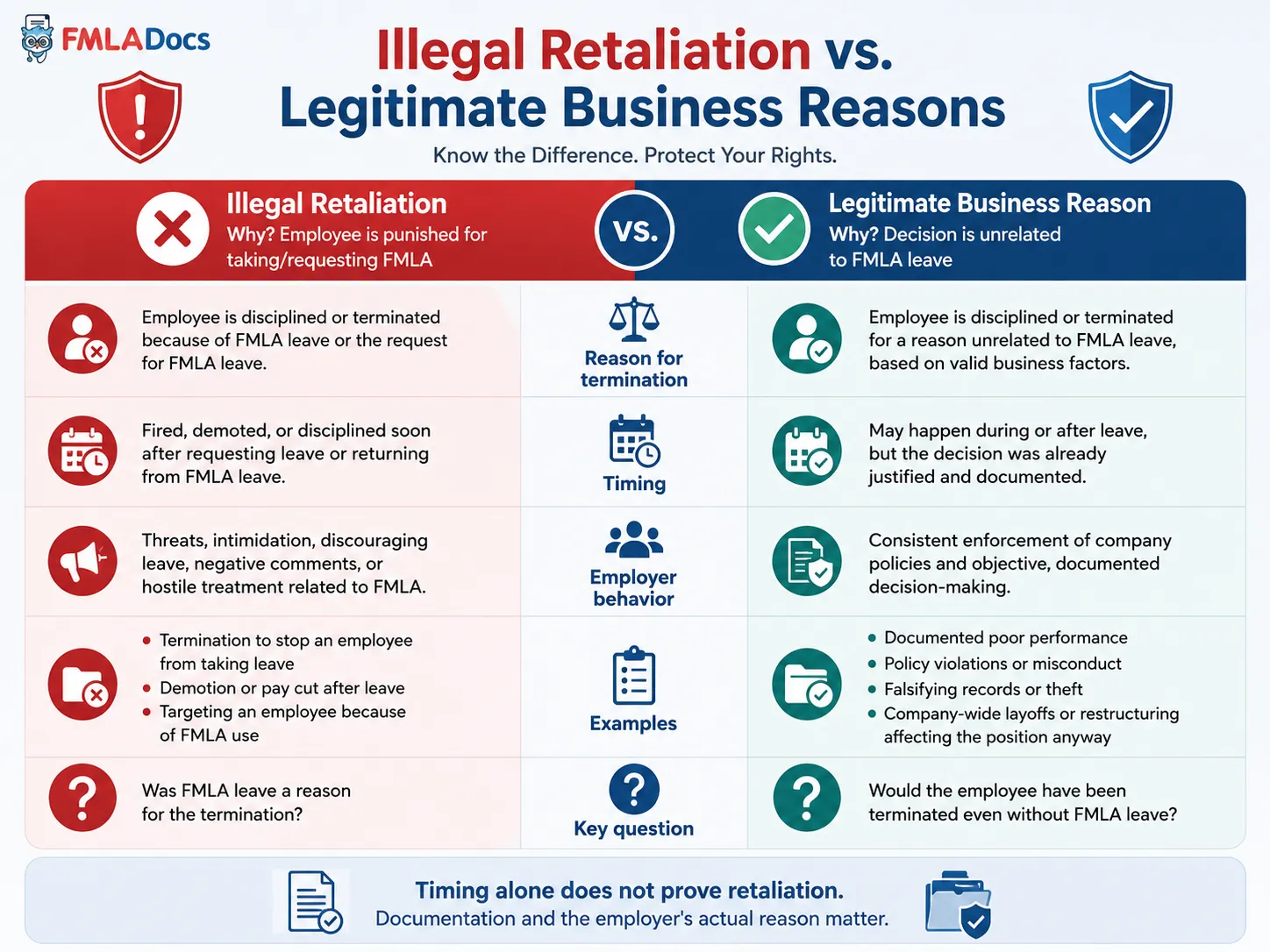
When your employer fires you during or after FMLA leave, the law draws a clear line between illegal retaliation for taking protected leave and legitimate business decisions. Understanding this distinction protects your rights. It also helps you assess whether you have grounds for legal action.
What Counts as Illegal Retaliation
Federal law prohibits your employer from punishing you for requesting or using FMLA leave. Termination that happens because you took protected time off violates your rights. So does firing you to prevent you from taking entitled leave.
According to legal experts, these actions count as illegal:
-
Firing you within days or weeks of requesting FMLA leave
-
Terminating you immediately after you return from protected leave
-
Threatening your job if you don’t cancel your leave request
-
Discouraging you from taking leave through intimidation or warnings
-
Creating a hostile work environment after you return from FMLA
The law also prohibits interference. That means your employer can’t block your ability to take entitled leave. Denying a valid request without legitimate reasons violates federal protections.
Legitimate Reasons That Aren’t Protected
FMLA protects your job during leave. It doesn’t shield you from discipline for legitimate workplace issues. Your employer can still fire you for reasons unrelated to your leave.
Valid termination reasons include:
-
Performance problems documented before your leave began
-
Policy violations like falsifying timesheets or attendance records
-
Workplace misconduct such as harassment or theft
-
Company-wide layoffs affecting multiple positions including yours
-
Job elimination due to restructuring that would have happened regardless
The burden falls on your employer to prove the termination would have occurred even without your FMLA leave. They must show clear documentation of issues that existed before you requested time off. Vague complaints or suddenly discovered problems raise red flags.
How Timing Creates Suspicion
Timing matters when evaluating whether termination violates FMLA protections. Firing someone right after they request leave looks suspicious. But timing alone doesn’t prove illegal retaliation.
Courts examine the full context. They look at whether performance issues were documented before the leave request. They review whether your employer followed normal disciplinary procedures. They consider whether similarly situated employees received different treatment.
Termination within two weeks of requesting leave triggers heightened scrutiny. So does firing you on your first day back. These patterns suggest your leave played a role in the decision. Your employer must provide strong evidence their reasons were legitimate and unrelated to your protected activity.
If you’re facing termination during or after FMLA leave, document everything. Save emails, performance reviews, and any communications about your leave. This evidence becomes critical if you need to challenge the decision. FMLADocs can help you get proper medical certification quickly, which strengthens your position if disputes arise.
Layoffs, RIFs, and Key-Job Exceptions During FMLA
Can your employer fire you on FMLA during company layoffs? Yes, but only under specific conditions. FMLA protects your job, but it doesn’t shield you from legitimate business decisions that affect everyone.
Understanding when termination is legal helps you spot wrongful termination during FMLA leave.
Company-Wide Layoffs and Restructuring
Your employer can include you in company-wide layoffs even while you’re on FMLA. The law doesn’t create special immunity from business decisions that affect multiple employees. What matters is whether the layoff is legitimate.
To stay compliant, employers must prove the layoff would have happened regardless of your leave. According to layoff compliance requirements, documentation showing business reason is what separates legal terminations from FMLA retaliation and interference.
Red flags that suggest wrongful discharge include:
-
Only employees on FMLA were laid off
-
Your position was posted online days after termination
-
Someone was hired to do your exact job immediately
-
No other employees in your department were affected
If the layoff affects your entire department or multiple teams across the company, that supports a legitimate business reason. Document everything you receive about the restructuring.
Reduction in Force That Includes Your Position
A reduction in force (RIF) eliminates specific positions for budget or operational reasons. Your employer must prove your position was cut for reasons unrelated to your leave. This means showing the decision was made before you requested FMLA or would have included you anyway.
Strong evidence of a legitimate RIF includes:
-
Multiple employees in similar roles were terminated
-
Budget documents showing planned workforce reductions
-
Organizational charts demonstrating eliminated positions
-
Timeline proving decisions predated your FMLA request
If you return to find your job “eliminated” but the work is still being done by others, that’s a warning sign. If your position was posted with a different title but identical duties, you may have grounds for a wrongful termination claim.
Save all termination notices, severance offers, and communications about the RIF. Compare what you were told with what actually happened to other employees.
The Highly Compensated Employee Exception
The key-job exception applies only to highly compensated employees in the top 10% of your employer’s workforce. This narrow exception lets employers deny job restoration if your absence causes substantial economic injury.
Your employer must prove actual economic harm, not just inconvenience. They must show that restoring you to your position would cause serious financial damage to operations. This exception rarely applies in practice.
To use this exception, your employer must:
-
Notify you in writing that you qualify as a key employee
-
Explain the specific economic injury your restoration would cause
-
Give you a chance to return to work immediately
-
Prove the harm is substantial and documented
Being told you’re “too important” or “difficult to replace” isn’t enough. Your employer needs concrete financial evidence. If they invoke this exception, consult an employment attorney immediately. Most key-job denials don’t meet the legal standard.
Watch for employers who claim restructuring but show contradictory evidence. If your job still exists under a different name or was filled right away, you may have been fired illegally while on FMLA.
Performance Issues That Predate Leave
Your employer can fire you for performance issues that existed before your FMLA leave began. This is legal. The key word is “predate.” If problems were documented before you requested leave, your job protection doesn’t erase them.
That said, timing matters. Performance issues that suddenly appear after you request leave look suspicious. Courts recognize this pattern as potential retaliation.
What Documented Performance Problems Look Like
Legitimate performance documentation has specific characteristics. It includes written warnings with dates, performance improvement plans with measurable goals, and disciplinary notices describing specific incidents.
Here’s what real documentation looks like:
-
Written warnings dated at least 30 days before your leave request
-
Performance improvement plans with clear metrics and timelines
-
Disciplinary notices citing specific dates, times, and incidents
-
Email trails showing ongoing performance discussions
-
Attendance records showing patterns before leave
Vague complaints don’t count. “Not meeting expectations” without examples isn’t documentation. “Attitude problems” without specific incidents won’t hold up. Your employer needs concrete evidence with dates and details.
The Importance of Written Records Before Leave
Performance issues must be communicated to you in writing before your leave. Verbal warnings alone don’t establish a paper trail. If your employer claims you had performance problems but never put anything in writing, that’s a red flag.
Before taking leave, request copies of your personnel file. Most states require employers to provide this. Review everything for performance-related documents. If your file shows positive reviews and no warnings, that’s evidence in your favor.
Save these records to a personal email account. Don’t rely on work email or company systems. If you’re fired, you’ll lose access immediately. Having your own copies protects you if you need to file a complaint or lawsuit later.
Sudden Performance Issues That Appear During Leave
Watch for performance problems that materialize only after you request FMLA leave. This pattern suggests retaliation, not legitimate business reasons. If you had positive reviews before leave but negative evaluations during or after, document everything.
Your employer cannot manufacture performance issues to justify firing you. Courts look at timing. If problems appear within days or weeks of your leave request, that’s suspicious. If your employer suddenly starts documenting minor issues they previously ignored, that’s suspicious too.
Compare your treatment to coworkers. If others make similar mistakes without discipline but you’re written up, that’s evidence of discrimination. If your employer applies policies inconsistently after your leave request, that supports a retaliation claim.
Keep copies of all performance reviews from before your leave. These prove your work history. If your employer claims you were always a problem employee, your positive reviews contradict that story. This evidence becomes critical if you need to show FMLA misuse or retaliation by your employer.
Document any changes in how you’re treated after requesting leave. Note new scrutiny, changed expectations, or different standards applied to you. This pattern helps prove your firing was about taking leave, not performance.
What to Document If You’re Terminated on FMLA
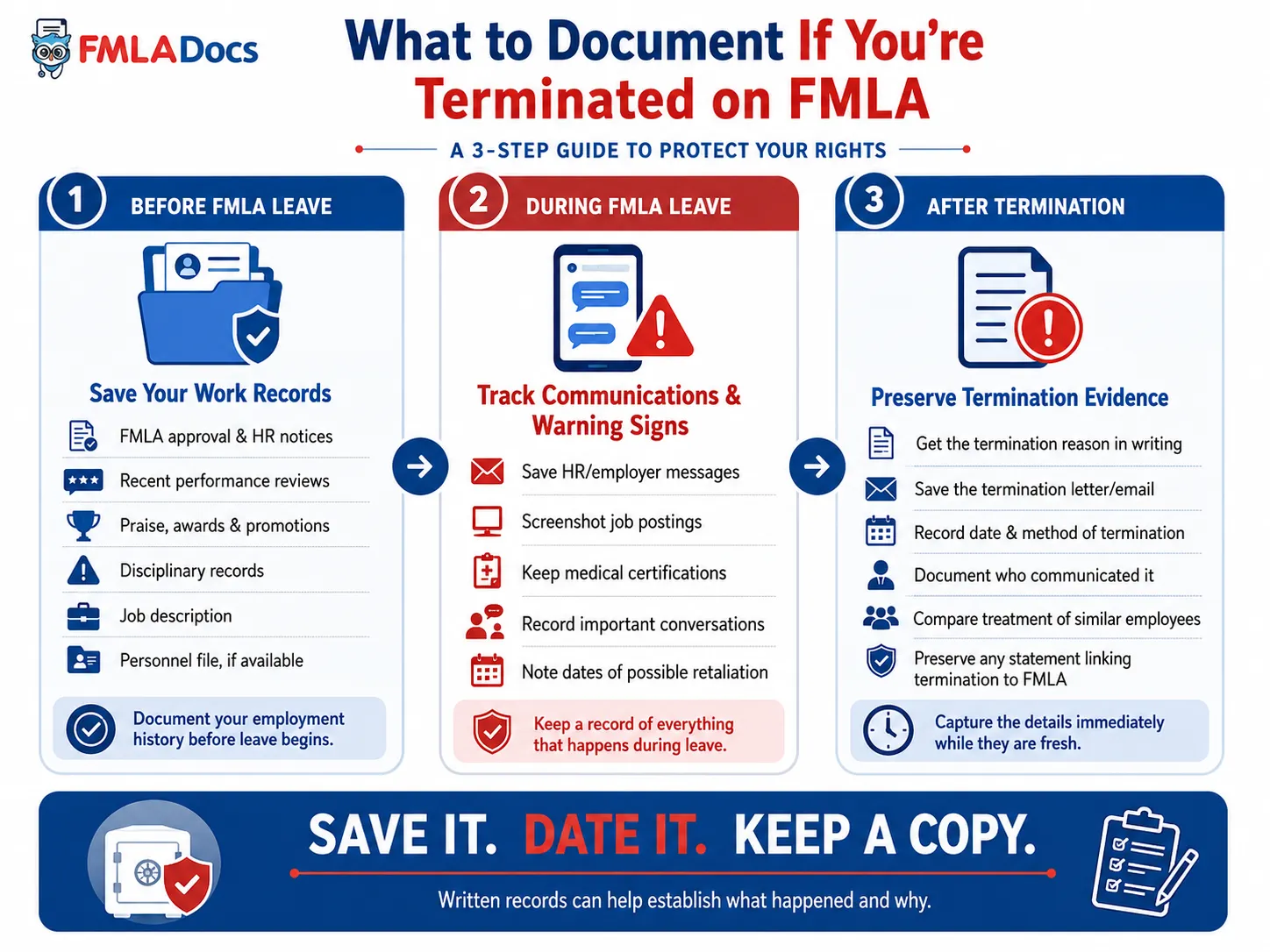
If your employer fires you while on FMLA leave, documentation becomes your strongest defense. The evidence you collect now determines whether you can prove wrongful termination later. Start gathering records immediately, before you lose access to work systems.
Records to Save Before Taking Leave
Before your leave begins, transfer critical documents to your personal email. Don’t rely on work accounts you might lose access to. Save all FMLA notices your employer sent you. This includes the eligibility notice and the designation notice confirming your leave approval.
Copy your performance reviews from the past 12-24 months. These show your work history was strong before leave. If you received positive evaluations, commendations, or promotions, save those too. They prove your termination wasn’t performance-based.
-
All FMLA approval letters and correspondence with HR
-
Performance reviews showing positive ratings
-
Emails praising your work or documenting achievements
-
Any disciplinary records (or lack thereof) from your personnel file
-
Your job description and responsibilities
Request your personnel file from HR if your state allows it. Many states require employers to provide copies. This file contains your complete work history with the company.
Documentation During Your Leave Period
While on leave, monitor your position status. Check job boards weekly to see if your role appears online. If your employer posts your job during your protected leave, screenshot the listing immediately. Include the date, job title, and full description.
Save every communication from your employer. Forward work emails to your personal account. Take screenshots of text messages with timestamps. After phone calls with HR or management, send a follow-up email summarizing what was discussed. This creates a written record of verbal conversations.
Keep copies of all medical certification forms you submitted. Save recertification documents too. These prove you met FMLA requirements throughout your leave. If you notice warning signs of retaliation during this period, document those incidents with dates and details.
Evidence to Preserve After Termination
Request a written explanation of your termination within 48 hours. Send this request via email so you have proof you asked. Your employer’s stated reason matters. If they claim performance issues, compare that to your positive reviews from before leave.
Save the termination letter or email. Document the exact date and method of termination. Note who delivered the news and what they said. If they terminated you by phone, send a follow-up email confirming the conversation.
-
Written termination notice with stated reason
-
All medical certification forms you submitted
-
Evidence of other employees in similar situations being treated differently
-
Communications showing your employer knew about your FMLA status
-
Any admission that your leave factored into the termination decision
Look for patterns of different treatment. Did your employer fire other employees on FMLA? Or did they accommodate others with similar situations? This comparison evidence strengthens your case. Document everything while details are fresh. Memory fades, but written records last.
Proper documentation reduces disputes that lead to wrongful termination during FMLA leave. Strengthen your leave request with physician certification. FMLADocs connects you with board-certified physicians who complete your medical certification correctly within 24-48 hours.
DOL Complaint and Legal Consultation Triggers

If your employer fires you on FMLA, you have legal options. The Department of Labor Wage and Hour Division handles FMLA violations. You can file a complaint if you believe your termination was retaliation for taking protected leave.
When to File a Department of Labor Complaint
File a DOL complaint when your employer violates FMLA protections. This includes firing you for requesting leave or terminating you during protected time off. The DOL investigates complaints and can order reinstatement or back pay.
You don’t need a lawyer to file. The process is free. Visit the DOL website or call your local Wage and Hour Division office. They’ll guide you through the complaint form.
Common situations that warrant a complaint include:
-
Termination immediately after you request FMLA leave
-
Being fired while on approved leave
-
Denial of restoration to your position after leave ends
-
Retaliation for exercising your FMLA rights
Document everything before filing. Save emails, text messages, and any written communication about your leave. Keep copies of your FMLA paperwork and termination notice.
The Two-Year Statute of Limitations
You have two years from the violation date to file a DOL complaint. This deadline is strict. If your employer’s violation was willful, you get three years instead.
The clock starts when the violation occurs. For wrongful termination during FMLA leave, that’s your termination date. Don’t wait until the last minute. Gathering evidence takes time.
According to wrongful termination resources, missing the statute of limitations means losing your right to file. The DOL can’t investigate complaints filed after the deadline expires. Act quickly if you believe your rights were violated.
Why Employment Attorney Consultation Matters
Consult an employment attorney before signing any severance agreement. Many employers offer severance in exchange for releasing your right to sue. Once you sign, you can’t file a complaint or lawsuit.
Red flags that trigger legal consultation include:
-
Termination within days of requesting leave
-
Sudden performance issues that weren’t documented before your leave
-
Your position being filled permanently while you’re still on protected leave
-
Employer refusing to provide written explanation for termination
An attorney who handles FMLA cases can review your situation. They’ll tell you if you have a valid claim. Many offer free consultations. Don’t sign releases waiving your rights without legal review. You may give up valid claims worth thousands of dollars.
Returning After Wrongful Termination Options (High-Level, Not Legal Advice)
If your employer fires you while on FMLA, you may have legal options to recover damages and get your job back. The law provides several remedies for wrongful termination during FMLA leave. Understanding these options helps you decide whether to pursue a claim.
This section covers what you can recover if you win a case. It also explains the reinstatement process. These are high-level overviews, not legal advice.
Remedies Available Under FMLA
Federal law allows you to file a complaint with the Department of Labor or file a private lawsuit. The DOL can investigate your complaint and pursue enforcement action on your behalf. This costs you nothing and can pressure employers to settle.
You can also hire an attorney and file directly in court. This gives you more control over the case. Both paths can lead to the same remedies.
Act quickly. You have two years from the violation date to file. If the violation was willful, you get three years. Evidence becomes harder to gather over time. Witnesses forget details. Documents disappear. Starting early protects your case.
What Successful Claims Can Recover
Winning a wrongful termination case can result in several types of compensation. These remedies aim to make you whole after the violation.
-
Back pay: Covers wages lost from termination until resolution of your case. This includes salary, bonuses, and commissions you would have earned.
-
Front pay: Compensates for future lost earnings if reinstatement isn’t feasible or practical. Courts award this when returning to your old job isn’t realistic.
-
Lost benefits: You can recover health insurance premiums, retirement contributions, and other benefits you lost during termination.
-
Liquidated damages: Can double your economic losses in cases of willful FMLA violations. This punishes employers who knowingly break the law.
-
Attorney fees and court costs: Your employer may be required to pay your legal expenses if you win.
According to performance documentation before leave, employers can terminate for poor performance after FMLA only if they have documented issues predating the leave period. Without that documentation, termination looks like retaliation.
The Reinstatement Process
If you win a wrongful termination case, you may be entitled to reinstatement. This means getting your job back or an equivalent position. The role must have the same pay, duties, schedule, and location.
Reinstatement isn’t automatic. Courts consider whether the working relationship is too damaged. They also look at whether your position still exists. If the company eliminated your role for legitimate business reasons, reinstatement may not be possible.
When reinstatement isn’t feasible, courts award front pay instead. This compensates you for future earnings you’ll lose by not returning. The amount depends on how long it takes to find comparable work.
Some employees don’t want to return after being fired. That’s understandable. You can still pursue back pay, lost benefits, and liquidated damages without seeking reinstatement.
Conclusion
FMLA protects your right to take leave. It doesn’t shield you from all terminations. Your employer can fire you for legitimate business reasons. They can’t fire you because you took protected leave. The difference matters in court.
You learned how FMLA retaliation and interference differs from lawful termination. You saw when layoffs can affect FMLA employees. You discovered how performance issues before leave create legal grounds for firing. You now know what to document if termination happens.
If your employer fire me on FMLA, act fast. File a DOL complaint within two years. Consult an employment attorney right away. Gather your documentation before memories fade.
Protect yourself before problems start. FMLADocs connects you with board-certified physicians who complete your medical certification correctly. Most certifications finish within 24-48 hours. Proper documentation reduces disputes that lead to wrongful termination during FMLA leave. Don’t let incomplete paperwork put your job at risk.
Frequently Asked Questions
**Can you get fired while on FMLA leave?**
Yes, but an employer generally cannot fire you because you requested or used FMLA leave. An employee may still be terminated for a legitimate, unrelated reason, such as misconduct or a position elimination that would have occurred regardless of the leave.
**Is firing during FMLA automatically illegal?**
No. Being fired while on FMLA leave does not automatically prove an FMLA violation. The question is whether the termination was connected to the employee's FMLA rights or whether the employer had a legitimate reason unrelated to the leave.
**Can I be laid off while on FMLA?**
Yes. FMLA does not prevent an employer from carrying out a legitimate layoff that would have occurred even if the employee had not taken leave. However, an employer cannot use a layoff as a pretext to terminate someone because they took FMLA leave.
**Can HR fire me for missing work on FMLA?**
Not for absences that are properly protected under FMLA. Employers generally cannot count protected FMLA leave against an employee under attendance policies or use it as a negative factor in disciplinary decisions.
**What is FMLA retaliation?**
FMLA retaliation occurs when an employer takes an adverse employment action because an employee exercised or attempted to exercise FMLA rights. Examples can include termination, demotion, discipline, or negative attendance treatment because the employee used or requested protected leave.
**Can I lose my job if my FMLA runs out?**
Potentially, yes. FMLA generally provides up to 12 workweeks of protected leave during a 12-month period, although eligible military caregivers may receive up to 26 workweeks. Once FMLA protection ends, additional leave or job protection may depend on other applicable laws, employer policies, or accommodations.
**What should I do if I am fired during FMLA?**
Ask the employer for the reason for termination and keep copies of relevant emails, FMLA notices, medical certifications, attendance records, and other communications. If you believe your FMLA rights were violated, you can contact the U.S. Department of Labor's Wage and Hour Division about filing a complaint.
**Does anxiety or stress-related FMLA leave get less protection?**
No. Qualifying mental health conditions can be covered by FMLA just like qualifying physical health conditions. When the leave meets FMLA requirements and is properly supported when certification is required, employees receive the same FMLA protections against interference and retaliation.
Meet the author
Nida Hammad
I am a professional writer with over five years of experience creating clear, engaging, and well-researched content. I specialize in healthcare topics, helping readers understand complex information in simple wording. Currently, I write for FMLA DOC, where I focus on producing accurate and trusted guides for people seeking support with FMLA and medical needs.
Get Your FMLA Certification Online in Minutes