

FMLA Employer Requirements 2026
 by Nida Hammad
Last updated:
FMLA employer requirements carry penalties up to $20,000 per willful violation. Yet most HR teams struggle with notice deadlines, certification rules, and job protection standards. The Department of Labor increased enforcement this year. Retaliation claims and notice violations now face stricter scrutiny.
Covered employers must post workplace notices, maintain health benefits during leave, and restore jobs after FMLA ends. Misunderstanding these obligations triggers compliance failures. Employee complaints follow. Department of Labor investigations drain resources and damage your reputation.
This guide breaks down every FMLA employer requirement for 2026. You’ll learn which businesses must comply and which workers qualify. We cover the three distinct notice types you must provide. You’ll see how to handle medical certifications, track intermittent leave, and protect employee benefits. The guide includes military leave rules, recordkeeping standards, and a compliance checklist. You’ll also discover how to prevent the most common violations that trigger investigations and lawsuits.
FMLA Employer Requirements In 2026
The Department of Labor updated enforcement priorities this year. Employers face stricter scrutiny on retaliation claims and notice violations. Understanding employer FMLA obligations under current regulations protects your business from costly penalties.
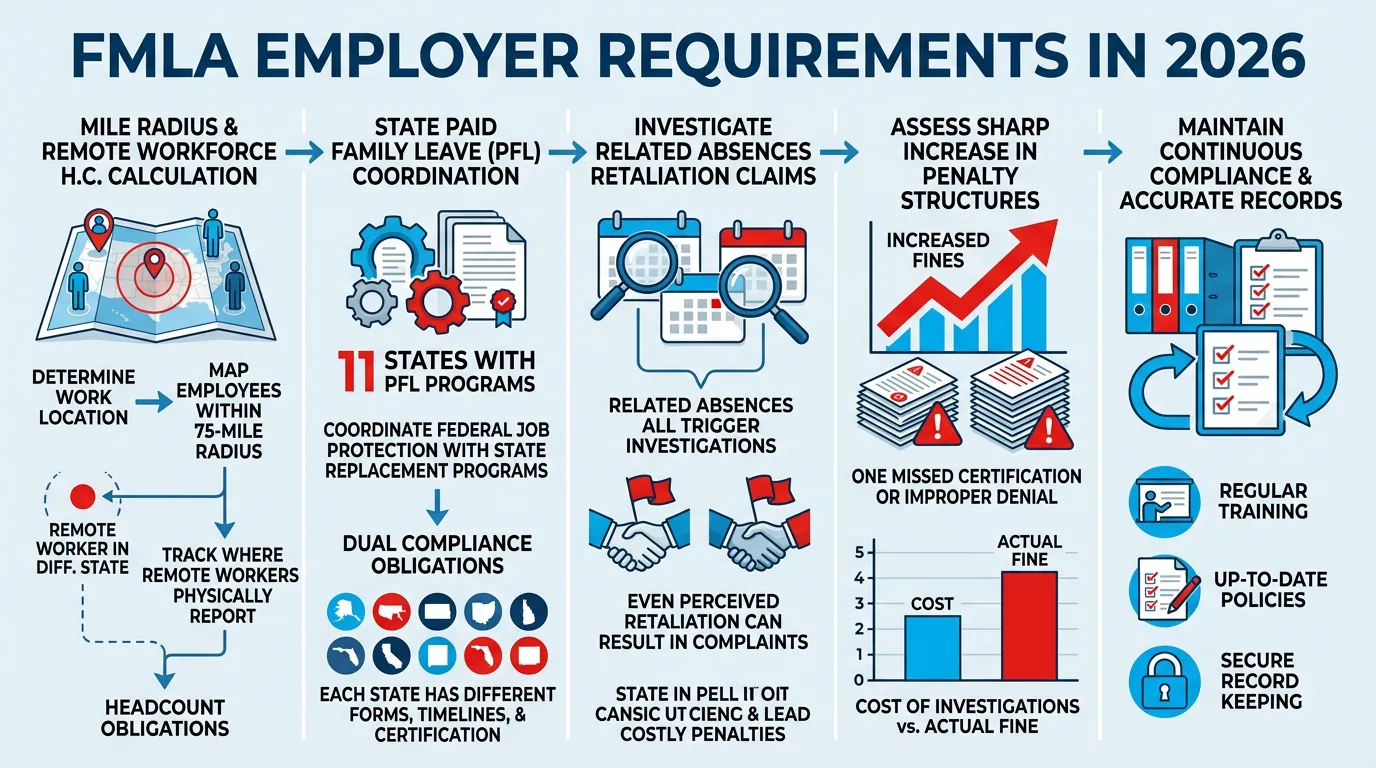
According to the Department of Labor, civil fines now reach $20,000 per willful violation as of January 2026. That’s a sharp increase from previous penalty structures. One missed certification or improper denial can trigger investigations that cost far more than the fine itself.
What Changed in 2026 FMLA Regulations
Remote work arrangements complicate the 75-mile radius calculation for employer coverage. Employees working from home in different states create new compliance questions. You must track where remote workers physically report and how that affects your headcount obligations.
State-level paid family leave programs now interact with federal FMLA in 11 states. This creates dual compliance obligations. Employers must coordinate federal job protection with state wage replacement programs. Each state has different forms, timelines, and certification requirements. Employer FMLA obligations goes into more depth on this.
Digital recordkeeping requirements now meet DOL accessibility standards. You can maintain FMLA records electronically if they’re readily accessible during investigations. Paper files are no longer required, but digital systems must allow quick retrieval and audit trails.
Why Compliance Matters More Than Ever
Employee awareness of FMLA rights has increased dramatically. More workers know they can request leave for mental health conditions, chronic illnesses, and family caregiving. This means more applications, more certifications to review, and more potential for procedural errors.

Retaliation claims are the DOL’s top enforcement priority for 2026. Denying a promotion after FMLA leave, reducing hours upon return, or disciplining employees for leave-related absences all trigger investigations. Even perceived retaliation can result in complaints.
The Cost of Getting It Wrong
Civil penalties start at $20,000 per willful violation. But that’s just the beginning. Legal fees for defending DOL investigations often exceed $50,000. Settlement costs for employee lawsuits average $75,000 to $150,000.
Beyond financial penalties, compliance failures damage your reputation. Word spreads quickly when employees feel their rights were violated. Recruiting becomes harder. Turnover increases. Your best workers leave for employers who handle leave requests properly.
The solution is straightforward. Train HR staff on current FMLA employer requirements. Update your policies to reflect 2026 changes. Review certification processes to catch incomplete forms early. Document every step of every leave request.
FMLA Employer Coverage and Employee Eligibility Requirements
Understanding who qualifies for FMLA protection starts with two separate tests. First, does your employer meet coverage requirements? Second, do you meet employee eligibility standards? Both must be true before you can access job-protected leave.
Many workers assume any full-time job qualifies them. That’s not how the law works. The rules are specific, and missing even one requirement can leave you without protection.
The 50-Employee Threshold and 75-Mile Radius Rule
Your employer must have 50 or more employees within a 75-mile radius of your worksite. This count must hold for at least 20 workweeks in the current or preceding calendar year. The weeks don’t need to be consecutive.
According to USA.gov’s guidance on employer responsibilities under FMLA, the 75-mile radius is measured by surface miles using surface transportation over public streets, roads, highways, and waterways. It’s not a straight-line calculation.
Remote workers count toward the worksite where they report or receive assignments. Your home office location doesn’t determine the count. If you report to a regional office in Chicago, you count toward that location’s 50-employee threshold.
Joint employers and integrated employers may be treated as a single employer. This matters when parent companies, subsidiaries, or franchises share operational control.
Employee Eligibility: 12 Months and 1,250 Hours
You must work for your employer for at least 12 months. These months don’t need to be consecutive. A break in service doesn’t reset the clock if you return within seven years.
You also need 1,250 hours worked in the 12 months immediately before your leave starts. That averages about 24 hours per week. Hours worked include overtime, training time, and business travel time. Paid time off, holidays, and sick days don’t count toward the 1,250-hour requirement.
Part-time employees can qualify if they meet the hour threshold. Request your hours-worked records from HR before submitting paperwork. Many employees discover they’re just short of 1,250 hours and could have planned differently.
Understanding FMLA eligibility requirements helps you verify your status before investing time in the application process.
Special Coverage Rules for Public Agencies and Schools
All public agencies qualify as covered employers regardless of employee count. This includes federal, state, and local government entities. A small town with 15 employees still must provide FMLA leave to eligible workers.
Public and private elementary and secondary schools also qualify regardless of size. Teachers, administrators, and support staff at these schools can access FMLA protection if they meet the individual eligibility requirements.
These special rules recognize the public service nature of government work and education. The 50-employee threshold doesn’t apply, but employees still must meet the 12-month and 1,250-hour standards.
FMLA Employer Notice and Leave Request Requirements
FMLA employer requirements include three distinct notice obligations. Each one has specific timing rules and content standards. Missing any of these can expose you to DOL violations and employee complaints.
These notices protect both parties. They tell employees what rights they have. They also document what your company approved or denied.
Workplace Postings and Notice Obligations
You must display the official DOL FMLA poster in a visible location. According to the workplace posting requirements regulation, this means areas where employees gather regularly. Break rooms, time clock areas, and main entrances work well.
The poster is WHD Publication 1420. You can download it free from the DOL website. It explains basic FMLA rights in plain language.
Beyond the poster, you need written policies. Employee handbooks must include FMLA rights and procedures. This general notice should cover:
-
Who qualifies for FMLA leave
-
What reasons are covered
-
How to request leave
-
What medical certification you require
-
Employee rights during and after leave
Electronic delivery works if employees have regular email access during work hours. Don’t rely on email alone if workers lack consistent computer access.
Eligibility Notice: Your First Response Obligation
Once you learn an employee needs leave, you have five business days to respond. This eligibility notice tells them whether they qualify for FMLA protection.
Form WH-381 satisfies this requirement. It’s called Notice of Eligibility and Rights & Responsibilities. The form states whether the employee meets all three eligibility criteria.
If they don’t qualify, explain why. Maybe they haven’t worked 1,250 hours. Maybe your company has fewer than 50 employees within 75 miles. Be specific about what’s missing.
This notice also explains employee responsibilities. It covers certification deadlines, call-in procedures, and potential consequences for not following your policies.
Designation Notice: Confirming Leave Approval or Denial
After you have enough information, you must issue a designation notice. You have five business days once you receive sufficient details to make a decision.
Form WH-382 handles this step. It’s the Designation Notice. This document confirms whether you’re approving or denying the leave request.
If approved, specify how much leave you’re granting. State whether it’s continuous or intermittent. Include the start and end dates if known.
If denied, explain exactly why. Common reasons include incomplete certification, condition doesn’t meet serious health criteria, or employee doesn’t qualify for FMLA.
FMLADocs helps employers avoid certification delays. Our licensed physicians complete medical certifications within 24-48 hours. This keeps your five-day designation window manageable.
Electronic delivery is acceptable here too. Email works if the employee regularly checks work email. Keep proof of delivery for your records.
FMLA Medical Certification and Documentation Requirements
You can require medical certification for both employee health conditions and family care situations. Use form WH-380-E for personal medical issues. Use form WH-380-F when employees need time to care for family members.
Telehealth certifications carry the same weight as in-person visits. This change makes it easier for employees to get proper documentation without office visits.
When You Can Request Certification
You can ask for certification when an employee first requests FMLA leave. You can also request it for subsequent leaves if the condition or circumstances change.

The request must be made in writing. Be clear about what information you need. Don’t ask for details beyond what the forms require.
The 15-Day Employee Response Period
Employees get at least 15 calendar days to return completed certification. This timeline starts when you make the request. You can grant extensions if needed.
Don’t deny leave automatically if the deadline passes. Work with employees who face legitimate delays in getting appointments or paperwork.
Handling Incomplete or Insufficient Certifications
You must notify employees in writing about missing information. Point out precisely what’s incomplete or unclear. Give them at least seven days to fix the issues.
You can request clarification from the healthcare provider. You cannot ask for additional medical information beyond the original certification scope. You need written employee authorization before contacting their provider directly.
You can require a second opinion if you have reasonable doubt about the first certification. You pay for this exam. The employee must cooperate with the second provider. A third opinion becomes necessary when the first two conflict. Both parties must accept this final opinion as binding. You cover the cost of the third examination too.
FMLA Intermittent Leave and Leave Tracking Requirements
Intermittent FMLA creates unique tracking challenges for employers. You can’t treat these hours like standard PTO. The law sets specific rules for how you measure, document, and manage leave taken in separate blocks.
Getting this wrong exposes you to compliance violations. Here’s what you need to know.
Tracking Hours vs. Days Used
You must track intermittent leave in the smallest increment you use for other leave types. That can’t be less than one hour. If you track sick leave in 15-minute blocks, you track FMLA the same way.
This matters because employees only use their 12-week entitlement for actual time absent. A three-hour doctor appointment uses three hours, not a full day. Your digital time-tracking system must capture FMLA hours separately from other leave categories.
Many employers make the mistake of rounding up to full days. That burns through an employee’s 12-week bank faster than the law allows. Track actual hours used, not estimated days.
Transfer to Alternative Positions
You can transfer an employee to an alternative position during intermittent leave if the schedule disrupts operations. The new role must offer equivalent pay and benefits. It should better accommodate recurring absences.
This isn’t a punishment tool. You can’t demote someone or cut their responsibilities because they take protected leave. The alternative position must match their qualifications and maintain their status.
Document your business justification before making any transfer. Show how the recurring absences create operational challenges that the new position solves.
Periodic Reporting and Recertification Requirements
You can require periodic reports on leave status and intent to return. Ask employees to confirm they still need intermittent leave. Request updates on their condition and expected return schedule.
For conditions lasting beyond the initial medical estimate, you can require recertification every 30 days. This confirms the ongoing medical necessity. You can’t deny intermittent leave just because it’s operationally inconvenient, even when episodes are unpredictable.
Set clear reporting procedures from the start. Tell employees how often to check in and what information you need. Consistent communication protects both parties.
FMLA Health Insurance, Benefits, and Job Protection Requirements
FMLA employer requirements extend beyond granting leave. Employers must protect health benefits, restore jobs, and maintain working conditions. These protections form the backbone of FMLA compliance for employers.
Maintaining Group Health Coverage During Leave
Your employer must keep your group health insurance active during FMLA leave. The coverage continues on the same terms as if you never stopped working. This means the same plan, same benefits, same provider network.
You don’t lose coverage because you’re out on leave. The employer pays their share of premiums just like before. This protection applies to medical, dental, and vision plans offered through group coverage.
If your employer changes plans for all employees during your leave, you get the new plan too. You can’t be singled out for different treatment. The law treats you as an active employee for benefits purposes.
Employee Premium Payment Options
You still pay your share of premiums during leave. The employer can’t waive your portion or make you pay theirs. Your payment obligation stays the same.
Employers have two options for collecting your premium share:
-
Require payment on the same schedule as when you worked (biweekly, monthly)
-
Allow you to catch up when you return from leave
-
Collect through payroll deduction if you receive any pay during leave
If you’re more than 30 days late on premium payments, your employer can drop your coverage. They must give you 15 days’ written notice first. You can get coverage back when you return to work.
Job Restoration Rights and Equivalent Position Standards
When you return from FMLA leave, your employer must restore you to your original position. If that exact job isn’t available, they must give you an equivalent position. Equivalent means truly comparable, not just any open role.
The position must match your previous job in these ways:
-
Same pay rate and salary level
-
Same benefits package and accrual rates
-
Same shift and work schedule
-
Same or similar duties and responsibilities
-
Same level of authority and decision-making power
-
Same advancement opportunities and career path
Your employer can’t use your leave against you in performance reviews. They can’t pass you over for promotions because you took FMLA time. Taking leave can’t be a negative factor in any employment decision. These protections are part of your employee FMLA rights under federal law.
If you worked remotely before leave, that arrangement continues when you return. The employer can’t force you back to the office if your position still allows remote work.
Key Employee Exception for Highest-Paid Workers
One exception exists to job restoration rights. Employers can deny restoration to “key employees” if bringing them back would cause substantial economic injury. Key employees are the highest-paid 10% of workers within 75 miles of the worksite.
This exception is narrow and rarely used. The employer must prove actual economic harm, not just inconvenience. They must notify you in writing that you qualify as a key employee. You get a chance to return to work immediately to avoid losing restoration rights.
Most employees never face this exception. It applies only to top earners in specific situations where their absence creates genuine financial hardship for the company.
FMLA Employer Recordkeeping Requirements
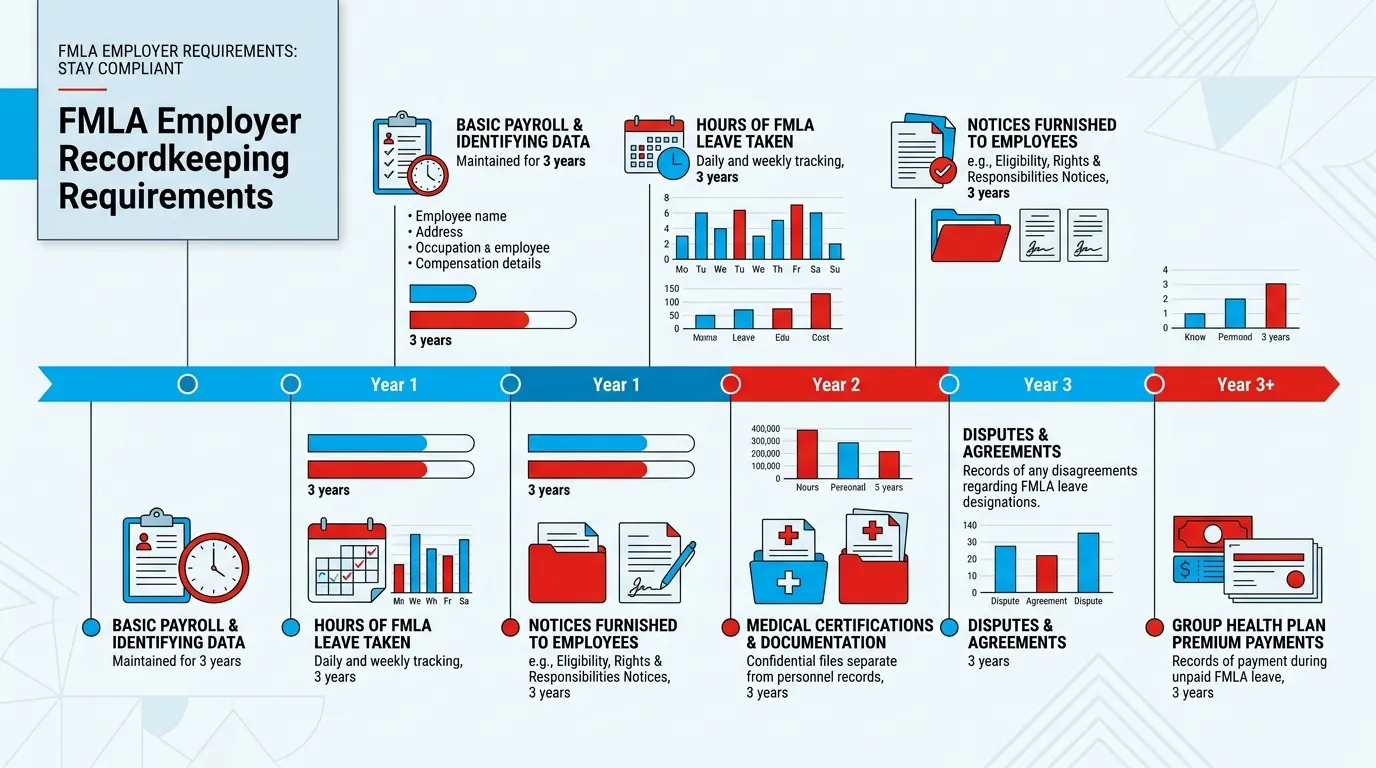
FMLA employer requirements include strict recordkeeping and confidentiality rules. You must maintain detailed records for three years. These records protect both you and your employees during audits.
Require Documentation for Each Leave Request
You need specific documents for every FMLA request. Keep dates of leave, hours used, and copies of all notices you provided. Store employee eligibility determinations and designation notices.
Medical certifications must be in your files too. Track when employees submit forms and when you respond. This documentation proves FMLA compliance for employers during investigations.
Confidentiality of Medical Information
Medical certifications require separate storage from personnel files. Only supervisors who need to know about restrictions or accommodations can access this information. This protects employee privacy under federal law.
According to state family leave laws, some states add extra confidentiality requirements beyond federal FMLA. Check your state rules to stay compliant.
Retention Timeline and Audit Preparation
Keep all FMLA records for three years minimum. The DOL can request records during investigations. You must produce them within 72 hours of the request.

Electronic recordkeeping works if you maintain the same accessibility as paper records. Cloud-based HR systems need audit trails. These trails must show who accessed medical information and when. This transparency protects you during compliance reviews.
FMLA Military Leave and Special Employer Requirements
Military families face unique situations that require special FMLA provisions. These rules differ from standard leave in both duration and documentation. Employers must understand these distinctions to stay compliant with FMLA employer requirements.
Military Caregiver Leave: Up to 26 Weeks
According to the Office of Personnel Management, military caregiver leave provides up to 26 weeks in a single 12-month period. This applies when you care for a covered servicemember with a serious injury or illness. The extended duration recognizes the intensive care military injuries often require.
Covered servicemembers include current military members undergoing treatment for service-related conditions. Veterans discharged within the past five years also qualify if their injury or illness stems from military service. This five-year window protects those whose service-connected conditions emerge after discharge.
Qualifying Exigency Leave for Military Families
Qualifying exigency leave covers specific situations when a family member deploys. You can take leave for short-notice deployment, military events and ceremonies, childcare arrangements, financial and legal matters, counseling, rest and recuperation, and post-deployment activities. Each category addresses real needs military families face during deployment cycles.
Special Certification Requirements for Military Leave
Certification requirements differ for military leave compared to standard FMLA. Employers can accept DOD forms or healthcare provider statements for caregiver leave. For exigency leave, employers may require invitational travel orders or other military documentation proving the qualifying event.
Military leave runs on a different 12-month calculation than standard FMLA leave. This separate tracking prevents military leave from consuming your regular 12-week entitlement. Employers must track both types independently to maintain proper FMLA compliance for employers.
FMLA Employer Requirements for Preventing Violations and Retaliation
FMLA employer requirements extend beyond granting leave. Employers must protect employees from interference and retaliation. Violations can result in lawsuits, DOL investigations, and financial penalties.
Interference vs. Retaliation: Understanding the Difference
Interference happens when employers block or discourage FMLA rights. Retaliation occurs when employers punish employees for using those rights. Both violate federal law but work differently.
Interference includes denying leave due to short staffing or operational needs. It also means requiring more documentation than legally allowed. Employers cannot make employees find replacements before taking leave. They cannot count FMLA absences against attendance policies.
Retaliation involves adverse actions after an employee requests or takes leave. This includes demotions, pay cuts, schedule changes, or termination. Timing matters here. Actions taken shortly after an FMLA request create a strong inference of retaliation.
Common Actions That Constitute Retaliation
Certain employer actions trigger retaliation claims under FMLA compliance for employers. Disciplining an employee for FMLA-protected absences creates a presumption of retaliation. This applies even if the employer claims other reasons.
Other retaliatory actions include:
-
Reducing hours or changing shifts after leave
-
Assigning less desirable tasks or locations
-
Excluding employees from meetings or projects
-
Creating hostile work environments through comments or treatment
-
Denying promotions or raises that were otherwise earned
Employers cannot discourage FMLA use through subtle pressure. Statements like “we really need you here” or “this hurts the team” can constitute interference. According to Thomson Reuters Legal, tracking intermittent leave in the smallest increments helps document compliance. But using that data to penalize employees crosses into retaliation.
Training Managers to Avoid FMLA Violations
Managers need clear training on employer FMLA responsibilities. They must understand what questions are allowed about medical conditions. Asking for diagnosis details violates privacy rules. Requesting information beyond the certification form constitutes interference.
Training should cover these topics:
-
How to recognize FMLA-qualifying situations
-
Proper procedures for designating leave
-
What documentation employers can legally request
-
How to handle intermittent leave requests
-
Why timing of adverse actions matters
Managers must designate leave as FMLA even when employees don’t use that specific term. An employee saying “I need time off for surgery” triggers FMLA obligations. Failing to designate leave properly denies job protection rights.
Regular training updates keep managers current on FMLA job protection rules. This protects both employees and the organization from costly violations.
FMLA Employer Compliance Checklist and Legal Consequences
Staying on top of FMLA employer requirements means running regular checks. Missing a step can trigger investigations or lawsuits. This section covers what to review monthly, how DOL investigations work, and what penalties look like.
Monthly Compliance Review Checklist
Set up a monthly audit to catch problems before they become complaints. This keeps your FMLA compliance for employers on track.
-
Review all pending leave requests for timely eligibility and designation notices
-
Verify medical certifications are stored separately from personnel files
-
Confirm health insurance premiums are being maintained for employees on leave
-
Check that no FMLA absences are counted against attendance policies
-
Audit intermittent leave tracking to confirm accurate hour deductions
According to FMLA job protection standards, employers must restore employees to the same or equivalent position. Your monthly review should confirm no one returning from leave faces demotion or reduced hours.
Document every review. Keep notes on what you checked and when. This record protects you if a complaint arises later.
Expectations From DOL Investigation Process
DOL investigations typically begin with employee complaint or random audit. The agency contacts you by phone or letter requesting records.
You’ll need to provide employee files, leave requests, medical certifications, and payroll records. The DOL reviews whether you gave proper notices and maintained benefits during leave. They check if you restored employees correctly.
Most investigations take 60-90 days. The DOL may interview employees and managers. They look for patterns of denial or retaliation.
If violations are found, the DOL tries to resolve them through back pay or policy changes. Cooperation speeds resolution. Resistance escalates enforcement.
Penalties for Willful Violations and Private Lawsuits
Willful violations carry civil penalties up to $20,000 per violation as of 2026. The DOL defines willful as knowing or reckless disregard of FMLA requirements.
Employees can sue for lost wages, benefits, liquidated damages, and attorney fees. Liquidated damages equal the amount of lost wages and benefits. This doubles what you owe.
Employers who prevail in lawsuits still incur significant legal defense costs. Even winning is expensive. Defense can run $50,000 to $200,000 depending on case complexity.
Proactive compliance audits reduce risk more than reactive damage control after complaints. Catching errors internally costs far less than fighting them in court.
Conclusion
FMLA compliance demands clear systems for eligibility tracking, notice delivery, and certification management. This guide covered coverage requirements, employee eligibility tests, notice obligations, medical certification rules, intermittent leave tracking, benefits protection, recordkeeping standards, military leave provisions, retaliation prevention, and compliance checklists. Each area requires specific procedures that protect both employee rights and your organization.
Start by auditing your current processes against these FMLA employer requirements. Update your notice templates to match current Department of Labor standards. Train your HR team on proper certification management and what questions they can ask. Build tracking systems that capture every required element of the leave process. Document each step thoroughly.
Strong documentation protects you when disputes arise. Your records prove you followed proper procedures and met all employer obligations under FMLA. This evidence becomes your strongest defense in any investigation or lawsuit.
Review your procedures now and fix any gaps. If employees need help with medical certifications, FMLADocs connects them with licensed physicians who complete FMLA paperwork correctly the first time. This reduces your administrative burden and cuts compliance risk.
Frequently Asked Questions
What penalties can employers face for willful FMLA violations in 2026?
Civil fines reach $20,000 per willful violation as of January 2026. This represents a sharp increase from previous penalty structures. Legal fees for defending DOL investigations often exceed $50,000. Settlement costs for employee lawsuits average $75,000 to $150,000. Beyond financial penalties, compliance failures damage your reputation and make recruiting harder. One missed certification or improper denial can trigger investigations that cost far more than the fine itself.
How do remote work arrangements affect FMLA employer coverage requirements?
Remote work complicates the 75-mile radius calculation for employer coverage. You must track where remote workers physically report and how that affects your headcount obligations. Employees working from home in different states create new compliance questions. The DOL updated enforcement priorities this year to address these situations. You need to determine if remote workers count toward the 50-employee threshold based on their work location, not just your main office address.
What are the DOL's top enforcement priorities for FMLA in 2026?
Retaliation claims are the DOL's top enforcement priority for 2026. Denying a promotion after FMLA leave triggers investigations. Reducing hours upon return or disciplining employees for leave-related absences also raises red flags. Even perceived retaliation can result in complaints. The Department of Labor increased enforcement this year with stricter scrutiny on retaliation claims and notice violations. Employee awareness of FMLA rights has increased dramatically, leading to more applications and more potential for procedural errors.
Do employers need to maintain paper FMLA records or can they use digital systems?
Digital recordkeeping now meets DOL accessibility standards. You can maintain FMLA records electronically if they're readily accessible during investigations. Paper files are no longer required. Your digital systems must allow quick retrieval and audit trails. This change makes compliance easier for employers who already use HR software. The records must be available immediately when DOL investigators request them during audits or complaint investigations.
How do state paid family leave programs interact with federal FMLA requirements?
State-level paid family leave programs now interact with federal FMLA in 11 states. This creates dual compliance obligations for employers. You must coordinate federal job protection with state wage replacement programs. Each state has different forms, timelines, and certification requirements. Employers need to track both federal and state deadlines. You can't deny FMLA leave just because an employee receives state benefits. The two programs run together, not separately.
What three types of notices must employers provide under FMLA regulations?
Covered employers must post workplace notices about FMLA rights. You must provide eligibility notices when employees request leave. Designation notices confirm whether leave qualifies under FMLA. Each notice type has specific timing requirements and content standards. Missing any of these three notice types triggers compliance failures. Employee complaints follow when proper notices aren't given. The DOL scrutinizes notice violations more strictly in 2026, making proper documentation critical for avoiding investigations.
Meet the author
Nida Hammad
I am a professional writer with over five years of experience creating clear, engaging, and well-researched content. I specialize in healthcare topics, helping readers understand complex information in simple wording. Currently, I write for FMLA DOC, where I focus on producing accurate and trusted guides for people seeking support with FMLA and medical needs.
Get Your FMLA Certification Online in Minutes