

What Disqualifies You From FMLA? Eligibility Failures
 by Nida Hammad
Last updated:
What disqualifies you from FMLA? The answer isn’t always obvious. You might work full-time, have a legitimate medical need, and still get denied. Federal law sets strict FMLA eligibility guidelines that trip up thousands of workers each year. The most common reasons include insufficient work history, employer size limits, and conditions that don’t meet the serious health condition definition.
Many employees don’t discover they’re ineligible until after they’ve started the paperwork. By then, they’ve already told their employer about their health issue and lost valuable time exploring other options. This creates stress when you need stability most.
This guide breaks down the 12 most common FMLA disqualification reasons with clear criteria for each. You’ll learn about the FMLA 12-month employment requirement, the FMLA 1250 hours requirement, and what conditions don’t qualify for FMLA protection. We’ll also cover timing issues, family member restrictions, and what to do if federal FMLA doesn’t apply to your situation. You’ll know within minutes whether you qualify or need to pursue state programs instead.
1. Less than 12 months of employment (not necessarily consecutive)

One of the most common reasons employees don’t qualify for FMLA is insufficient tenure. Federal law requires 12 months of employment with your current employer before you can take protected leave. Many workers think a few months is enough. It is not. This requirement often surprises people when they need leave for pregnancy, surgery, or family care. Those 12 months do not have to be consecutive. If you left and returned, breaks of seven years or less typically count toward your total. You must have had a reasonable expectation of being recalled for the time to count.
The 12-Month Employment Requirement
Federal FMLA sets a clear bar: you must work for your employer at least 12 months before requesting leave. This doesn’t mean 12 consecutive months. Gaps in service can count if they meet specific criteria. The rule exists to balance employee protection with employer needs.
You also need 1,250 hours worked in the past 12 months. That’s roughly 24 hours per week. Part-time employees can qualify if they hit this threshold. Check your time records with HR to verify you meet both the tenure and hours requirements before starting the FMLA eligibility requirements and application process.
How Non-Consecutive Employment Counts
If you left your employer and got rehired, your old time counts. It counts toward the 12-month need. Breaks of seven years or less typically count if there was a reasonable expectation you’d return. This applies to seasonal workers, employees on layoff, or those who left and came back.
Document your original hire date, separation date, and rehire date. HR should calculate your total service time. If they don’t count prior service correctly, you may miss out on protection you’ve earned. This matters because intermittent FMLA leave for chronic conditions requires meeting the tenure threshold first.
What to Do If You’re Close But Not There Yet
Employees with 10 or 11 months of service face a tough spot. You’re close to qualifying but not protected yet. Check whether your state offers paid family leave programs with shorter tenure requirements. California, New York, and several other states provide benefits after less time on the job.
Some employers offer company leave policies more generous than federal FMLA. Ask HR whether internal policies cover employees with shorter tenure. Document your hire date and track your service time carefully. If you’re weeks away from the 12-month mark, delaying non-emergency leave until you qualify protects your job.
2. Under 1,250 hours in the prior 12 months
Working full-time doesn’t automatically mean you qualify for FMLA. You must have logged at least 1,250 hours in the 12 months right before your leave starts. That’s about 24 hours per week on average. Miss this threshold by even a few hours, and your employer can deny your request.
This requirement trips up part-time employees and those with variable schedules. You might have worked for your employer for years, but if you didn’t hit 1,250 hours in the past 12 months, you don’t qualify.
The 1,250-Hour Threshold Explained
The 1,250-hour rule counts only actual work time. Paid time off, holidays, and sick days typically don’t count toward this threshold unless you were performing work. That means your vacation week in July and your sick days in September don’t help you reach 1,250 hours.
Here’s what counts:
-
Hours you were physically working or performing job duties
-
Overtime hours (these count toward your total)
-
Training time required by your employer
-
On-call time when you’re actively working
What doesn’t count:
-
Paid vacation days
-
Sick leave (unless you were working)
-
Holidays when you didn’t work
-
Unpaid leave periods
If you work 40 hours per week year-round, you’ll hit about 2,080 hours. But drop to 30 hours weekly, and you’re at 1,560 hours. Cut back to 20 hours weekly, and you fall short at 1,040 hours.
How Part-Time and Variable Schedules Affect Eligibility

Part-time employees can qualify if they work enough hours on a regular basis. A nurse working three 12-hour shifts weekly accumulates 1,872 hours annually. A retail employee working 25 hours weekly reaches 1,300 hours. Both are eligible.
Changing schedules make this calculation harder. One week you work 35 hours; the next week, 15. Seasonal workers deal with this too. You worked full-time over the holidays but only 10 hours weekly in January. By the time August arrives and you need FMLA, your hours might fall short.
According to the Department of Labor, employers must count all hours worked, including overtime. They are not required to predict or plan for future hours. Your eligibility depends on the hours you have already worked, not the hours you expect to work.
FMLADocs helps employees determine whether their work history meets the 1,250-hour requirement before they start the certification process. Our physicians review your details and verify eligibility as part of the medical certification.
Calculating Your Hours Worked
Don’t guess your hours. Request your hours-worked records from HR or payroll before submitting FMLA paperwork. Most employers track this data in their payroll systems. Ask for a report showing total hours worked in the past 12 months.
If you’re short by 50-100 hours, delaying your leave start date by a few weeks might get you over the threshold. Work an extra month at 25 hours weekly, and you add 100 hours to your total. That could mean the difference between approval and denial.
Here’s how to verify your hours:
-
Contact HR or payroll and request a 12-month hours-worked report
-
Review the report for accuracy (check for missing weeks or incorrect totals)
-
Calculate whether you meet the 1,250-hour minimum
-
If you’re close but short, ask when you’ll reach the threshold
Some employers provide this information through online portals. Others require a formal written request. Start this process early. Don’t wait until you’re ready to submit FMLA paperwork to discover you’re 75 hours short.
Understanding whether your condition qualifies as a serious health condition under FMLA standards matters just as much as meeting the hours requirement. Both criteria must be satisfied for approval.
3. Employer has fewer than 50 employees within 75 miles
Many employees assume FMLA applies to all employers. That’s not true. Your company must meet specific size requirements for you to qualify for federal FMLA protection.
The 50-Employee Rule and 75-Mile Radius
Your employer must have at least 50 employees within a 75-mile radius of your worksite. This is the 50-employee coverage rule for FMLA eligibility. If your company has 49 employees within that radius, federal FMLA does not apply.
The 75-mile radius is measured from your worksite, not company headquarters. Example: You work in a small satellite office with 20 people. Your company has 40 more employees within 75 miles of your location. You are covered. If those 40 employees are 80 miles away, you are not covered.
How Employee Count Is Calculated
The count adds all payroll employees. They must work 20 or more weeks. This covers the current or past year. Part-time workers count. Temporary workers count. Even employees on leave count toward the 50-employee threshold.
Your employer can’t exclude part-timers or seasonal workers to drop below 50. If they had 50 or more employees for at least 20 workweeks in 2026 or 2025, FMLA applies.
What Counts as Your Worksite
Remote workers count at their report office. They don’t count at their home address. If you work from home in Montana but report to a manager in Seattle, you’re counted at the Seattle location. Your company has multiple locations. Only employees within 75 miles of you count. They count toward the threshold. A company with 200 total employees might not cover you if only 35 work near your location.
Small employers under 50 employees aren’t required to provide FMLA. However, they may offer similar leave under company policy or state law. Check with HR about your options even if federal FMLA doesn’t apply.
4. Reason doesn’t qualify (non-serious condition, non-covered relationship)
Not every illness or injury qualifies for FMLA protection. Many employees assume their condition is too minor and never apply. Others submit paperwork only to face denial because their situation doesn’t meet federal standards.
Understanding what counts as a serious health condition saves you from wasted effort and protects your job when you truly need time off.
What Qualifies as a Serious Health Condition
What qualifies for FMLA leave involves inpatient care or continuing treatment by a healthcare provider. Inpatient care means an overnight stay in a hospital, hospice, or residential medical facility.

Continuing treatment covers several scenarios. You qualify if your condition causes more than three consecutive days of incapacity plus two or more provider visits. Chronic conditions requiring periodic visits at least twice yearly also qualify, even if episodes are unpredictable. Pregnancy and prenatal care automatically qualify. So do conditions requiring multiple treatments like chemotherapy, dialysis, or physical therapy for restorative surgery.
Common Conditions That Don’t Qualify
Common illnesses do not qualify under FMLA. Colds, flu, earaches, and upset stomachs usually go away in a few days. You do not need ongoing medical care for them. Minor injuries also do not qualify.
This includes sprains, cuts that need stitches, and minor burns. Cosmetic procedures do not qualify unless medically required. Routine dental work, braces, and most eye procedures are not covered. Taking a day off for a cleaning or filling does not activate FMLA protection.
The Continuing Treatment Requirement
Your provider must document how your condition causes incapacity and needs ongoing medical supervision. Simply listing a diagnosis isn’t enough. For mental health conditions like depression, anxiety, or PTSD, your certification must show you’re receiving continuing treatment. This means regular therapy sessions, medication management, or both.
The documentation should explain how your condition affects your ability to work. Does it cause episodes that prevent you from concentrating? Do symptoms make it hard to interact with coworkers or complete tasks?
Without clear evidence of incapacity and continuing treatment, employers can deny your request. Your provider’s role is to connect your diagnosis to functional limitations that justify protected leave.
5. You’re Requesting Leave for a Non-Qualifying Family Member
Federal FMLA only protects leave for specific family relationships. Many employees assume they can take FMLA to care for any relative. That’s not how the law works. Requesting leave for a non-covered family member will get your application denied.
Who Counts as a Covered Family Member
FMLA covers care for your spouse, child, or parent. That’s it. Your child includes biological, adopted, foster, stepchildren, and legal wards. If your child is over 18, they must have a disability that makes them unable to care for themselves.
Your parent means biological, adoptive, step, or foster parent. It also includes someone who stood in loco parentis when you were a child. According to qualifying family member definitions, in-laws don’t count as family members. This holds true even if you’re close to them.
Why Siblings, Grandparents, and In-Laws Aren’t Covered
Congress limited FMLA to immediate family only. Siblings don’t qualify, no matter how much care they need. Grandparents aren’t covered, even if they raised you. In-laws aren’t included, despite being family by marriage.
This creates real hardship for employees caring for aging grandparents or sick siblings. But federal law draws a clear line. Requesting leave for these relationships will result in denial.
State Laws That Expand Family Definitions
Some states offer broader protections than federal FMLA. California, New York, and Washington include siblings, grandparents, and grandchildren in their paid family leave programs. Oregon and Colorado cover domestic partners.
If you need to care for a family member not covered by federal FMLA, check your state’s laws. You might have job protection through state programs even when federal FMLA doesn’t apply. Contact your state labor department to verify what’s available.
6. You’re Trying to Use FMLA for Routine Medical Appointments

FMLA doesn’t cover routine checkups or preventive care. Your annual physical won’t qualify under FMLA. Your dental cleaning won’t qualify under FMLA. Your eye exam won’t qualify under FMLA. These exams qualify only if they treat a serious health condition. The law protects time off for conditions that cause incapacity or need continuing treatment. A wellness visit doesn’t meet that standard.
What Counts as Incapacity vs. Routine Care
The distinction between incapacity versus routine care determines whether your appointment qualifies. Incapacity means you can’t work, attend school, or perform daily activities because of your condition. Routine care means you’re maintaining health without active treatment for a serious condition.
You can’t use FMLA for a routine dentist appointment or annual physical. These don’t involve incapacity or continuing treatment. They’re preventive maintenance, not treatment for an active condition.
When Preventive Care Doesn’t Qualify
Preventive appointments help keep you healthy, but they don’t treat conditions you already have. Your employer can deny FMLA for these visits including routine screenings, vaccinations, and wellness checkups. Prenatal care is different. Pregnancy visits do qualify for FMLA. You also get coverage for recovery time, postpartum care, and supporting a partner during and after delivery.
How Chronic Conditions Change the Calculation
If you have a chronic condition, periodic monitoring appointments can qualify. These visits must be part of continuing treatment for your serious health condition. You must have appointments at least twice per year. These appointments may cause times when you cannot work.
For example, quarterly diabetes management visits qualify because they treat an ongoing condition. Monthly therapy sessions for depression qualify as continuing treatment. These aren’t routine care. They’re active treatment for conditions that affect your ability to work.
7. Missed notice/certification deadlines
Timing matters when you request FMLA leave. Many employees don’t realize that failing to give proper notice can delay or even deny their leave, even when they otherwise qualify. The law sets clear notice requirements that protect both you and your employer.
The 30-Day Notice Requirement for Foreseeable Leave
For leave you can plan ahead, give 30 days’ notice. This covers surgery, birth, and scheduled medical care. If that’s not possible, you need to provide as much notice as you can. This gives your employer time to arrange coverage and manage workflow.
Situations include:
-
Scheduled surgery or medical procedures
-
Expected childbirth or adoption placement
-
Planned fertility treatments
-
Regular chemotherapy or dialysis sessions
Start the conversation early. Don’t wait until you have every detail figured out. Initial notice can be informal, but follow up with formal paperwork as soon as you can.
What Counts as ‘As Soon As Practicable’ for Emergencies
Unplanned leave has different rules. When a sudden illness, injury, or emergency strikes, you must notify your employer as soon as you can. This means within one to two business days of learning you need leave.
Follow your employer’s normal call-in procedures. If you usually call your supervisor, do that. If you submit requests through an HR portal, use that system. You don’t need to mention “FMLA” specifically in your initial notice. Just communicate the reason and expected timing.
Document everything. Note the date, time, and method of notification. Save emails or take screenshots of portal submissions. This record protects you if questions arise later about when you gave notice.
How Notice Failures Can Delay or Deny Leave
If you don’t meet notice requirements, your employer can delay your leave. For foreseeable leave, give 30 days’ notice. Your employer can postpone your leave by the notice period you missed. For emergencies, notify your employer within one to two business days or risk losing protection.
Employers may question whether you truly couldn’t provide timely notice. Learning to apply for FMLA correctly from the start prevents timing mistakes. Notice requirements differ from eligibility requirements. You can satisfy all other FMLA requirements but still face delays if you notify your employer incorrectly. Treat notice deadlines with the same importance as medical certification deadlines.
8. Your Leave Request Is for a Workers’ Compensation Injury (Without Meeting FMLA Criteria)
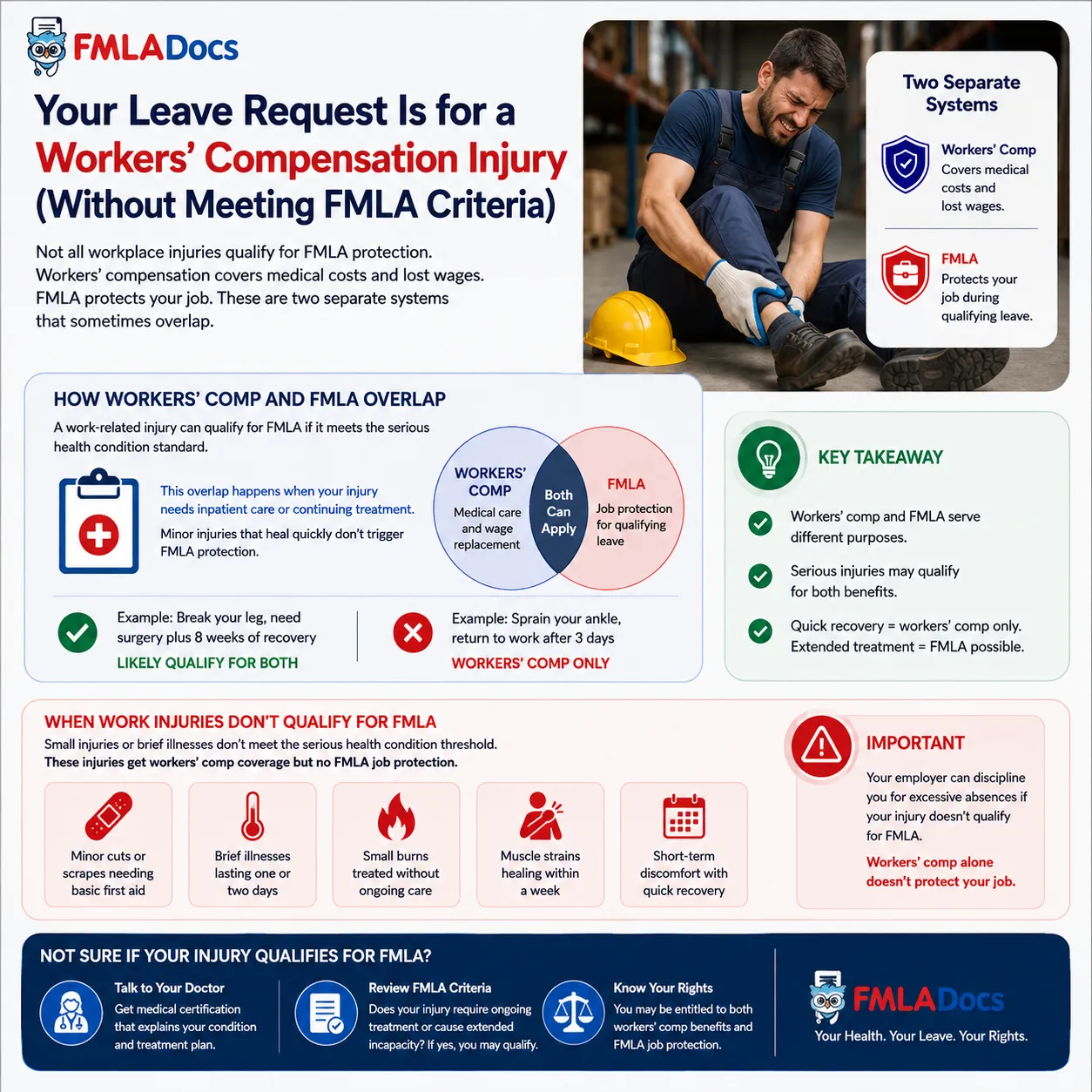
Not all workplace injuries qualify for FMLA protection. Workers’ compensation covers medical costs and lost wages. FMLA protects your job. These are two separate systems that sometimes overlap.
How Workers’ Comp and FMLA Overlap
A work-related injury can qualify for FMLA if it meets the serious health condition standard. According to ADA National Network, this overlap happens when your injury needs inpatient care or continuing treatment. Minor injuries that heal quickly don’t trigger FMLA protection.
If you sprain your ankle and return to work after three days, that’s workers’ comp only. If you break your leg and need surgery plus eight weeks of recovery, you likely qualify for both.
When Work Injuries Don’t Qualify for FMLA
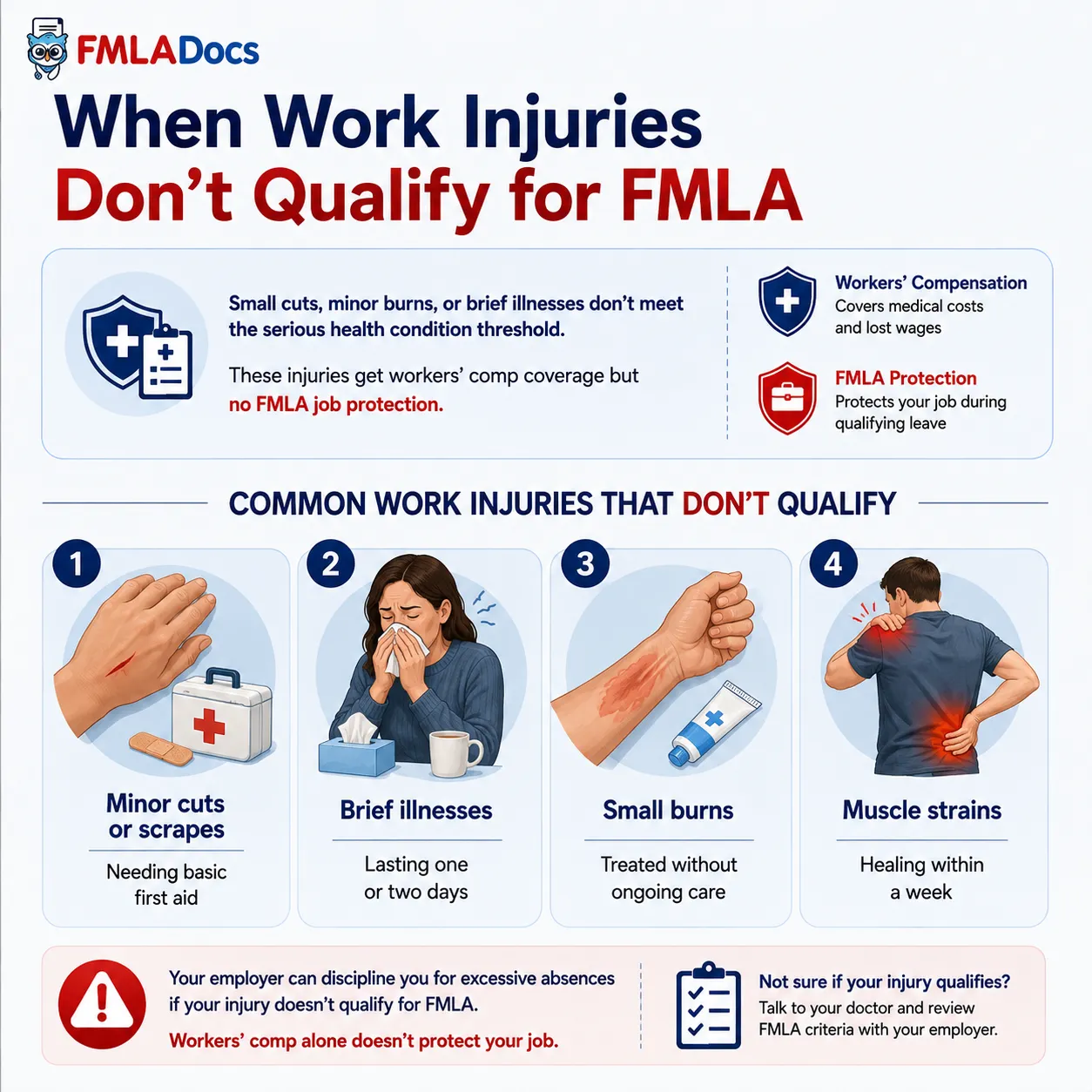
Small cuts, minor burns, or brief illnesses don’t meet the serious health condition threshold. These injuries get workers’ comp coverage but no FMLA job protection.
Common work injuries that don’t qualify:
-
Minor cuts or scrapes needing basic first aid
-
Brief illnesses lasting one or two days
-
Small burns treated without ongoing care
-
Muscle strains healing within a week
Your employer can discipline you for excessive absences if your injury doesn’t qualify for FMLA. Workers’ comp alone doesn’t protect your job.
Running Both Protections Concurrently
Your employer can require you to use FMLA leave at the same time as workers’ comp leave. Both run concurrently. This means your 12-week FMLA clock starts even while you’re on workers’ comp.
Workers’ comp provides wage replacement and medical coverage. FMLA provides job protection. They serve different purposes but often run together for serious workplace injuries.
9. You’re a Key Employee, and Your Absence Would Cause Substantial Economic Injury

This FMLA disqualification reason affects a small group of high earners. Most employees never face this exception. But if you’re in the top 10% of earners at your company, your employer might deny job restoration after leave.
The key employee exception doesn’t stop you from taking leave. It just means your employer isn’t required to give you your job back afterward.
Who Qualifies as a Key Employee
You’re a key employee if you meet two criteria. First, you must be salaried. Hourly workers can’t be classified as key employees, no matter how much they earn.
Second, you must be among the highest-paid 10% of employees within 75 miles of your worksite. This calculation includes all employees at locations within that radius, not just your specific office.
For example, if your employer has 500 employees within 75 miles, you’d need to be in the top 50 earners. The threshold changes based on your company’s size and geographic footprint.
The Substantial Economic Injury Exception
Being a key employee isn’t enough to deny restoration. Your employer must also prove your absence would cause substantial and grievous economic injury to operations.
This standard is narrow. Simple inconvenience doesn’t count. Increased costs don’t count. Needing to hire a temporary replacement doesn’t count. Your employer must show your specific absence would cause serious, long-term financial harm.
In practice, this exception rarely applies. Even executives and high earners usually don’t meet the substantial injury test. Understanding what qualifies for FMLA leave helps you know whether this exception might affect you.
Your Rights If You’re Denied as a Key Employee
Your employer must notify you in writing if they plan to deny restoration based on key employee status. This notice must come as soon as they determine your absence would cause substantial economic injury.
You then have the right to return to work immediately or continue your leave knowing your job isn’t protected. The choice is yours. Many employees choose to take the leave anyway because they need it.
The burden of proof sits with your employer. They must document why your absence specifically causes substantial economic injury. You don’t have to prove you’re not a key employee.
10. You Already Exhausted Your 12 Weeks This Year
Once you’ve used your 12 weeks of FMLA leave, you can’t take more until your leave year resets. This disqualifies you from additional job-protected time off. Many employees don’t track their usage carefully and face denial when they need leave again.
How the 12-Week Entitlement Works
You get 12 weeks (480 hours) of FMLA leave per 12-month period. Once you use all 480 hours, your entitlement is gone. You must wait until your leave year resets to qualify again.
This applies whether you take leave continuously or intermittently. A six-week surgery recovery uses 240 hours. Four separate one-week absences use 160 hours. The total can’t exceed 480 hours in your 12-month period.
When Your Leave Year Resets
Your employer chooses one of four methods to calculate the 12-month period. The calendar year method runs January 1 through December 31. The fixed year method uses any 12-month period like a fiscal year.
The rolling 12 months forward method measures backward from the date you use FMLA leave. The rolling 12 months backward method looks back at the previous 12 months. Each method affects when your entitlement renews.
Ask HR which method your company uses. This tells you exactly when your 12 weeks reset.
Tracking Intermittent Leave Usage
Intermittent leave is tracked by the hour. A four-hour doctor’s appointment uses four hours of your 480-hour entitlement. It doesn’t use a full day or week.
Keep your own records of FMLA time used. Document dates and hours for every absence. Verify your employer’s calculations match your records. Errors happen when tracking intermittent leave across months.
If you’ve exhausted your 12 weeks, other options may exist. State paid family leave, short-term disability, or company leave policies might provide coverage. Check with HR about alternatives before assuming you’re out of options. Understanding which conditions qualify for FMLA protection helps you plan future leave needs once your entitlement resets.
11. You’re Requesting Leave for a Condition That Doesn’t Cause Incapacity
FMLA protects employees who can’t work due to their condition. But having a diagnosis alone doesn’t qualify you. Your condition must actually prevent you from performing your job duties.
This distinction trips up many employees. They assume their regular doctor visits or ongoing treatment automatically qualify them. That’s not how FMLA works.
What ‘Incapacity’ Means Under FMLA
Incapacity means you can’t work, attend school, or perform regular daily activities. Your condition or its treatment must make these tasks impossible.
According to the Department of Labor, this standard applies whether you need continuous leave or intermittent time off. The key is functional limitation, not just medical need.
For example, chemotherapy that causes severe nausea and fatigue qualifies. You can’t perform job functions during treatment and recovery. But routine physical therapy you attend before work doesn’t qualify if you can still work your full shift.
Conditions That Require Treatment But Don’t Prevent Work
Many conditions need ongoing care but don’t cause incapacity. These typically don’t qualify for FMLA:
-
Routine prenatal visits when pregnancy is uncomplicated
-
Physical therapy sessions you can schedule outside work hours
-
Counseling appointments that don’t interfere with job performance
-
Medication management visits when symptoms are controlled
If you can work through your condition with workplace adjustments, you may need ADA accommodations instead. That might mean a modified schedule, ergonomic equipment, or flexible break times.
How to Document Incapacity for Approval
Your medical certification must explain how your condition prevents work. Don’t just list your diagnosis and treatment schedule.
For intermittent leave, your provider should document that episodes cause temporary inability to perform job functions. Include frequency, duration, and specific limitations during episodes.
Strong documentation describes functional impact. Panic attacks that occur twice weekly, last 45-90 minutes, and prevent concentration or customer interaction. Migraines that happen four times monthly, last 12-24 hours, and make screen work impossible.
Vague language like “ongoing treatment needed” or “periodic absences required” gets forms rejected. Be specific about what you can’t do during incapacity periods.
What to Do If You Don’t Qualify for Federal FMLA
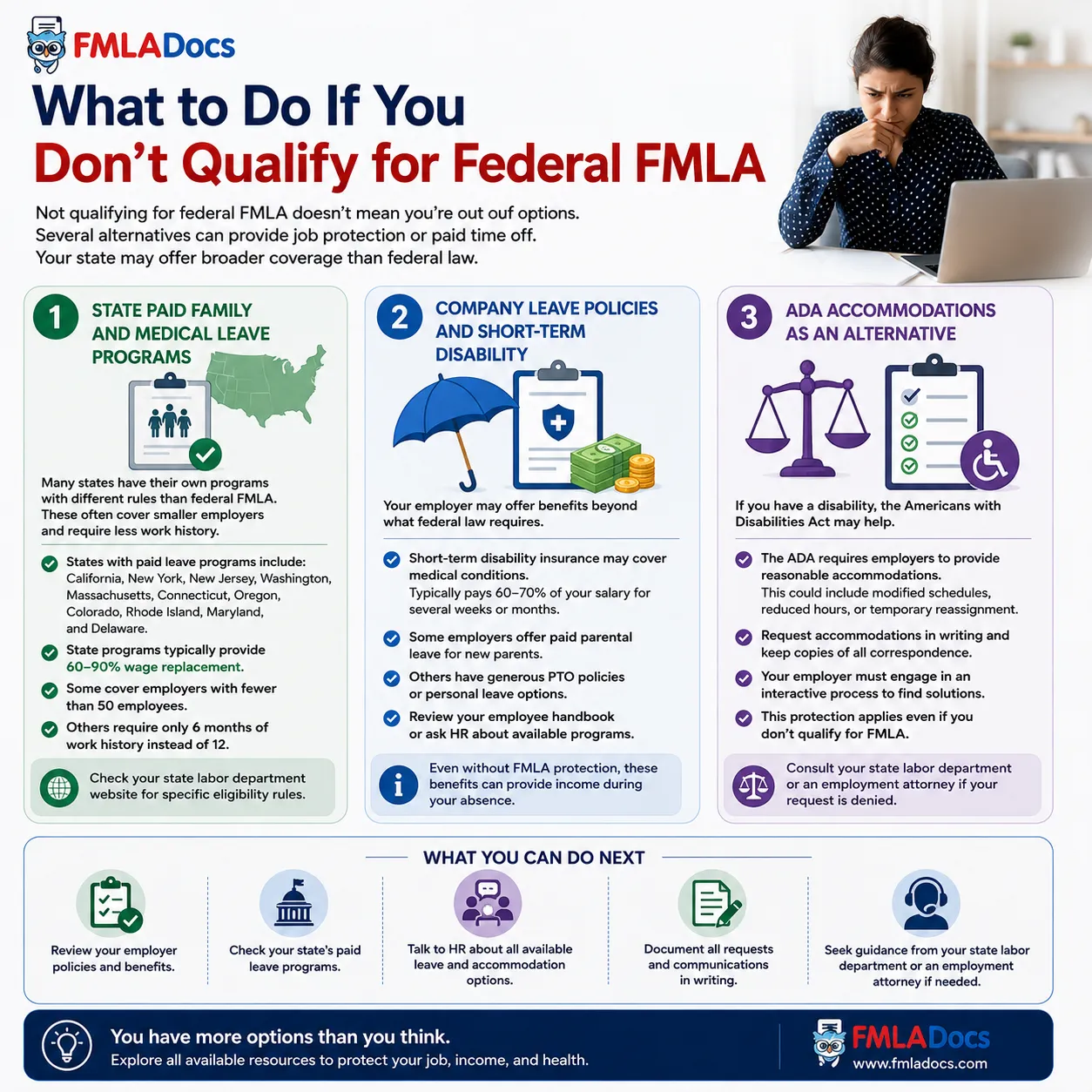
Not qualifying for federal FMLA doesn’t mean you’re out of options. Several alternatives can provide job protection or paid time off. Your state may offer broader coverage than federal law.
Not sure if you qualify? Start Intake →
State Paid Family and Medical Leave Programs
Many states have their own programs with different rules than federal FMLA. These often cover smaller employers and require less work history. According to the National Conference of State Legislatures, California, New York, New Jersey, Washington, Massachusetts, Connecticut, Oregon, Colorado, Rhode Island, Maryland, and Delaware all offer paid family leave programs.
State programs typically provide 60-90% wage replacement. Some cover employers with fewer than 50 employees. Others require only six months of work history instead of 12. Check your state FMLA vs state family leave for specific eligibility rules.
Company Leave Policies and Short-Term Disability
Your employer may offer benefits beyond what federal law requires. Many companies provide short-term disability insurance that covers medical conditions. This typically pays 60-70% of your salary for several weeks or months.
Some employers offer paid parental leave for new parents. Others have generous PTO policies or personal leave options. Review your employee handbook or ask HR about available programs. Even without FMLA protection, these benefits can provide income during your absence.
ADA Accommodations as an Alternative
If you have a disability, the Americans with Disabilities Act may help. The ADA requires employers to provide reasonable accommodations. This could include modified schedules, reduced hours, or temporary reassignment.
Request accommodations in writing and keep copies of all correspondence. Your employer must engage in an interactive process to find solutions. This protection applies even if you don’t qualify for FMLA. Consult your state labor department or an employment attorney if your request is denied.
Conclusion
Knowing what disqualifies you from FMLA helps you plan your next move with confidence. The most common disqualifiers are simple: fewer than 12 months on the job, under 1,250 hours worked, an employer with fewer than 50 employees within 75 miles, or a health condition that doesn’t meet the serious health condition standard. A wrong reason for leave can also disqualify a request.
Falling short of federal FMLA rules doesn’t close every door. State paid leave programs expand coverage in many areas. Company policies often provide more generous terms. Short-term disability can replace income during recovery, and the ADA may protect your job when FMLA doesn’t apply.
Start by checking your employment records. Verify your hours and tenure. Review your state’s paid leave laws. Talk to your healthcare provider about whether your condition meets the serious health condition definition. Don’t assume you’re disqualified without checking every option first.
If you need medical certification completed quickly, FMLADocs connects you with licensed physicians who handle FMLA paperwork daily. Most certifications finish within 24-48 hours, so you won’t miss the 15-day deadline. Understanding what disqualifies you from FMLA now means you can act early, get proper documentation, and protect your job before time runs out.
Frequently Asked Questions
What is the minimum work history required to qualify for FMLA?
You need 12 months of employment with your current employer. You also need 1,250 hours worked in the past 12 months. That's about 24 hours per week. The 12 months don't have to be consecutive. Breaks of seven years or less can count if there was a reasonable expectation you'd return. Part-time workers can qualify if they meet the hours threshold. Check your time records with HR to verify both requirements before applying.
Does my employer's size affect my FMLA eligibility?
Yes. Your employer must have at least 50 employees within 75 miles of your worksite. Small businesses with fewer than 50 workers don't have to offer FMLA. The 75-mile radius matters because it determines your local workforce size. If you work for a small company, federal FMLA won't protect your job. However, your state might offer paid family leave programs with different employer size rules. Check state programs if your employer is too small for federal coverage.
What medical conditions don't qualify for FMLA protection?
Minor illnesses like colds, flu, or routine dental work don't qualify. The condition must be serious and require inpatient care or continuing treatment. Cosmetic procedures that aren't medically necessary won't qualify either. Short-term conditions that resolve quickly typically don't meet the definition. The illness must prevent you from working or require ongoing medical supervision. Chronic conditions that flare up periodically can qualify if they meet specific criteria. Get proper medical documentation that explains why your condition is serious.
Can I use FMLA to care for any family member?
No. FMLA only covers your spouse, children, or parents. You can't use it for siblings, grandparents, in-laws, or friends. The law defines family narrowly. Stepparents and foster parents count if they stood in loco parentis when you were a child. Adult children qualify only if they have a serious health condition and can't care for themselves. Same-sex spouses qualify after the 2015 Supreme Court ruling. Extended family members don't qualify under federal FMLA regardless of your relationship closeness.
How do timing issues disqualify workers from FMLA?
You must request leave within specific timeframes. For planned medical treatment, give 30 days' notice when possible. Emergency situations require notice as soon as practical. Missing these deadlines can result in denial or delay. You also can't use FMLA retroactively for past absences you didn't report properly. If you wait too long to submit paperwork, your employer can deny the request. Document when you notified your employer and when you submitted forms. Late requests give employers grounds to reject otherwise valid claims.
What happens if I worked 11 months but need leave now?
You won't qualify for federal FMLA protection yet. You're one month short of the 12-month requirement. Check whether your state offers paid family leave with shorter tenure rules. California, New York, and other states provide benefits after less time on the job. Ask HR about company leave policies that might cover you. Some employers offer more generous terms than federal law requires. If possible, delay non-emergency leave until you hit the 12-month mark. Document your hire date carefully to track when you'll qualify.
Do part-time employees ever qualify for FMLA?
Yes, if they work enough hours. You need 1,250 hours in the 12 months before your leave request. That averages to about 24 hours per week. Many part-time workers meet this threshold. Track your hours carefully because employers sometimes miscalculate. If you work variable schedules, request your time records from HR. The hours requirement trips up workers who assume only full-time employees qualify. Part-time status alone doesn't disqualify you if you've worked sufficient hours.
What should I do if federal FMLA doesn't cover me?
Look into state paid family leave programs first. Many states offer benefits with different rules than federal FMLA. Check whether your employer has internal leave policies more generous than the law requires. Short-term disability insurance might cover your situation if it's medical. The Americans with Disabilities Act provides different protections that might apply. Document your situation and explore all options before assuming you have no protection. Some workers qualify for state benefits even when federal FMLA doesn't cover them.
Meet the author
Nida Hammad
I am a professional writer with over five years of experience creating clear, engaging, and well-researched content. I specialize in healthcare topics, helping readers understand complex information in simple wording. Currently, I write for FMLA DOC, where I focus on producing accurate and trusted guides for people seeking support with FMLA and medical needs.
Get Your FMLA Certification Online in Minutes