

How to request an FMLA extension (step-by-step)
 by Nida Hammad
 Last updated:
Your 12 weeks of FMLA extension leave are ending, but your recovery isn’t complete. Federal law caps job-protected leave at 12 weeks per year for most situations. When serious health conditions continue beyond that timeline, you need a clear plan. This means new medical certification, early conversations with HR, and coordination with disability benefits. Many employees miss critical deadlines because they wait too long to start the extension process.
This guide shows you exactly how to extend FMLA leave when your condition continues past the initial period. You’ll learn what new documentation your doctor must provide, when to talk to HR about your situation, and how short-term disability and state paid family leave programs work alongside federal protections. We cover the specific forms employers require, realistic approval timelines, and backup options when standard FMLA protections run out. You’ll also see how to coordinate multiple benefit programs so you maintain income and job security during extended recovery.
Don’t wait until your 12 weeks run out to find your next step,start your extended leave plan now with FMLADocs and get ahead of the deadlines that matter most.
Understanding the 12-Week FMLA Baseline and When Your Condition Continues The FMLA Extension Reality
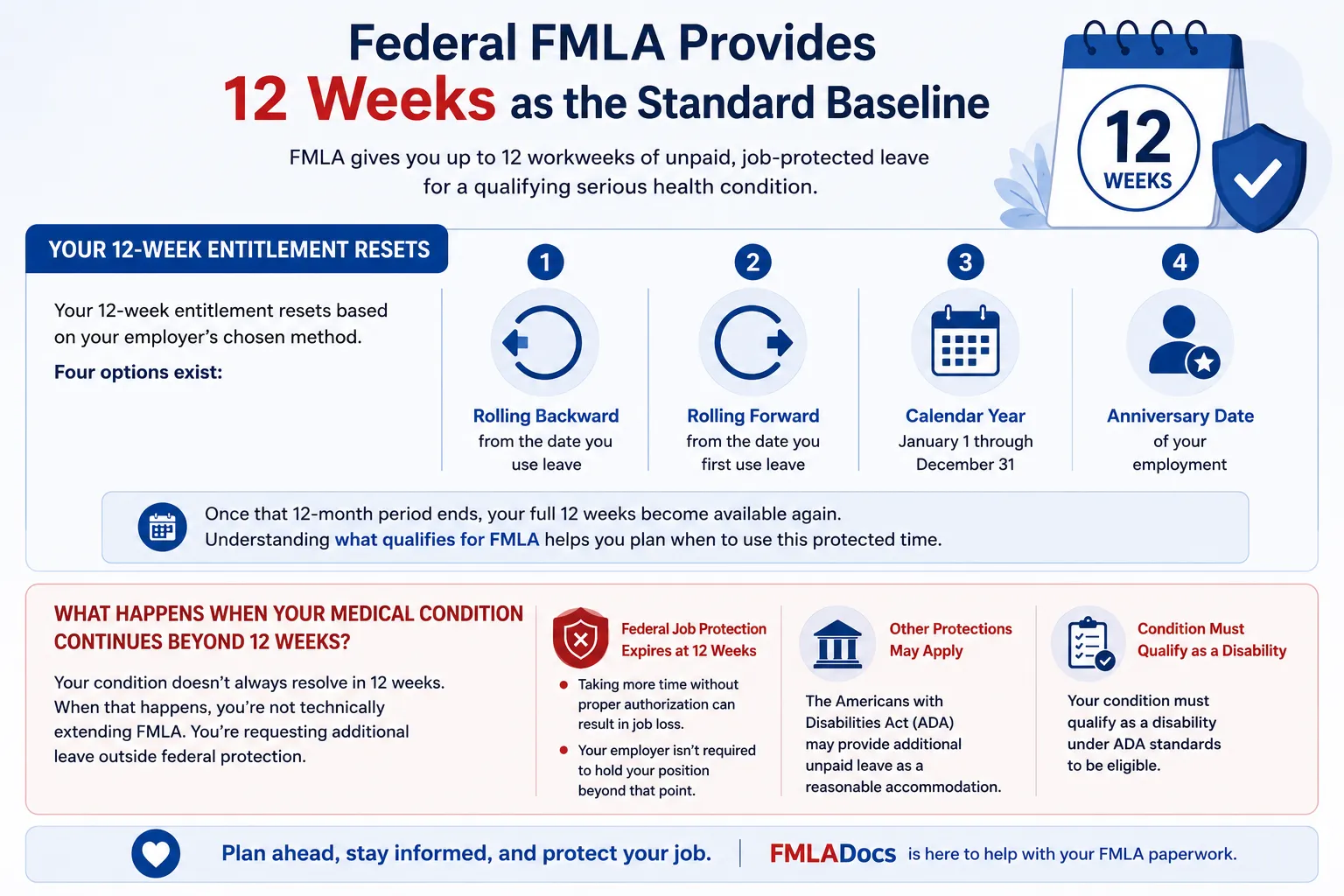
Federal law provides exactly 12 weeks of job-protected leave per year. That’s 480 hours for most qualifying reasons. No automatic fmla extension exists under federal law. This baseline applies to your own serious health condition, caring for family members, bonding with a new child, or military family leave.
One exception breaks this rule. Military caregiver leave allows up to 26 weeks. That’s the only federal extension built into the law.
Federal FMLA Provides 12 Weeks as the Standard Baseline
Your 12-week entitlement resets based on your employer’s chosen method. Four options exist:
-
Rolling backward from the date you use leave
-
Rolling forward from the date you first use leave
-
Calendar year (January 1 through December 31)
-
Anniversary date of your employment
Once that 12-month period ends, your full 12 weeks become available again. Understanding what qualifies for FMLA helps you plan when to use this protected time.
What Happens When Your Medical Condition Continues Beyond 12 Weeks
Your condition doesn’t always resolve in 12 weeks. When that happens, you’re not technically extending FMLA. You’re requesting additional leave outside federal protection.
Federal job protection expires at the 12-week mark. Taking more time without proper authorization can result in job loss. Your employer isn’t required to hold your position beyond that point. serious health condition goes into more depth on this.
That said, other protections may apply. The Americans with Disabilities Act may provide additional unpaid leave as a reasonable accommodation. Your condition must qualify as a disability under ADA standards.
The Difference Between Extension and Additional Leave Types
Some employers offer more generous policies than federal law requires. These company benefits provide additional unpaid or paid time beyond the FMLA baseline. Always check your employee handbook.
Nine states now provide paid family and medical leave programs. California, New York, New Jersey, Washington, Massachusetts, Connecticut, Oregon, Colorado, and Rhode Island offer partial income replacement. These programs can extend your time off when your condition continues.
State disability insurance in California, New York, New Jersey, Rhode Island, and Hawaii covers your own medical conditions. Short-term disability through your employer may also coordinate with FMLA to provide income during leave.
New Medical Certification Required When Your Condition Continues
When you need leave beyond your initial 12-week FMLA period, you must provide new medical certification. Your original forms covered that first timeframe. Extending beyond 12 weeks requires updated documentation showing your current medical status and ongoing treatment needs.
This isn’t just a formality. Your employer needs proof that your condition continues and additional time is medically necessary. Without proper certification, your job protection ends when your initial FMLA period expires.
Why You Need Updated Doctor Forms for Extended Leave
Your first FMLA certification established that you qualified for leave. That approval had a specific end date. Once that date passes, your job protection stops unless you submit new certification.
Many employees assume their employer will automatically extend leave if they’re still unable to work. That’s not how it works. The burden falls on you to request an extension and provide supporting medical documentation.
Understanding the FMLA approval timeline for extension requests helps you plan ahead. Submit your request at least 2-3 weeks before your current leave expires. This gives your employer time to review and make a determination.
What Your Healthcare Provider Must Document
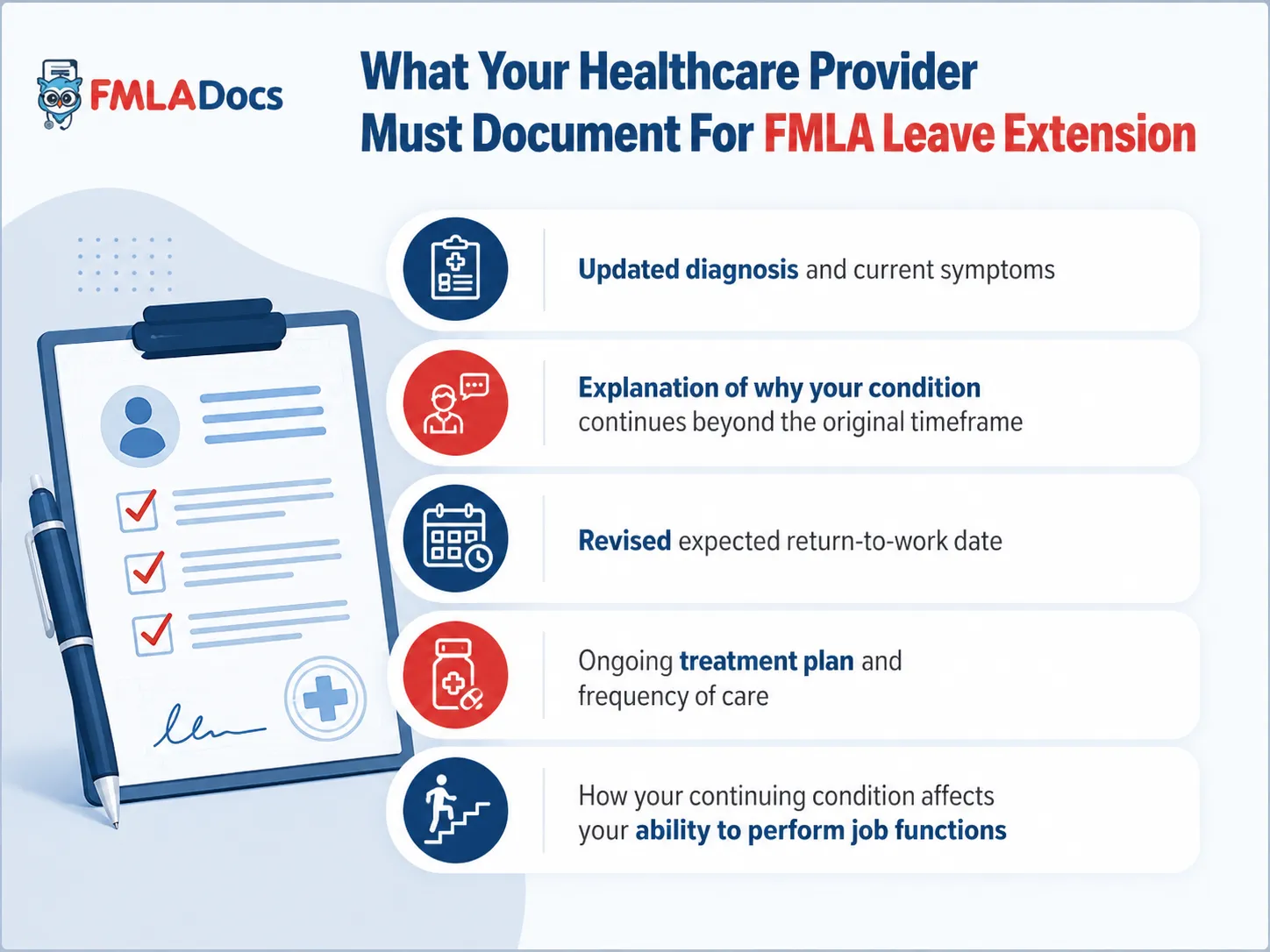
Your doctor must complete updated DOL Form WH-380-E for your own condition or WH-380-F for family member care. These forms require specific clinical details explaining why you can’t return to work as originally anticipated.
The new certification must include:
-
Updated diagnosis and current symptoms
-
Explanation of why your condition continues beyond the original timeframe
-
Revised expected return-to-work date
-
Ongoing treatment plan and frequency of care
-
How your continuing condition affects your ability to perform job functions
Your doctor must provide specific functional limitations. Writing “condition continues” or “still unable to work” without clinical detail will likely result in denial. Vague language doesn’t meet certification requirements.
For post-surgical complications, certification should document what complications occurred. It should explain why recovery is taking longer than typical. It must provide medical basis supporting the extended timeline.
For chronic conditions like severe depression or Crohn’s disease, updated certification should reflect current symptom severity. It should note treatment adjustments. It must explain why you remain unable to work despite ongoing care.
If your healthcare provider can’t see you quickly enough to complete new forms, FMLADocs connects you with licensed physicians who complete FMLA certifications within 24-48 hours. This can prevent gaps in your job protection when timing is tight.
Timeline for Submitting New Certification to Your Employer
Submit new certification at least 2-3 weeks before your current FMLA leave expires. This buffer gives your employer time to review documentation and request clarification if needed. It also protects you from gaps in coverage.
Don’t wait until the last day of your approved leave to start this process. If your certification is incomplete or your doctor needs additional time, you could lose job protection while waiting for corrections.
Start the conversation with your healthcare provider early. Schedule your appointment as soon as you know you’ll need extended leave. Bring the blank DOL forms to your visit so your provider knows exactly what information is required.
If you’re also coordinating other benefits, understanding how FMLA works alongside short-term disability helps you manage multiple programs simultaneously. These benefits often run concurrently but have different documentation requirements.
Timeline for Talking to HR About Extended Leave
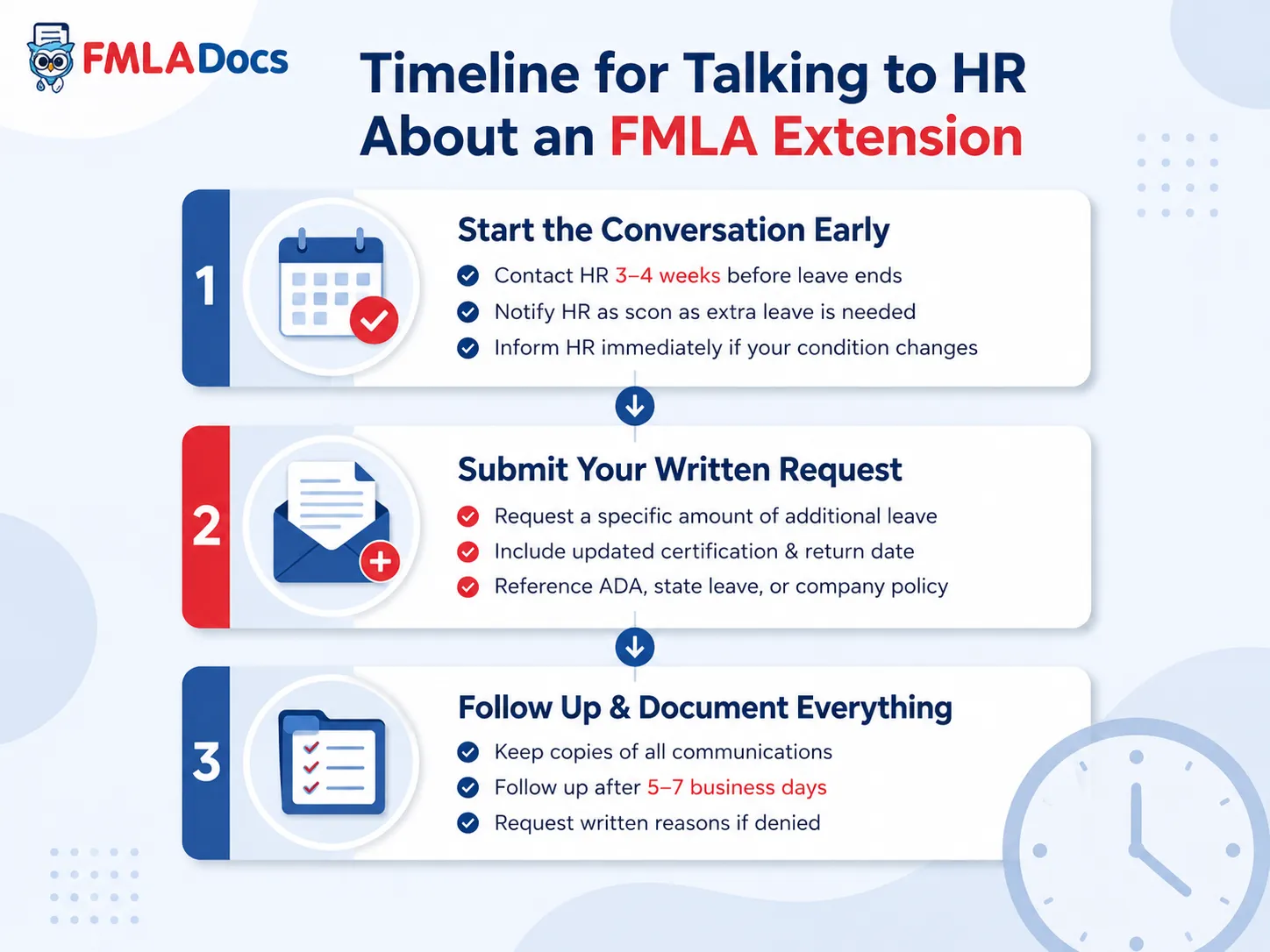
Start talking to HR about your FMLA extension at least three to four weeks before your 12-week period expires. Earlier is better. This gives you time to gather documentation and allows your employer to make decisions. Don’t wait until your last week of leave to mention you need more time. This creates pressure and may result in gaps in job protection.
When to Start the Conversation With Your Employer
Begin the conversation as soon as you know you’ll need additional time. According to the Department of Labor, federal FMLA provides 12 weeks of job-protected leave for qualifying reasons. Once you realize this won’t be enough, contact HR immediately.
The three-to-four-week window isn’t arbitrary. Your doctor needs time to complete new medical certification. HR needs time to review your request and consult with management. You need time to explore other options if your employer denies the extension.
If your condition worsens unexpectedly near the end of your leave, notify HR right away. Even if you can’t provide full documentation yet, starting the conversation protects you. Send an email stating you need to discuss extending your leave beyond the original 12 weeks.
What to Communicate in Your Extension Request
Submit your extension request in writing via email. This creates a documented record. Address it to your HR representative or leave administrator. Include specific details in your request.
State how much additional time you’re requesting. Be specific. Write “four additional weeks” not “more time.” Explain the medical reason your condition continues. Use general terms, not private details. Mention that you’re providing updated medical certification. Include your expected return-to-work date.
Reference any applicable protections beyond federal FMLA. The Job Accommodation Network explains how the Americans with Disabilities Act may provide additional leave protections after your 12-week FMLA period expires. State leave laws or company policies might also support your request.
Request a meeting or phone call if you have a good relationship with your HR representative. Personal communication can help. But always follow up in writing. FMLADocs can help you get the updated medical certification you need quickly, often within 24-48 hours.
Following Up and Documenting All Communications
Keep copies of all written communications in a personal email account. Don’t rely only on work email. Document verbal conversations with date, time, person spoken to, and summary of discussion. This protects you if disputes arise later.
Follow up if you don’t receive a response within five to seven business days. Employers should respond promptly to leave extension requests. Send a polite email asking for a status update on your request.
Understand that your employer isn’t legally required to approve leave beyond 12 weeks under federal FMLA. But they may do so under state law, ADA, or company policy. If your employer denies your extension request, ask for the denial in writing with specific reasons stated. This is important if you need to pursue other options or legal remedies.
Coordinating STD and State PFML Programs With FMLA Extensions
When your FMLA extension runs beyond 12 weeks, other benefits can fill the gap. Short-term disability and state programs provide income and sometimes job protection after federal coverage ends. You need to coordinate these carefully to avoid gaps.
How Short-Term Disability Coordinates With Extended Leave
Short-term disability insurance runs concurrently with FMLA for the first 12 weeks. STD provides income replacement at 60-70% of wages. FMLA provides job protection. You get both at once.
Most STD policies extend 13-26 weeks total. That means income continues after your 12-week FMLA period expires. Your employer can’t guarantee job protection under federal law past 12 weeks. But you still receive disability payments.
When your condition continues past 12 weeks, STD benefits may keep coming. Federal job protection stops. Some employers offer extended leave policies beyond FMLA. Check your employee handbook for company-specific protections.
State Paid Family and Medical Leave Beyond Federal FMLA
Nine states provide paid family and medical leave that extends beyond federal FMLA. According to state paid family leave programs, these benefits include both income replacement and job protection. California offers 8 weeks paid family leave. New York provides 12 weeks at 67% wages.
Other states include New Jersey (12 weeks), Washington (12-16 weeks), Massachusetts (12-20 weeks), Connecticut (12 weeks), Oregon (12 weeks), Colorado (12 weeks), and Rhode Island (4-6 weeks). State programs typically run concurrently with federal FMLA first. Then they provide additional paid time after federal protection expires.
Some states offer job protection beyond federal FMLA too. California provides up to 4 months for pregnancy disability. Oregon offers 12 weeks of state FMLA for smaller employers not covered by federal law.
Applying for Benefits When Your FMLA Period Ends
You must apply separately for state PFML benefits. They don’t activate automatically when FMLA ends. Applications go to your state’s program administrator, not your employer. Each state has different forms and deadlines.
Coordinate timing carefully. Apply for state benefits before your federal FMLA expires. This prevents gaps in income or protection. Most states require 30 days’ notice for foreseeable leave.
Keep documentation of everything. Save all benefit applications, approval notices, and payment records. You may need these if disputes arise about leave duration or job protection. State disability insurance in California, New York, New Jersey, Rhode Island, and Hawaii covers your own medical conditions with partial wage replacement, often extending beyond 12 weeks.
Conclusion
Your FMLA coverage ends at 12 weeks. But your options don’t stop there. You can request additional leave through new medical certification, state programs, disability benefits, or ADA accommodation. The key is starting early and documenting everything in writing.
Talk to HR at least three to four weeks before your leave expires. Provide updated medical certification that explains why your condition continues. Check whether your state offers paid family and medical leave programs. Coordinate with any short-term disability benefits you have. Explore whether ADA reasonable accommodation applies to your situation.
No extension is guaranteed. Each FMLA extension depends on your employer’s policies, your state’s laws, and your medical circumstances. But taking action early gives you the best chance of protecting your job while you recover.
If you need help with new FMLA certification for extension, FMLADocs connects you with licensed physicians who complete your documentation within 24 to 48 hours. Start your extension request today and get the medical certification you need without delays.
Frequently Asked Questions
How many weeks of job-protected leave does federal FMLA actually provide?
Federal law provides exactly 12 weeks of job-protected leave per year. That's 480 hours for most qualifying reasons. No automatic fmla extension exists under federal law. The only exception is military caregiver leave, which allows up to 26 weeks. Once your 12-week entitlement ends, federal job protection expires. Your employer isn't required to hold your position beyond that point. However, your 12-week entitlement resets based on your employer's chosen method, which could be rolling backward, rolling forward, calendar year, or anniversary date.
What happens to my job if my medical condition continues past 12 weeks?
Federal job protection expires at the 12-week mark. Taking more time without proper authorization can result in job loss. You're not technically extending FMLA when you need more time. You're requesting additional leave outside federal protection. That said, other protections may apply. The Americans with Disabilities Act may provide additional unpaid leave as a reasonable accommodation. Your condition must qualify as a disability under ADA standards. Some employers also offer more generous policies than federal law requires through company benefits.
Do I need new medical certification if my condition continues beyond the initial FMLA period?
Yes, you must provide new medical certification when you need leave beyond your initial 12-week FMLA period. Your original forms covered only that first timeframe. The new documentation must come from your doctor and explain why your condition continues. This certification is critical for requesting additional leave outside federal protection. Without proper medical documentation, your employer has no obligation to approve extra time off. Start this process early, before your 12 weeks run out, to avoid missing critical deadlines.
Can state programs provide income or leave beyond the federal 12-week limit?
Yes, nine states now provide paid family and medical leave programs that can extend your time off. California, New York, New Jersey, Washington, Massachusetts, Connecticut, Oregon, Colorado, and Rhode Island offer partial income replacement. State disability insurance in California, New York, New Jersey, Rhode Island, and Hawaii covers your own medical conditions. Short-term disability through your employer may also coordinate with FMLA to provide income during leave. These programs work alongside federal protections and can help you maintain income during extended recovery when your condition continues.
When should I start talking to HR about needing leave beyond 12 weeks?
Start early conversations with HR before your 12 weeks run out. Many employees miss critical deadlines because they wait too long to start the extension process. You need time to gather new medical certification, understand your employer's policies, and coordinate with disability benefits. Waiting until the last minute can result in gaps in coverage or even job loss. Talk to HR as soon as you realize your recovery won't be complete within the standard timeframe. This gives you time to explore backup options and coordinate multiple benefit programs.
How does the 12-week FMLA entitlement reset for the next year?
Your 12-week entitlement resets based on your employer's chosen method. Four options exist: rolling backward from the date you use leave, rolling forward from the date you first use leave, calendar year running January 1 through December 31, or anniversary date of your employment. Once that 12-month period ends, your full 12 weeks become available again. Check with HR to understand which method your employer uses. This helps you plan when to use protected time and when your entitlement renews for future medical needs.
Can I use FMLA leave intermittently instead of all at once?
Yes, when medically necessary, FMLA leave can be taken intermittently or on a reduced schedule (for example, periodic treatments or flare-ups) rather than as one continuous block, though this requires employer notice and often periodic certification.
Will I keep my health insurance while on FMLA leave, and what happens if I need unpaid leave beyond that?
During FMLA leave, your employer must maintain your group health coverage on the same terms as if you were still working, though you're typically responsible for your usual share of premiums. If leave extends beyond FMLA, continued coverage isn't guaranteed under federal law, so you'd want to ask HR about options like COBRA or continuing to pay premiums directly to avoid a coverage gap.
Meet the author
Nida Hammad
I am a professional writer with over five years of experience creating clear, engaging, and well-researched content. I specialize in healthcare topics, helping readers understand complex information in simple wording. Currently, I write for FMLA DOC, where I focus on producing accurate and trusted guides for people seeking support with FMLA and medical needs.
Get Your FMLA Certification Online in Minutes