
Intermittent FMLA Explained: Guidelines, Rules, and How It Works
 by Nida Hammad
 Last updated:
Introduction
If you live with a chronic health condition, care for a seriously ill family member, or need periodic medical treatment, taking long stretches of continuous time off work may not be your reality. You might need a few hours here for a doctor’s appointment, a day there when symptoms flare up, or a modified schedule during treatment. That is exactly what intermittent FMLA is designed to address.
Understanding intermittent FMLA, including what it covers, who qualifies, and what the intermittent FMLA guidelines require, is essential for any employee navigating a serious health condition without wanting to sacrifice their job. This guide breaks down everything you need to know about FMLA intermittent leave, from the legal foundations to the practical steps for requesting and using it.
What Is Intermittent FMLA?
So, what is intermittent FMLA? Intermittent FMLA is a provision under the Family and Medical Leave Act (FMLA) that allows eligible employees to take job-protected leave in separate, non-consecutive blocks of time due to a single qualifying reason. Rather than taking weeks of leave all at once, an employee using intermittent FMLA might take one afternoon off for chemotherapy, miss a Monday due to a migraine, or leave early several times a month for a chronic pain flare-up.
The FMLA provides eligible employees up to 12 workweeks of unpaid, job-protected leave per year, along with continuation of group health benefits during the leave period, as confirmed by the U.S. Department of Labor. Intermittent leave draws from this same 12-week annual entitlement but spreads it out as needed over the course of the year.
Unlike traditional FMLA leave, which is taken in one continuous block, intermittent leave gives employees and their healthcare providers the ability to match leave time to actual medical need. This makes it especially useful for conditions that do not require constant hospitalization but do involve unpredictable or recurring episodes that interfere with work.
Intermittent Leave vs. Reduced Schedule Leave
These two forms of flexible FMLA leave are related but distinct. Intermittent leave means taking separate blocks of time off for the same qualifying reason, such as a few hours every week for dialysis or a day off when a mental health condition causes an acute episode. Reduced schedule leave, on the other hand, means temporarily cutting back work hours across each day or week, such as moving from full-time to part-time status during a recovery period.
Both types are protected under FMLA, and both draw from the same 12-week entitlement. The key difference is structure: intermittent leave is episodic and unpredictable, while reduced schedule leave follows a consistent pattern.
Intermittent FMLA is leave taken in separate blocks or on a reduced schedule for a serious health condition, not only a single continuous leave.
Who Qualifies for Intermittent FMLA?
Eligibility for FMLA intermittent leave follows the same requirements as standard FMLA. To qualify, an employee must meet three key criteria as outlined by the Department of Labor’s FMLA Employer Guide:
Employee Eligibility Requirements
-
12 months of employment: The employee must have worked for the same employer for at least 12 months, though not necessarily consecutively.
-
1,250 hours worked: The employee must have completed at least 1,250 hours of actual work in the 12 months immediately before the leave begins. Paid vacation and sick time do not count toward this total.
-
Employer size and location: The employee must work at a location where the employer has 50 or more employees within a 75-mile radius.
To learn more about general FMLA qualifications, including specific qualifying conditions, visit What Qualifies for FMLA Leave.
Employer Coverage
Not all employers are covered by FMLA. The law applies to all public agencies (federal, state, and local governments) regardless of size, as well as private employers with 50 or more employees during at least 20 workweeks in the current or prior calendar year. Public and private elementary and secondary schools are also covered.
Qualifying Reasons for Intermittent Leave
Intermittent FMLA is available for specific qualifying situations:
-
Your own serious health condition: Chronic conditions such as diabetes, migraines, asthma, anxiety, or depression that require periodic treatment or cause recurring incapacity.
-
Caring for a seriously ill family member: A spouse, child, or parent (not in-laws) with a serious health condition who needs your ongoing care or support.
-
Military caregiver leave: Caring for a covered servicemember with a serious injury or illness, up to 26 weeks in a single 12-month period, as detailed in the DOL Military FMLA Guide.
-
Qualifying military exigency: Addressing specific situations arising from a family member’s active military deployment.
-
Birth or adoption bonding: Only permitted with employer approval for healthy newborns or newly placed children; automatically permitted if the child has a serious health condition.
Not Sure If Your Condition Qualifies for Intermittent FMLA?
FMLADocs connects you with licensed physicians who can review your case and complete your FMLA certification online, typically within 24 hours. No waiting rooms, no delays.
What Conditions Qualify for Intermittent FMLA?
A condition qualifies for intermittent FMLA if it meets the legal definition of a “serious health condition” under FMLA. The most common qualifying categories include:
-
Conditions requiring inpatient care: Any overnight stay in a hospital or medical facility, plus any period of incapacity or subsequent treatment.
-
Conditions causing 3+ days of incapacity with continuing treatment: Periods when you or a family member cannot work, attend school, or perform daily activities for more than three consecutive days, combined with at least two visits to a healthcare provider or a single visit plus follow-up care such as prescription medication.
-
Chronic conditions: Conditions that require at least two visits to a healthcare provider per year and cause occasional periods of incapacity. This category covers many of the most common reasons for intermittent FMLA use.
-
Permanent or long-term conditions under supervision: Conditions that are incurable or require ongoing supervision, such as Alzheimer’s disease, severe stroke, or terminal illness.
-
Conditions requiring multiple treatments: Ongoing treatment for conditions like chemotherapy for cancer, physical therapy after surgery, or dialysis for kidney disease.
Common examples of conditions that qualify for intermittent FMLA include anxiety disorders, depression and PTSD, migraines, rheumatoid arthritis, Crohn’s disease, lupus, chronic back pain, diabetes with complications, heart conditions, cancer treatment side effects, and recovery from surgery. Both physical and mental health conditions are covered.
How Intermittent FMLA Leave Works: The Key Guidelines
Understanding the intermittent FMLA guidelines helps you use your leave correctly and protects your rights.
Leave Increments
Intermittent FMLA can be taken in very small blocks of time. The minimum increment of leave is the shortest period of time the employer uses to account for other forms of leave, typically one hour or less. This means if your employer tracks leave in 15-minute intervals, your intermittent FMLA can be used in 15-minute blocks.
Counting Against the 12-Week Entitlement
Each hour, half-day, or full day of intermittent leave is counted proportionally against your 12-week annual FMLA entitlement. For a typical 40-hour-per-week employee, 12 weeks equals 480 hours of protected leave. Every hour taken under intermittent FMLA reduces the remaining balance.
Notice Requirements
When intermittent leave is foreseeable, such as for scheduled medical appointments or planned treatments, employees must provide 30 days advance notice when possible. When leave is unforeseeable, notice should be given as soon as practicable, generally within one or two business days of learning the need for leave. The DOL’s guidance on talking to your employer about leave explains that you do not need to mention FMLA by name. Providing enough information for your employer to know the absence may be FMLA-qualifying is sufficient.
Medical Certification
To use intermittent FMLA, employees must provide medical certification from a licensed healthcare provider. The certification must establish that the condition qualifies as a serious health condition, that intermittent leave is medically necessary, and should indicate the probable frequency and duration of leave episodes. Employers must allow at least 15 calendar days to obtain the completed certification.
Official FMLA forms are provided by the DOL and include Form WH-380-E (for the employee’s own condition) and Form WH-380-F (for a family member’s condition). These forms guide the healthcare provider in documenting all necessary medical information.
Employer Rights Under Intermittent FMLA
Employers have specific rights when managing intermittent FMLA. According to DOL Fact Sheet 77B on FMLA Protections, while employers are prohibited from interfering with, restraining, or denying the exercise of FMLA rights, they may transfer an employee on intermittent leave to an alternative position with equivalent pay and benefits, provided the new role better accommodates the recurring leave schedule. This transfer is temporary and the employee must be returned to their original or equivalent position upon return from leave.
Employers may also require employees to follow usual and customary call-in procedures for reporting absences, as long as this does not interfere with the employee’s FMLA rights. They may also request recertification of the condition periodically, generally no more often than every 30 days in connection with a leave absence.
How to Request Intermittent FMLA Leave
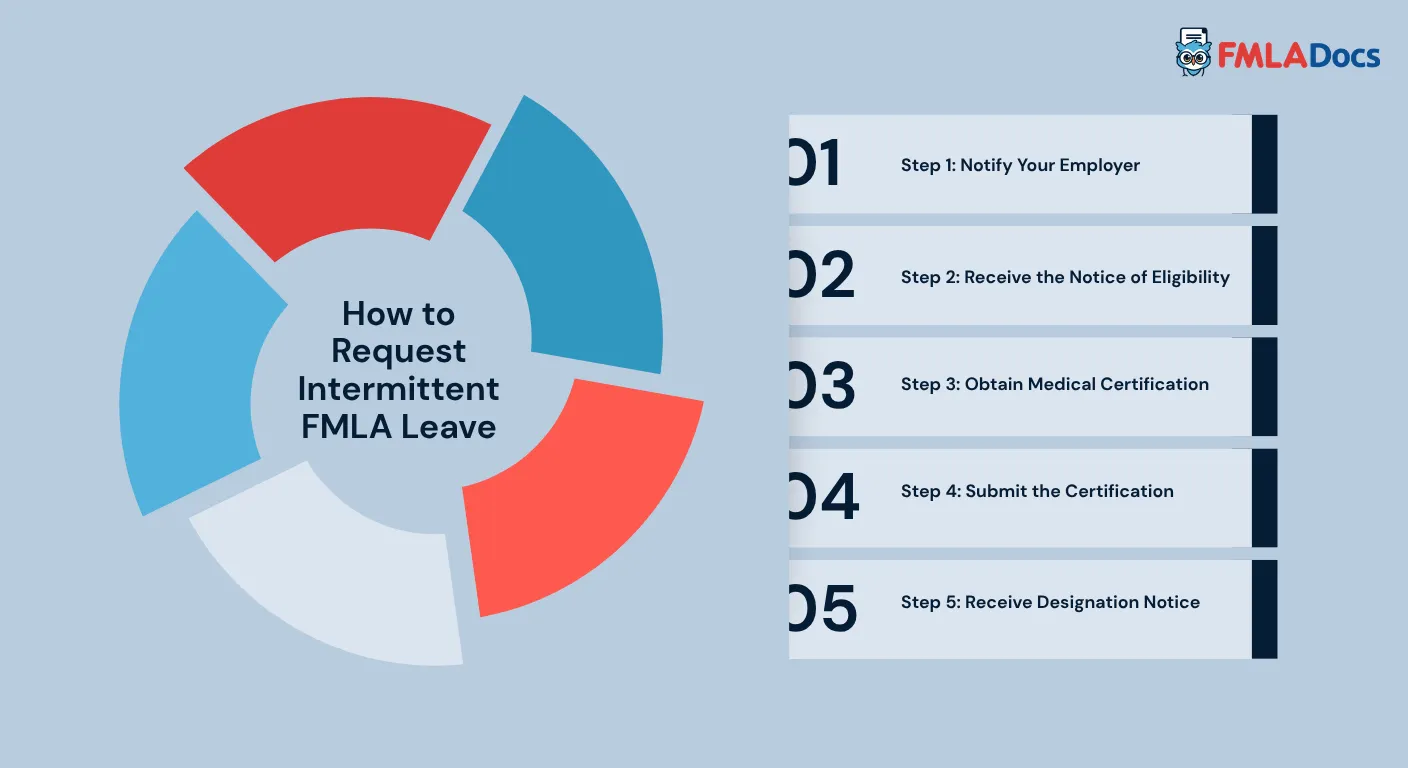
The process for requesting intermittent FMLA involves several steps that both employees and employers must follow correctly.
Step 1: Notify Your Employer
Inform your employer that you need time off for a medical reason and that the absence may qualify for FMLA. You do not need to use the phrase “intermittent FMLA” specifically. Providing enough context for your employer to recognize a potential FMLA situation is enough. For foreseeable leave, give 30 days notice. For unexpected needs, notify as soon as reasonably possible.
Step 2: Receive the Notice of Eligibility
Within five business days of your request, your employer must provide you with a Notice of Eligibility and Rights and Responsibilities (Form WH-381). This form tells you whether you are eligible for FMLA and what documentation you will need to provide.
Step 3: Obtain Medical Certification
Work with your healthcare provider to complete the required medical certification form. The form must confirm the diagnosis meets the serious health condition standard, that intermittent leave is medically necessary, and the likely frequency and duration of your leave episodes.
Step 4: Submit the Certification
Return the completed certification to your employer within 15 calendar days. If additional information is needed, the employer must notify you and allow time to provide a complete and sufficient certification.
Step 5: Receive Designation Notice
Within five business days of receiving the completed certification, your employer must provide a Designation Notice (Form WH-382) indicating whether your leave is approved as FMLA leave. Once designated, your leave is protected under the Act.
Get Your FMLA Certification Without the Hassle
FMLADocs works with licensed physicians who specialize in FMLA documentation. Submit your information online, and your completed, employer-ready certification can be ready within 24 hours.
>> Start Your FMLA Certification Today
Intermittent FMLA From the Employer’s Perspective
While this guide is primarily written for employees, understanding how employers are expected to handle intermittent FMLA can help employees recognize their rights and communicate more effectively with HR.
Employers must track intermittent FMLA usage carefully, notifying employees of how much leave has been used and how much remains. They may use their own internal systems or timekeeping to track leave increments, as long as the tracking method is no less precise than the increment used for other forms of leave. Employers who fail to designate FMLA leave properly or who discipline employees for FMLA-protected absences face significant legal liability under Section 105 of the FMLA.
Employers are also responsible for maintaining group health benefits during FMLA leave under the same terms as if the employee had continued to work, and for restoring the employee to the same or an equivalent position upon return from leave.
Protecting Your Rights Under Intermittent FMLA
Using intermittent FMLA provides strong job protections, but employees should be aware of their rights to fully benefit from the law.
Anti-Retaliation Protections
The FMLA explicitly prohibits employers from retaliating against employees for exercising their rights. This means an employer cannot fire, demote, reduce hours, or otherwise penalize you for taking intermittent FMLA leave. Counting FMLA absences against an employee in an attendance or disciplinary policy is also a violation of the law. If you believe your employer has interfered with your FMLA rights or retaliated against you, you can file a complaint with the Department of Labor’s Wage and Hour Division.
What Your Employer Can and Cannot Do
Employers can request medical certification, require you to follow normal call-in procedures, and temporarily transfer you to a comparable position during recurring intermittent leave. What they cannot do is deny a properly documented intermittent FMLA request, count protected absences against attendance records, or treat FMLA leave as a negative factor in employment decisions such as promotions or performance reviews.
State-Level Protections
Many states have enacted family and medical leave laws that provide broader protections than the federal FMLA. These state laws may extend coverage to smaller employers, expand the definition of qualifying family members, provide paid leave benefits, or offer longer leave periods. If you live in a state with its own family leave law, you may be entitled to additional protections beyond what federal FMLA provides.
Common Mistakes Employees Make With Intermittent FMLA
Even well-intentioned employees sometimes make errors that can jeopardize their FMLA protections.
-
Failing to notify the employer promptly: Not calling in or informing HR as soon as practicable when using unforeseeable intermittent leave can give employers grounds to deny FMLA protection for that absence.
-
Using leave for non-qualifying reasons: Intermittent FMLA only covers absences connected to the specific qualifying condition documented in the certification. Using it for unrelated reasons can constitute abuse and result in denial of leave.
-
Not keeping certification current: Medical certifications may expire. Keeping your documentation up to date ensures continuous protection.
-
Assuming all employers are covered: Employees at smaller companies or those who have not yet completed 12 months of employment should verify eligibility before assuming protection.
-
Not documenting communications: Keeping records of all leave requests, approvals, and related communications can be invaluable if a dispute arises.
Conclusion
Intermittent FMLA is one of the most valuable but often misunderstood provisions in employment law. It exists to ensure that workers managing chronic conditions, serious illnesses, or critical caregiving responsibilities are not forced to choose between their health and their jobs. By understanding the intermittent FMLA guidelines, meeting the eligibility requirements, and properly requesting leave with solid medical documentation, employees can protect their positions and their well-being simultaneously.
If you need help obtaining the medical certification required for intermittent FMLA, platforms like FMLADocs connect you with licensed physicians online who can review your case and complete your documentation quickly. Learn more about how intermittent FMLA works and what conditions qualify to take the next step toward protecting your leave rights.
Frequently Asked Questions
1. Can my employer deny my intermittent FMLA request?
Employers cannot outright deny a legitimate intermittent FMLA request if you meet eligibility requirements and provide proper medical certification. However, they can request additional documentation, require recertification, or ask for clarification if the initial certification is incomplete or raises questions. If you don't meet the basic eligibility criteria (12 months employment, 1,250 hours worked, covered employer), or if the medical certification doesn't demonstrate that intermittent leave is medically necessary, the request can be denied. Employers can also deny requests that lack proper notice or adequate medical justification.
2. How is intermittent FMLA tracked and counted?
Employers track intermittent FMLA in increments no greater than the shortest period they use for other types of leave, provided it's not more than one hour. Only actual time taken counts against your 12-week entitlement. For example, if you normally work 40 hours per week and take 8 hours of intermittent leave, that counts as one-fifth (1/5) of a week. For part-time employees, leave is calculated proportionally based on your regular schedule. Employers must maintain accurate records and cannot charge you for more leave than you actually took. Time you're scheduled off work (weekends, holidays) doesn't count against your FMLA entitlement.
3. Can my employer require me to switch to a different position while on intermittent FMLA?
Yes, but only under specific circumstances and with important protections. For foreseeable intermittent leave (such as planned treatments), employers may temporarily transfer you to an alternative position that better accommodates the intermittent schedule while minimizing business disruption. However, the alternative position must have equivalent pay and benefits, though the duties don't need to be identical. This transfer can only last as long as the intermittent leave is needed. Upon completion of your intermittent leave, you must be restored to your original position or an equivalent one. Employers cannot transfer employees taking unforeseeable intermittent leave, and the transfer cannot be used as a form of punishment or retaliation.
4. What happens if I exceed my 12 weeks of FMLA leave?
Once you've used all 12 weeks (480 hours for a full-time employee) of FMLA leave in a 12-month period, you are no longer entitled to job-protected leave under federal FMLA. However, you may still have options: Some employers offer additional leave as an accommodation under the Americans with Disabilities Act (ADA) if your condition qualifies as a disability. State laws may provide additional leave protections beyond federal FMLA. Your employer's policies might allow for extended medical leave. You can reapply for a new 12-week period once your 12-month eligibility period resets (calculation method varies by employer). It's crucial to communicate with your employer about your situation before exhausting your FMLA entitlement to explore available options.
5. Can I use intermittent FMLA for mental health conditions?
Absolutely. Mental health conditions qualify as serious health conditions under FMLA when they involve inpatient care or continuing treatment by a healthcare provider. Conditions such as depression, anxiety disorders, PTSD, bipolar disorder, and other mental health issues can qualify for intermittent FMLA if they require periodic treatment (therapy sessions, medication management) or cause episodic flare-ups that interfere with your ability to work. Your mental health provider must certify that intermittent leave is medically necessary and complete the same certification form used for physical health conditions. The same protections against discrimination and retaliation apply to mental health-related FMLA leave. Remember that you're not required to disclose specific details about your diagnosis to your employer—only that you have a qualifying condition requiring intermittent leave.
How Does Intermittent FMLA Leave Work?
Intermittent FMLA allows eligible employees to take leave in separate blocks of time rather than continuous weeks. Here's the 5-step process:<br><strong>Verify Eligibility</strong> – Work for a covered employer for 12+ months and 1,250+ hours in the past year<br><strong>Submit Medical Certification</strong> – Provide documentation from healthcare provider showing medical necessity<br><strong>Notify Your Employer</strong> – Give 30 days' notice for foreseeable leave, or as soon as practicable<br><strong>Coordinate Leave Schedule</strong> – Work with employer to minimize business disruption when possible<br><strong>Track Usage</strong> – Monitor your hours used against your 12-week annual entitlement
Meet the author
Nida Hammad
I am a professional writer with over five years of experience creating clear, engaging, and well-researched content. I specialize in healthcare topics, helping readers understand complex information in simple wording. Currently, I write for FMLA DOC, where I focus on producing accurate and trusted guides for people seeking support with FMLA and medical needs.
Get Your FMLA Certification Online in Minutes