

How to Get Your Doctor to Fill Out FMLA Paperwork
 by Anam Moin
 A single incomplete line on your FMLA certification form can delay your leave by weeks or result in denial altogether. Learning how to get your doctor to fill out FMLA paperwork correctly makes the difference between approved leave and administrative limbo.
Most employees don’t realize that getting FMLA paperwork completed isn’t just about handing forms to their doctor. Medical offices handle dozens of administrative requests daily. FMLA certifications require specific medical details that providers must carefully document. Incomplete forms create cascading delays that can jeopardize your job protection.
Many employees face denials not because they don’t qualify, but because their medical certification didn’t meet technical requirements. This guide walks through precisely how to prepare for your appointment, what information your doctor needs to complete the certification correctly, and how to communicate your needs effectively.
You’ll learn what happens after your doctor completes the form, how to handle incomplete or insufficient certifications, and what to do when you face common doctor’s office challenges.
Understanding What FMLA Medical Certification Requires How to Get Your Doctor to Fill Out FMLA Paperwork
When you need FMLA leave, your doctor must complete specific certification forms. These forms prove your medical need for time off. The Department of Labor requires exact information, not vague statements.
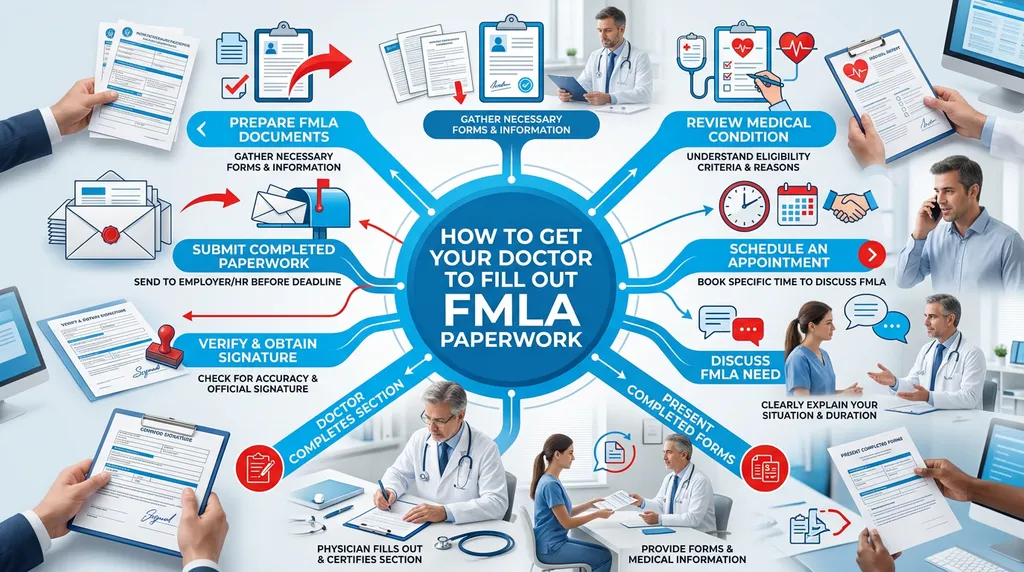
Two main forms exist. Form WH-380-E covers your own health condition. Form WH-380-F applies when you care for a family member. Both demand precise medical details.
Required Information on FMLA Certification Forms
Your healthcare provider must document several key facts. First, they need the condition start date. Next, they estimate how long you’ll need leave.
The form asks if you can work. Your doctor must state yes or no clearly. For intermittent leave, they provide frequency estimates. How often will episodes occur? How long will each last?
-
Condition start date and expected duration
-
Whether you’re unable to perform job functions
-
Frequency and duration of incapacity episodes
-
Whether continuous or intermittent leave needs to be taken
-
Clinical findings supporting the medical necessity
For family care situations, doctors document different details. They confirm the family member needs care. They estimate how often and for how long. Understanding how to fill out FMLA forms correctly prevents delays in approval.
Employers can’t demand a diagnosis. However, providers may include it. The form focuses on functional limitations, not disease names.
Why Doctors Need Specific Medical Details
Healthcare providers must establish medical necessity through clinical evidence. Patient statements alone don’t meet FMLA standards. Your doctor documents objective findings from exams, tests, or medical records.

This requirement protects both you and your employer. It prevents abuse while ensuring legitimate needs get approved. Doctors can’t simply write that you need time off.
They must explain how your condition prevents essential job functions. Can you stand for eight hours? Can you lift 50 pounds? Can you concentrate on complex tasks? The answers require medical judgement based on clinical data.
For family care leave, providers document why you specifically must provide care. They can’t just confirm someone is sick. They explain why professional care isn’t sufficient or why your presence is medically necessary.
Common Certification Mistakes That Cause Delays
Vague responses trigger employer requests for clarification. Writing “as needed” for frequency doesn’t meet sufficiency standards. Your doctor must give specific estimates like “two to three times monthly” or “approximately four hours weekly.”
Incomplete forms missing required fields create automatic delays. Employers must request corrections within seven days. This adds at least a week to your approval timeline.
-
Writing “ongoing” instead of specific duration projections
-
Leaving frequency fields blank or marking “varies”
-
Failing to address essential job function performance
-
Providing only patient-reported symptoms without clinical findings
-
Missing signature or date fields
Ambiguous language causes problems too. Phrases like “may need” or “could require” don’t establish necessity. Your provider must use definitive language. They write “will need” or “requires” based on medical evidence.
According to Department of Labor guidance, insufficient certifications with unclear responses both trigger clarification requests. This process adds seven or more days before your leave gets approved.
Some doctors write general statements about needing rest. This fails FMLA standards. They must connect your condition to specific work limitations. They explain which job duties you can’t perform and why.
Missing these details means your employer can legally deny leave until proper certification arrives. Your doctor gets one chance to correct deficiencies. After that, incomplete forms may result in leave denial.
Preparing for Your Doctor’s Appointment
Getting your doctor to fill out FMLA paperwork starts with proper preparation. Most delays happen because employees show up without the right forms or information. You can avoid this by gathering everything your doctor needs before your visit.
The more organized you are, the faster your doctor can complete the certification. This section covers what to bring, what your doctor needs to know, and what questions to ask.
Documents to Bring to Your Appointment
First, get the correct certification form from your employer’s HR department. Don’t assume your doctor’s office has the right form. They don’t.
If your employer hasn’t provided the form yet, download it from the Department of Labor website. The standard form is WH-381 for your own serious health condition.
For family member care, use form WH-380.
Bring these documents to your appointment:
-
The blank FMLA certification form from your employer
-
Your job description or a written list of your essential job functions
-
Documentation of previous treatments, test results, or specialist reports related to your condition
-
A written summary of your symptoms and how they affect your work
-
Records of any medications you’re currently taking
Also bring your insurance card and photo ID. Some doctor’s offices charge fees for completing FMLA forms. Ask about costs when you schedule.
Information Your Doctor Needs About Your Job
Your doctor can’t complete the form properly without understanding what qualifies for FMLA leave and how your condition affects your work. They need specific details about your job’s physical and mental demands.
Write down your essential job functions before the appointment. Include details like:
-
Physical requirements: lifting, standing, walking, sitting duration
-
Mental demands: concentration needs, stress levels, decision-making responsibilities
-
Schedule requirements: shift work, overtime, on-call duties
-
Environmental factors: temperature extremes, noise levels, exposure to chemicals
If you’re requesting intermittent leave, document specific examples. Show when symptoms prevent you from working or require medical appointments. Include dates, frequency, and duration of episodes.
For example, if you have migraines that occur twice weekly and last 8-12 hours, write that down. If anxiety attacks happen unpredictably but average three times per month, document that pattern.
Questions to Ask Before the Appointment
Call your doctor’s office at least three days before your appointment. Confirm they complete FMLA forms and understand the process.
Ask these questions when you call:
-
Do you complete FMLA certification forms?
-
How long does processing typically take? (Some offices need 5-10 business days)
-
Is there a fee for completing the form?
-
Should I bring the form to my appointment or mail it afterward?
-
Will I need a follow-up appointment to pick up the completed form?
Some practices require you to leave the form and pick it up later. Others complete it during your visit. Know the process so you can plan accordingly.
Also ask if your doctor needs any additional medical records transferred from specialists. If you’ve seen other providers for this condition, authorize those records in advance. This prevents delays if your doctor needs supporting documentation.
Finally, confirm your appointment time and arrive 15 minutes early. Bring everything on your checklist. The more prepared you are, the smoother the process goes.
How to Communicate Your FMLA Needs to Your Doctor
Clear communication with your doctor makes the difference between smooth FMLA approval and frustrating delays. You need to explain your situation in specific, concrete terms that help your doctor complete the medical certification accurately.
Vague statements about needing time off won’t give your doctor enough information to document your case properly.
Start by being direct about why you’re there. Don’t assume your doctor knows you need FMLA paperwork just because you mentioned work stress or family obligations.
Explaining Why You Need FMLA Leave
Tell your doctor explicitly: “I need FMLA certification because my condition prevents me from performing my job duties.” This direct statement frames the conversation around functional limitations, not just symptoms. Your doctor needs to understand the connection between your medical condition and your ability to work.
Explain what FMLA is if your doctor seems unfamiliar with the process. Many doctors understand the general concept but may not know the specific documentation requirements. You can mention that you need medical certification to protect your job while you take leave.
Bring your FMLA paperwork to the appointment. Hand it to your doctor and point out the sections that require medical information. This saves time and shows you’re prepared. The form asks specific questions about your condition’s impact on work functions.
For family care situations, describe the care activities you provide. Say something like: “My mother needs assistance with medication management, transportation to chemotherapy appointments twice weekly, and monitoring for treatment side effects.”
This level of detail helps your doctor understand why your presence is medically necessary.
Describing How Your Condition Affects Work
Use concrete examples that show functional limitations.
Don’t say “I get bad headaches.” Instead say: “My migraines bring severe light sensitivity and nausea that stop me from using my computer or going to meetings.” Being this clear helps your doctor write down how your symptoms block your work tasks.

Think about your actual work tasks before the appointment. What can’t you do when symptoms flare? If you work in retail, maybe you can’t stand for extended periods. If you work at a desk, maybe you can’t concentrate or type accurately. Connect symptoms directly to job requirements.
Don’t minimize what you’re experiencing. Doctors can only certify based on what you report and what medical evidence supports. If you downplay symptoms to seem tough or avoid complaining, your doctor may not grasp the severity. Be honest about your worst days, not just your best ones.
Many people struggle with understanding what documentation their doctor needs, including whether a doctor’s note for FMLA is sufficient or if formal certification requires them.
The FMLA certification form requires more detail than a standard doctor’s note. Your doctor needs to address specific functional limitations and expected duration.
Discussing Intermittent vs. Continuous Leave Needs
If you need intermittent leave, explain the unpredictable nature clearly. Say: “My condition causes flare-ups about 2-3 times monthly, lasting 1-2 days each time.” Give your doctor frequency and duration estimates based on your actual experience over recent months.
Describe what happens during flare-ups. Do you need to leave work suddenly? Do you know the night before that you won’t be able to work the next day? This information helps your doctor document the pattern and medical necessity of intermittent leave.
For continuous leave, explain how long you expect to need off work. If you’re having surgery, mention the procedure and typical recovery time. If you’re caring for a family member, explain the treatment timeline or ongoing care needs.
Ask your doctor to be as specific as possible with frequency and duration estimates. Vague responses like “as needed” or “occasional” will trigger employer follow-up requests for clarification. Specific numbers like “2-4 days per month” or “12 weeks continuous” make the certification complete and sufficient.
Bring documentation that supports your timeline. Medical appointment schedules, treatment plans, or hospital discharge papers help your doctor provide accurate estimates. This preparation makes the certification process faster and more accurate.
What Happens After Your Doctor Completes the Form
Once your doctor finishes the FMLA paperwork, your responsibilities shift to verification and submission. You can’t assume everything is correct just because a medical professional signed it. Missing details or vague responses can delay approval or trigger requests for more information.
Reviewing the Completed Certification
Check the form before you leave the office. Look for blank sections or incomplete answers. Employers can reject certifications that don’t include all required information.
Focus on these areas:
-
Frequency estimates for intermittent leave (such as “2-3 episodes per month lasting 1-2 days each”)
-
Duration projections showing when you expect to return
-
Specific medical facts supporting your need for leave
-
Doctor’s contact information and signature with date
Vague responses like “as needed” or “ongoing” don’t meet FMLA standards. Ask your doctor to add specific timeframes if responses seem unclear. This prevents back-and-forth requests from your employer later.
Submitting Certification to Your Employer
You have 15 calendar days from your employer’s request to submit the completed form. Late submission can result in denial of FMLA protection for absences after the deadline.
The FMLA approval timeline starts when your employer receives complete documentation.
Make copies before you submit anything. Keep the blank form you provided, the completed certification, and proof of submission with date stamps. Send the form through a method that provides delivery confirmation.
If you submit by mail, use certified mail with return receipt. For email submissions, request a read receipt. Hand delivery works too, but get a signed acknowledgment showing the date received.
Employer Review and Potential Follow-Up
Your employer has five business days after receiving complete certification to provide designation notice. This confirms whether they approve your leave as FMLA-protected. They can’t take longer without violating federal requirements.
If your employer requests clarification or additional information, they must specify exactly what’s needed in writing. You then have at least seven days to provide corrections. They can’t ask for new information beyond what the original certification requires.
Common follow-up requests include:
-
Clarification of handwriting or unclear responses
-
Authentication confirming your doctor completed the form
-
Correction of incomplete sections you missed during initial review
Your employer can contact your doctor only for authentication or clarification. They can’t request additional medical details beyond what’s on the form. Only HR professionals or leave administrators can make this contact, never your direct supervisor.
Handling Incomplete or Insufficient Certifications
Incomplete certifications have blank required fields. Insufficient certifications have vague, ambiguous, or non-responsive answers. Both require fixing, but you must get a chance to correct any problems. Your employer can’t deny leave without first allowing you to fix the problem.
Understanding the difference between these two types helps you respond correctly. Incomplete means missing information. Insufficient means unclear or inadequate responses.
Common Reasons Employers Reject Certifications
Employers reject certifications for specific reasons. According to the certification content regulations, common insufficiency issues include:
-
No specific frequency estimates for intermittent leave
-
Missing duration projections for the condition
-
Failure to address essential job functions
-
Unclear medical necessity statements
-
Vague descriptions of symptoms or limitations
Your doctor might write “patient needs time off as needed” without specifying how often. That’s insufficient. Employers need concrete estimates to plan coverage and track leave usage.
Missing duration projections create similar problems. Your certification should state how long the condition will last. Without this, employers can’t determine if leave extends beyond FMLA protection periods.
Essential job function issues arise when certifications don’t explain how your condition affects work duties. Your doctor must address whether you can perform specific tasks your employer lists on the form.
Working With Your Doctor to Correct Deficiencies
Contact your doctor’s office immediately when they request clarification. Explain what specific information the employer needs. Provide any additional context about your job duties that might help your doctor complete the form accurately.
Bring the employer’s written notice to your appointment. This shows your doctor exactly what’s missing or unclear. Don’t try to interpret the request yourself.
Give your doctor details about your work schedule and physical requirements. If you need intermittent leave, explain your typical work pattern. This helps your doctor provide realistic frequency estimates.
Ask your doctor’s office about their timeline for completing corrections. Most offices can turn around clarifications within a few days. If delays occur, document all attempts to obtain information.
Some doctors resist providing detailed information due to privacy concerns. Explain that FMLA certification is a legal requirement for job protection. Your doctor can provide necessary medical facts without disclosing your full medical history.
Your Rights During the Clarification Process
When employers request clarification, they must provide written notice stating exactly what additional information is needed. They must give you at least seven calendar days to respond. This timeline starts when you receive the notice.
Your employer’s HR department may contact your doctor directly for clarification. However, they can only seek to understand existing responses. They cannot request new medical information beyond what’s already on the form.
Only HR professionals, leave administrators, or management officials can contact your doctor. Your direct supervisor cannot make these calls. This protects your medical privacy and prevents inappropriate pressure.
If your doctor’s office is unresponsive or refuses to provide clarification, document all attempts to obtain information. Keep records of phone calls, emails, and office visits. Communicate delays to your employer in writing immediately.
You have the right to FMLA protection during the clarification period. Your employer cannot deny leave while you’re working to correct deficiencies. The leave remains protected until you fail to provide complete certification after reasonable opportunities.
If you ultimately cannot get your doctor to complete the form properly, consider seeking help from another healthcare provider. You’re not locked into one doctor for FMLA certification purposes.
Special Considerations for Different Types of FMLA Leave
Not all FMLA leave requests follow the same certification path. The type of leave you need changes what your doctor must document. Understanding these differences helps you get complete paperwork the first time.
Certification for Intermittent Leave Requests
Intermittent leave certifications require more detail than continuous leave forms. Your doctor must establish medical necessity for episodic absences. They need to provide frequency and duration estimates.
The unpredictable nature of flare-ups matters here. Your provider should document how often episodes occur. They should explain how long each episode typically lasts.
For scheduled treatment requirements, the approach differs slightly. Your doctor outlines the treatment schedule. They estimate how much time each appointment requires. This includes travel time and recovery periods after procedures.
Many employees struggle with intermittent FMLA certification requirements because providers don’t include enough specificity. Vague statements like “as needed” don’t meet certification standards. Your doctor should write “approximately 2-3 episodes per month, lasting 1-2 days each.”
Certification for Family Member Care
Caring for a family member requires different documentation than your own health condition. The certification must state that care is needed. It must estimate how often you’ll provide that care.
Simply stating a family member has a serious health condition isn’t sufficient. Your family member’s doctor must explain why your presence is medically necessary. They should describe what type of care you’ll provide.
Frequency and duration estimates become critical here. The provider should specify how many hours per week you need to give care. They should indicate how long this care arrangement will continue.
For example, if your parent needs help after surgery, the certification should state you’ll provide transportation to appointments twice weekly and assist with daily activities for six weeks. That level of detail protects your leave.
Certification for Chronic Conditions
Chronic conditions like diabetes, asthma, and migraines follow special rules. The certification must document that the condition requires periodic healthcare provider visits. These visits must occur at least twice yearly.
Your doctor must also show the condition causes recurring incapacity episodes. These episodes prevent you from working or performing daily activities. The certification should describe how often these episodes happen.
Pregnancy-related certifications need careful attention too. They should address specific complications or incapacity. Routine prenatal care alone doesn’t establish serious health condition status. Your provider must document conditions like severe morning sickness, gestational diabetes, or bed rest requirements.
Mental health condition certifications require the same specificity as physical conditions. Providers must document functional limitations. They must outline treatment requirements and frequency. A certification stating “depression” without explaining how it limits your work capacity won’t pass review.
For conditions requiring multiple treatments, the timeline matters. Surgery recovery certifications should outline the entire treatment schedule. Chemotherapy certifications should include the number of cycles planned. Each should provide expected recovery timelines between treatments.
Dealing With Common Doctor’s Office Challenges
Getting your doctor to fill out FMLA paperwork isn’t always smooth. You might face fees, delays, or outright refusals. These challenges are common, but you can handle them with the right approach.
When Your Doctor’s Office Charges Fees
Doctors can charge reasonable fees for completing FMLA paperwork. This is legal under federal law. Most offices charge between $25 and $75 for form completion.
You’re responsible for paying these fees upfront. Some insurance plans cover administrative costs, so check your policy. Your employer might also reimburse you, though they’re not required to do so.
-
Ask about fees when you request the forms
-
Get a receipt for potential reimbursement
-
Check if your insurance covers administrative paperwork
-
Budget for this cost when planning your leave
Don’t let fees stop you from getting the certification you need. The cost is small compared to losing FMLA protection.
Handling Long Processing Times
Medical offices often take 5-10 business days to complete FMLA forms. They handle heavy administrative workloads beyond patient care. Your request joins a queue with other paperwork.
According to the Department of Labor, you have 15 calendar days to return completed certification to your employer. If your deadline approaches, request expedited processing from your doctor’s office.
Many offices offer rush services for additional fees. Ask if this option exists. The extra cost might save your job protection.
-
Submit forms immediately after your appointment
-
Call to confirm receipt within 2-3 days
-
Follow up at the one-week mark if you haven’t heard back
-
Explain your deadline clearly to office staff
-
Offer to pay rush fees if time is tight
Document every interaction. Write down dates, names, and what you discussed. This record protects you if delays cause problems.
What to Do If Your Doctor Refuses to Complete Forms
Some doctors refuse to complete FMLA certification. This creates a serious problem for your leave request. Start by asking why they won’t certify.
Common reasons include:
-
They don’t believe your condition qualifies under FMLA
-
They lack sufficient information about your treatment history
-
Office policy prohibits certain types of certification
-
They need additional medical records or test results
Ask what information would change their decision. You might need to provide specialist consultations, recent test results, or detailed treatment records. These documents help your doctor understand the full scope of your condition.
If your doctor still won’t certify, you have the right to seek a second opinion. Choose a provider familiar with your condition and treatment history. Bring complete medical records to your appointment.
Document all communication attempts with your doctor’s office. Record dates, who you spoke with, and reasons given for refusal. This documentation matters if you need to explain delays to your employer or file a complaint.
Consider whether your condition truly meets FMLA requirements. Not every health issue qualifies as a serious health condition. Review the criteria honestly before pursuing other providers.
Recertification and Ongoing FMLA Documentation
Your FMLA leave doesn’t always end after the first certification. Many conditions need ongoing care. That means more paperwork. Employers can ask for updated medical forms. They can’t do it whenever they want, though. Federal rules set clear limits on timing.
Understanding these rules helps you stay protected. You’ll know when to expect requests. You’ll be ready with the right documents. This keeps your job protection intact throughout your treatment.
When Employers Can Request Recertification
Employers can request recertification, but timing matters. According to the Triage Cancer Foundation, they can’t ask more often than every 30 days. That’s the standard rule for most ongoing conditions.
However, your initial certification changes this timeline. If your doctor stated a minimum duration over 30 days, your employer must wait. They can’t request recertification until that period expires. This protects you from constant paperwork during stable treatment phases.
For longer conditions, different rules apply:
-
Conditions lasting six months or more: recertification only every six months
-
Requests must connect to an actual absence from work
-
Employers can’t ask just because time passed
Your employer can request earlier recertification in specific situations. These include when you ask to extend your leave beyond what they certified. They can also ask if your circumstances change significantly. If they receive information questioning your absence reasons, that’s another trigger.
One more scenario allows earlier requests. Your employer can provide attendance records showing your FMLA absence patterns. They can ask your doctor to confirm the condition matches those patterns. This helps verify consistency between your certification and actual leave usage.
Preparing for Recertification Appointments
Recertification appointments are simpler than initial visits. You don’t need to explain everything from scratch. Your doctor already knows your case. You’re just updating the record.
Bring the recertification form your employer provided. Make sure it’s the right form. Some employers use DOL forms. Others create their own. Either way, you need the specific document they sent.
Update your doctor on any changes since your last visit. This includes:
-
New symptoms or worsening conditions
-
Changes in your treatment plan or medications
-
Different work restrictions you now need
-
Any improvements in your condition
Your doctor needs to confirm your ongoing need for leave. They’ll review how your condition affects your work ability. They’ll document whether you still can’t do your job. This confirmation keeps your FMLA protection active.
The process usually takes less time than initial certification. Your doctor has your medical history. They know your treatment plan. They just need to verify things haven’t changed or document what has.
Annual Certification Requirements
When your leave needs span multiple years, new rules kick in. Your employer can request fresh certification at the start of each new 12-month period. This isn’t technically recertification. It’s a new certification for a new leave year.
This distinction matters for your rights. With new certifications, employers can request second opinions. They can also ask for third opinions if needed. These options aren’t available for standard recertifications. The new leave year resets these verification rights.
Keep your doctor informed throughout your treatment. Tell them about significant changes right away. This includes:
-
Major shifts in your symptoms or pain levels
-
New diagnoses related to your condition
-
Changes in your ability to do specific work tasks
-
Modifications to your treatment approach
Proactive communication prevents certification problems. Your doctor can document changes as they happen. This makes annual certifications smoother. It also helps if your employer questions your leave patterns.
Track your own leave usage throughout the year. Know when your 12-month period ends. Expect a new certification request when the new period starts. Preparing reduces stress and delays.
Conclusion
Getting your doctor to fill out FMLA paperwork doesn’t have to be stressful. You now know what medical certification requires and how to prepare for your appointment. You understand how to communicate your needs clearly and what happens after submission. You can handle incomplete certifications and manage recertification when needed.
Start by requesting the correct FMLA certification form from your employer today. Schedule your doctor’s appointment right away. Medical offices need 5-10 business days to complete forms. You have only 15 days to submit certification after your employer’s request.
Bring your job description and explain how your condition affects your work duties. Review the completed form before you submit it. Keep copies of everything. Respond quickly if your employer asks for clarification.
The key to success is preparation and clear communication. When you know how to get your doctor to fill out FMLA paperwork correctly, you can better protect your leave rights and avoid unnecessary delays.
If you need help completing your documentation, get your FMLA certification online through FMLADocs and connect with licensed healthcare professionals familiar with FMLA medical certification requirements.
Frequently Asked Questions
What specific medical details must my doctor include on FMLA certification forms?
Your doctor must document the condition start date and expected duration. They need to state whether you can perform job functions. For intermittent leave, they provide frequency estimates for episodes. The form requires clinical findings that support medical necessity. Your provider must explain how your condition prevents essential job tasks like standing, lifting, or concentrating. They can't write vague responses like 'as needed.' Instead, they give specific estimates such as frequency per week and duration per episode. The certification focuses on functional limitations backed by exam results, tests, or medical records rather than just patient statements.
How do I prepare for my doctor's appointment to get FMLA paperwork completed correctly?
Bring your employer's FMLA certification form to the appointment. Explain your job duties in detail so your doctor understands what functions you can't perform. Provide information about physical requirements like standing duration, lifting weight, or concentration needs. If you need intermittent leave, describe how often episodes occur and how long they last. Medical offices handle dozens of administrative requests daily, so arrive prepared with all necessary details. Schedule enough appointment time for your doctor to review and complete the form. Bring any relevant medical records or test results that support your need for leave. Clear communication about your work requirements helps your doctor document the right information.
Can my employer demand to know my specific diagnosis on FMLA forms?
No, employers can't demand a diagnosis on FMLA certification forms. The forms focus on functional limitations, not disease names. Your doctor may choose to include a diagnosis, but it's not required. The Department of Labor requires information about how your condition affects job performance instead. Your provider documents whether you can stand for eight hours, lift specific weights, or concentrate on complex tasks. They explain medical necessity through clinical findings from exams and tests. This approach protects your privacy while proving legitimate need for leave. The certification establishes that you can't perform essential functions without revealing your specific medical condition.
What happens if my doctor writes vague responses on the FMLA certification?
Vague responses trigger employer requests for clarification, which delays your leave approval. Writing 'as needed' for frequency doesn't meet sufficiency standards. Your employer can reject incomplete certifications and request additional information. This creates cascading delays that can jeopardize your job protection. Many employees face denials not because they don't qualify, but because their medical certification didn't meet technical requirements. Your doctor must give specific estimates instead of general statements. A single incomplete line can delay your leave by weeks or result in denial altogether. If the certification lacks required details, you'll need to return to your doctor for corrections, losing valuable time.
How does FMLA certification differ when I need to care for a family member?
Form WH-380-F applies when you care for a family member instead of yourself. Your doctor documents different details for family care situations. They confirm the family member needs care and can't care for themselves. The provider estimates how often and for how long you must provide care. They explain why you specifically must provide care rather than professional caregivers. Your doctor can't just confirm someone is sick. They must document why your presence is medically necessary for the family member's treatment or recovery. The certification shows that professional care isn't sufficient or that your involvement is required for medical reasons. This prevents abuse while ensuring legitimate family care needs get approved.
Why do doctors need clinical evidence instead of just my description of symptoms?
Patient statements alone don't meet FMLA standards for medical certification. Healthcare providers must establish medical necessity through clinical evidence from exams, tests, or medical records. This requirement protects both you and your employer from abuse of the system. Your doctor can't simply write that you need time off based on what you tell them. They must document objective findings that support functional limitations. Medical judgment must be based on clinical data, not just reported symptoms. This ensures legitimate needs get approved while preventing fraudulent claims. The certification requires professional medical assessment of your ability to perform job functions. Your doctor's clinical findings carry legal weight that patient descriptions don't provide.
Meet the author
Anam Moin
I'm Anam Moin, and my work at FMLADocs focuses on workplace leave and FMLA education. I cover certification, documentation, employee rights, and leave-related questions to provide readers with useful information when they need it most.
Get Your FMLA Certification Online in Minutes