

Washington FMLA laws: Eligibility, Benefits, and Employee Protections
 by Nida Hammad
Last updated:
Washington FMLA laws work differently than most states because Washington adds paid benefits on top of federal protections. Federal FMLA gives you 12 weeks of unpaid, job-protected leave. Washington’s Paid Family and Medical Leave program pays you during that time off. Most workers in the state qualify for this paid leave, including part-time staff and people working for small businesses that federal law doesn’t cover.
The confusion starts when you figure out which law applies to you. Federal rules set one standard. Washington state sets another. The two systems overlap but don’t match perfectly.
You need to know three things: how Washington paid family and medical leave benefits get calculated, what paperwork you must file, and how your employer handles both sets of rules at once.
This guide walks you through both systems. You’ll learn who qualifies for Washington’s paid leave program, which life events trigger coverage, how much money you’ll receive, and what steps you take to apply. We also cover employer duties, job protection rights, and how to handle intermittent leave schedules.
Whether you’re planning time off for a new baby or managing a serious health condition, understanding Washington FMLA laws helps you get every benefit and protection you’ve earned.
Understanding Washington’s Paid Family and Medical Leave Program and Washington FMLA Laws
Washington state operates two separate leave systems. Federal FMLA provides unpaid, job-protected leave. Washington’s Paid Family and Medical Leave (PFML) program adds wage replacement on top of that protection. You can use both at the same time.
The programs differ in scope and funding. Federal FMLA covers employers with 50 or more workers within 75 miles. Washington PFML covers nearly every employer in the state. That includes small businesses with just one employee.
How Washington PFML Differs from Federal FMLA
Federal FMLA gives you up to 12 weeks of unpaid leave per year. Your job stays protected, but you don’t get paid. Washington PFML pays you while you’re out. The state program provides up to 12 weeks for most qualifying reasons.
Here’s what sets them apart:
-
FMLA protects your position without pay
-
PFML provides weekly wage replacement during leave
-
FMLA requires 1,250 hours worked in the past year
-
PFML requires just 820 hours in the qualifying period
-
FMLA applies only to larger employers
-
PFML covers almost all Washington workers
You don’t choose between them. If you qualify for both, you get job protection from FMLA and payment from PFML. The leave runs at the same time.
Understanding Washington PFML benefits and eligibility requirements helps you plan your time off. The state program fills the gap federal law leaves open.
Coverage and Participation Requirements
Washington PFML covers nearly every worker in the state. You qualify if you worked at least 820 hours during your qualifying period. That’s roughly 16 hours per week over a year.
The program includes:
-
Full-time and part-time employees
-
Seasonal and temporary workers
-
Employees at businesses of any size
-
Workers who meet the 820-hour threshold
Self-employed individuals can opt in voluntarily. Once you elect coverage, you must stay enrolled for three years. You pay premiums and receive the same benefits as traditional employees.
Tribal governments and federal employees are exempt. Everyone else working in Washington likely has coverage. Your employer handles enrollment automatically through payroll.
Premium Contributions and Funding
Both workers and employers fund Washington PFML through payroll premiums. The total premium rate for 2026 is 0.74% of gross wages. Employees pay roughly 73% of that cost. Employers cover the remaining 27%.
Here’s how it breaks down:
-
Employee portion: approximately 0.54% of wages
-
Employer portion: approximately 0.20% of wages
-
Deductions appear on every paycheck
-
No wage cap applies to premium calculations
Small employers with fewer than 50 employees don’t pay the employer portion. Their workers still contribute the employee share. This reduces the burden on small businesses while maintaining worker coverage.
The Washington State Employment Security Department administers the program. They collect premiums, process claims, and distribute benefits. You apply directly through their online portal when you need leave.
Employee Eligibility Requirements for Washington Paid Leave
Washington’s Paid Family and Medical Leave program sets clear eligibility rules. These differ from federal FMLA in several ways. Understanding these requirements helps you know if you qualify for benefits.
Work History and Hours Requirements
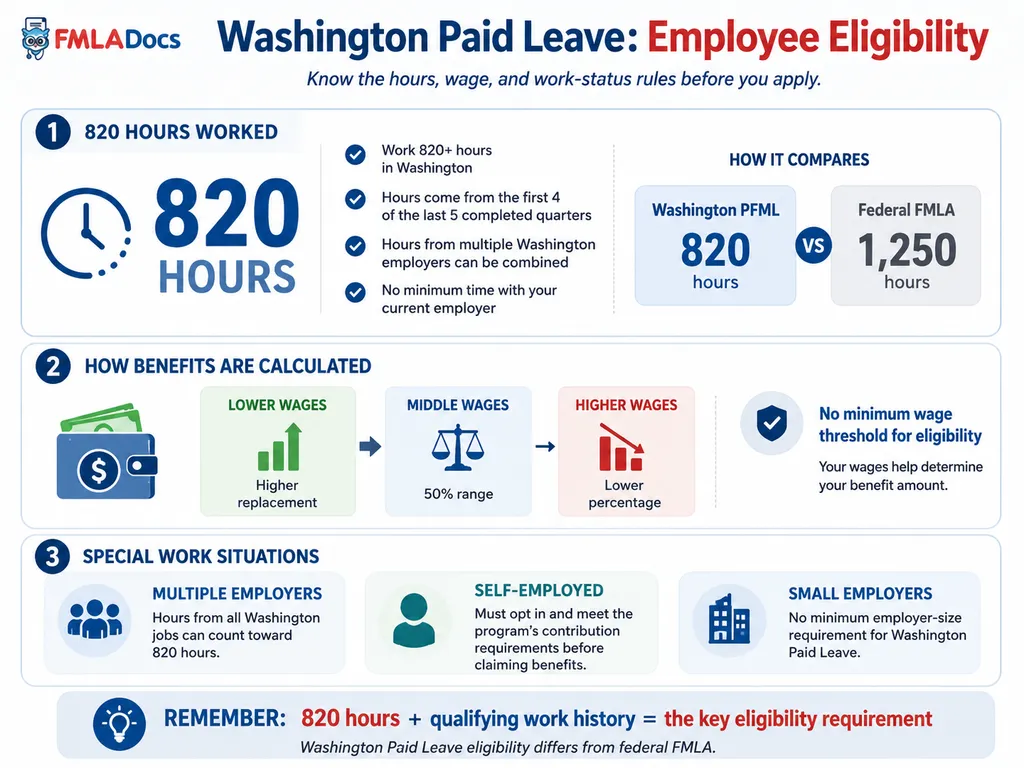
To qualify, you need at least 820 hours of work in Washington during a specific period. This period covers the first four of the last five completed calendar quarters before your leave starts.
Here’s an example: if your leave begins in March 2026, your qualifying period runs from January 2025 through December 2025.
Washington’s 820-hour threshold is lower than the federal FMLA requirement of 1,250 hours. That makes paid leave easier to access for part-time workers. All your Washington employers’ hours count toward this total, not just your current job.
According to eligibility and benefit calculations from the University of Washington, seasonal and temporary workers can qualify if they meet the hour requirement. You don’t need to work for a specific employer for any minimum time. This flexibility helps workers who change jobs or work multiple positions.
Wage Threshold Calculations
Washington paid leave doesn’t use a minimum wage threshold for eligibility. Instead, your benefit amount depends on your average weekly wage during the qualifying period. The state calculates this by dividing your total wages by the number of hours worked.
Benefits replace a percentage of your wages on a sliding scale:
-
90% of your average weekly wage up to 50% of the state average
-
50% of wages between 50% and 100% of the state average
-
Lower percentages for wages above the state average
Maximum weekly benefits cap at a set amount adjusted annually. This structure provides higher replacement rates for lower-wage workers while still offering benefits to higher earners.
Special Eligibility Rules for Multiple Employers
If you work for multiple employers, hours from all jobs count toward the 820-hour requirement. This is a major advantage over federal FMLA, which requires 1,250 hours with a single employer. You can combine hours from part-time positions to meet the threshold.
Self-employed individuals must opt into the program and pay premiums for at least three years before claiming benefits. Once enrolled, you can’t opt out for five years. This requirement protects the program from adverse selection while extending coverage to independent contractors and business owners.
No minimum employer size requirement exists under Washington paid leave. Even if you work for a small business with just one employee, you can qualify. This contrasts sharply with federal FMLA, which only covers employers with 50 or more workers within 75 miles.
Qualifying Reasons for Washington Family and Medical Leave

Washington state provides paid family and medical leave through its Paid Family and Medical Leave (PFML) program. This program covers specific life events and health conditions. Workers can take up to 12 weeks of paid leave per year for most reasons. Military-related leave extends up to 16 weeks in some cases.
Understanding qualifying conditions for protected leave helps you plan. Washington’s program mirrors federal FMLA protections while adding paid benefits. You don’t lose your job when you take approved leave.
Family Leave Qualifying Events
Family leave covers bonding and caregiving situations. You can take leave when a new child enters your family. This includes biological birth, adoption, or foster care placement.
Bonding leave must occur within 12 months of the child’s arrival. Both parents qualify for this leave. You can take time off simultaneously or at different times.
Caring for a family member with a serious health condition also qualifies. Washington defines family members broadly:
-
Spouse or registered domestic partner
-
Child (biological, adopted, foster, or stepchild)
-
Parent (biological, adoptive, foster, or stepparent)
-
Grandparent or grandchild
-
Sibling (including half-siblings and step-siblings)
The family member must have a serious health condition requiring your care. This can include helping with medical appointments or providing daily assistance. You don’t need to be the only caregiver to qualify.
Medical Leave Qualifying Conditions
Medical leave covers your own serious health condition. This condition must prevent you from performing your job duties. Pregnancy complications and prenatal care qualify as medical leave under Washington law.
A serious health condition involves inpatient care or continuing treatment. Common qualifying conditions include:
-
Surgery and recovery periods
-
Chronic conditions requiring ongoing treatment
-
Pregnancy-related complications
-
Mental health conditions needing professional care
-
Injuries preventing work performance
Prenatal care appointments count as qualifying medical leave. This includes routine checkups and specialized testing. Postpartum recovery also qualifies for medical leave benefits.
You need medical certification from a licensed healthcare provider. This documentation confirms your condition and expected duration. FMLADocs connects you with licensed doctors who complete required certifications remotely.
Military Family Leave Provisions
Military family leave applies when a family member faces deployment. You can take leave for qualifying exigencies related to covered active duty. This includes short-notice deployment preparations and military events.
Qualifying military exigencies include:
-
Attending military ceremonies or programs
-
Arranging childcare for the service member’s children
-
Making financial and legal arrangements
-
Attending counseling sessions
-
Spending time with the service member during rest and recuperation
You can take up to 16 weeks of military caregiver leave. This applies when caring for a service member with a serious injury or illness. The condition must have occurred during active duty.
Military caregiver leave covers current service members and veterans. Veterans must have been discharged within the past five years. You must be the spouse, parent, child, or next of kin of the service member.
Benefit Amounts and Duration Under Washington Law
Washington paid family and medical leave provides income replacement when you can’t work. The state calculates your weekly benefit using a tiered formula. This protects lower-wage workers while capping benefits for higher earners.
Weekly Benefit Calculation Method
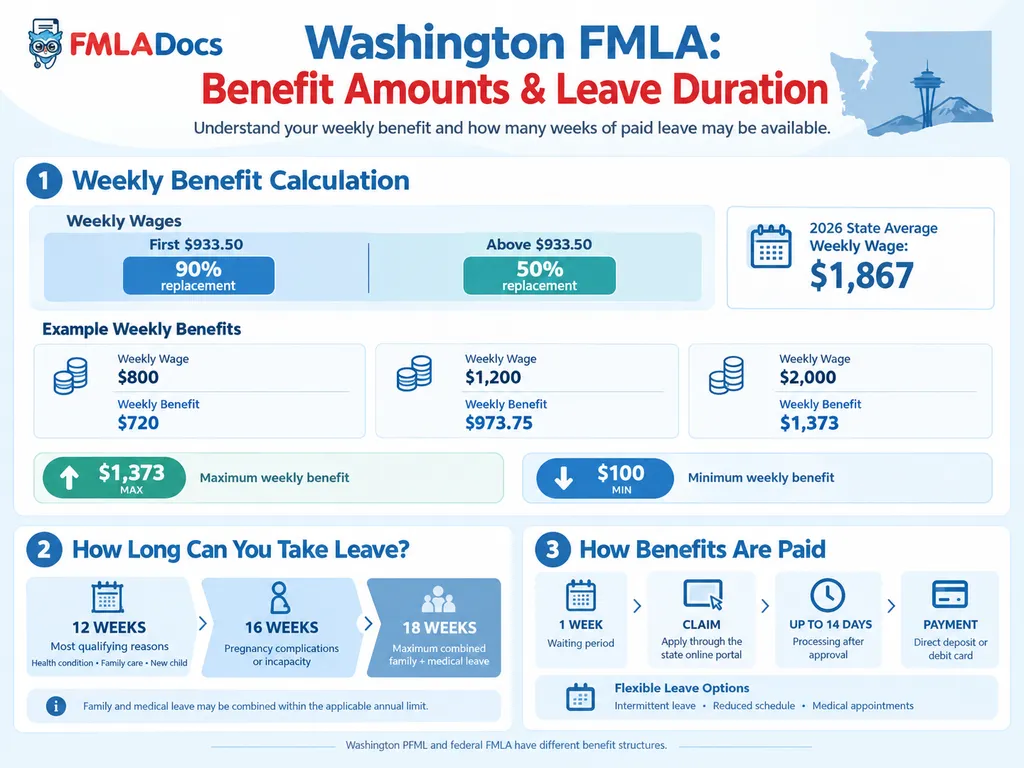
Washington replaces 90% of your weekly wages up to 50% of the state average weekly wage. After that threshold, you get 50% of your remaining wages. This two-tier structure helps workers at all income levels.
For 2026, the state average weekly wage is $1,867. That means you get 90% replacement on the first $933.50 you earn weekly. You get 50% replacement on earnings above that amount.
Here’s how it works in practice:
-
If you earn $800 weekly, you get $720 (90% of $800)
-
If you earn $1,200 weekly, you get $973.75 (90% of $933.50 plus 50% of $266.50)
-
If you earn $2,000 weekly, you get $1,373.00 (90% of $933.50 plus 50% of $1,066.50)
The maximum weekly benefit adjusts each year based on changes to the state average wage. In 2026, the maximum weekly benefit is $1,373. The minimum weekly benefit is $100, which protects part-time and lower-wage workers.
Maximum Leave Duration by Type
Washington state leave benefits allow up to 12 weeks for most qualifying reasons during 52 weeks. This covers your own serious health condition, caring for a family member, or bonding with a new child.
You can take up to 16 weeks if you have pregnancy complications or incapacity. This extended period recognizes the additional recovery time some pregnancies require.
You can combine family and medical leave in the same year for up to 18 weeks total. This helps when you face multiple qualifying events, such as your own health issue followed by a family member’s need for care.
Understanding how Washington PFML differs from federal FMLA helps you plan your leave strategy. The programs run concurrently but have different benefit structures.
Benefit Payment Timing and Structure
Benefits are paid weekly after a one-week waiting period. You don’t get paid for the first week of leave. This waiting period applies once per qualifying event.
You submit claims through the state’s online portal. The Employment Security Department processes approved claims within 14 days. Payments arrive via direct deposit or debit card.
You can take leave intermittently or on a reduced schedule. This flexibility helps when you need ongoing medical appointments or a gradual return to work. Each day of intermittent leave counts toward your total weeks available.
The state requires medical certification for most leave types. You must submit documentation within five business days of your claim. Delays in certification can delay your benefit payments.
Application Process and Required Documentation
Washington state’s paid family and medical leave program requires careful attention to timing and paperwork. You can’t just call in sick and expect benefits to arrive. The state has specific windows, forms, and medical requirements you must meet.
Missing a deadline or submitting incomplete documents delays your payments. In some cases, it can disqualify you entirely. Here’s what you need to know to get it right the first time.
When and How to Apply for Benefits
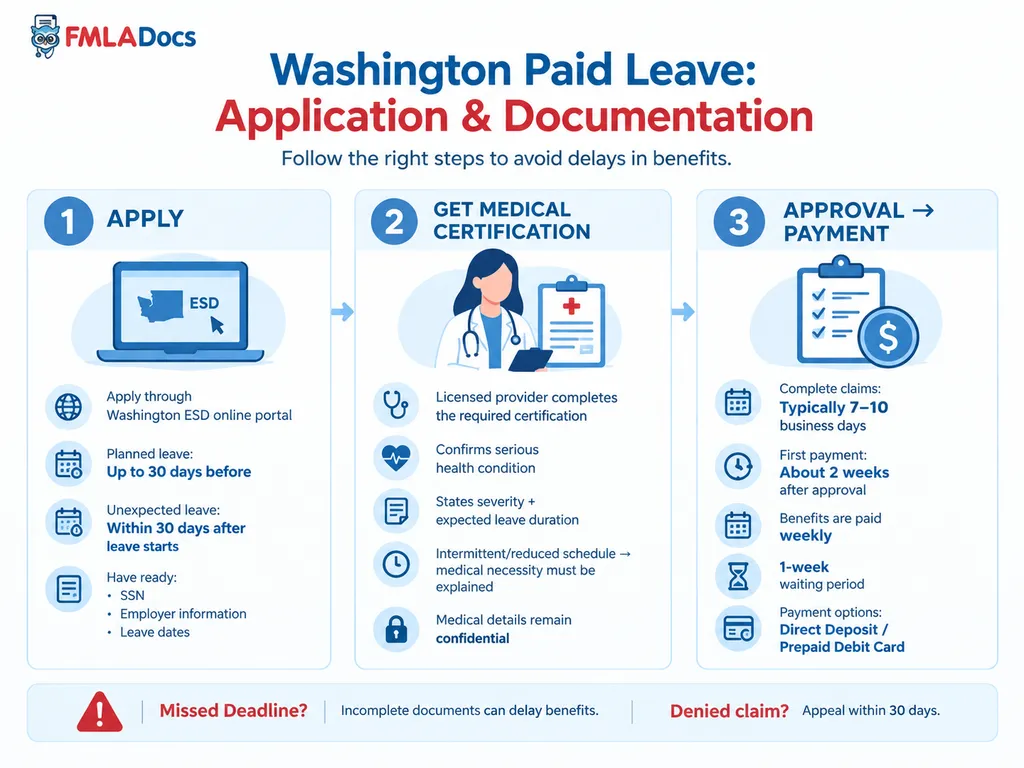
You apply for Washington paid family and medical leave through the Employment Security Department’s online portal. The system walks you through each step. You’ll need your Social Security number, employer information, and details about your leave dates.
For planned events like surgery or adoption, apply up to 30 days before your leave starts. This gives the state time to process your claim. You’ll get your first payment sooner, right when you need it.
For unexpected events like sudden illness or emergency family care, you have 30 days after your leave starts to file. The clock begins the day you stop working. If you miss this window, you may lose benefits for the days before you applied.
The portal saves your progress if you can’t finish in one sitting. You can log back in anytime to complete or update your application. Keep copies of everything you submit. You’ll want them if questions come up later.
Medical Certification Requirements
Washington requires medical certification from a licensed health care provider for most leave types. This isn’t just a doctor’s note saying you’re sick. The certification must document your serious health condition and explain why you need time off work.
Your provider completes a state-issued form that asks specific questions. They must confirm the condition exists, describe its severity, and estimate how long you’ll need leave. For intermittent FMLA leave or reduced schedule arrangements, they must explain why that pattern is medically necessary.
The certification goes directly from your provider to the Employment Security Department. You don’t handle the medical details yourself. However, you’re responsible for making sure your provider submits it on time. Follow up if you don’t see confirmation within a few days.
Your employer receives notification when you apply, but they don’t see your medical information. The state keeps health details confidential. Employers only learn that you applied and whether your claim was approved.
Timeline for Approval and Payment
The Employment Security Department typically makes approval decisions within 7 to 10 business days after receiving your complete application and medical certification. Incomplete submissions take longer because the state must request missing information.
Once approved, your first payment arrives about two weeks later. Washington pays benefits weekly, but there’s always a one-week waiting period before payments begin. You don’t receive benefits for that first week of leave.
Payments go through direct deposit or a prepaid debit card. Direct deposit is faster and more reliable. Set it up when you first apply. If you choose the debit card option, wait for it to arrive in the mail before your leave starts.
If your claim is denied, you will receive a written explanation and information about how to appeal. You have 30 days from the denial date to file an appeal. Don’t wait until the last day. Gather your supporting documents and submit everything as soon as possible.
Job Protection and Restoration Rights in Washington

Washington state offers strong job protection for employees who need family or medical leave. These protections go beyond federal law in many cases. Understanding your rights helps you take leave without fear of losing your job.
Which Employees Have Job Protection
Federal FMLA covers employees at businesses with 50 or more workers. You must have worked 1,250 hours in the past year. You also need 12 months of service with your employer.
Washington state law extends protection to more workers. The state’s Paid Family and Medical Leave program covers most employees. This includes those at smaller businesses. According to Washington paid family leave rights, nearly all workers in the state qualify for job protection under PFML.
You don’t need to work for a large company. Even part-time workers can qualify. The state program requires minimal work history. This makes protection accessible to more people.
Restoration to Position Requirements
When your leave ends, your employer must restore you to your job. This means the same position you held before leave. The pay and benefits must match what you had.
If your exact job isn’t available, you get an equivalent position. Equivalent means:
-
Same pay rate and schedule
-
Same or similar duties and responsibilities
-
Same benefits package including health insurance
-
Same shift and work location when possible
Your employer can’t demote you or cut your pay. They can’t reduce your hours or change your shift to punish you. Health insurance benefits continue during your leave period. You pay the same premiums you paid before.
Seniority and other benefits keep accruing during paid leave. This protects your standing with the company. You don’t lose ground while you’re away.
Limitations on Job Protection Rights
Job protection has some limits. Employers can deny restoration in specific situations. These exceptions are narrow and rarely apply.
The key employee exception affects highly paid workers. If you’re among the top 10% of earners, your employer might deny restoration. They must prove your absence causes substantial economic harm. This exception is hard to meet and rarely used.
Your employer can’t retaliate against you for taking leave. They can’t fire you, demote you, or treat you differently. Discrimination based on leave usage violates state and federal law.
However, job protection doesn’t prevent all terminations. If your employer would have fired you anyway, leave doesn’t shield you. Layoffs affecting your entire department can still happen. Performance issues from before your leave can still matter.
You must follow proper procedures to keep protection. Provide required notice when possible. Submit medical certification if requested. Stay in contact with your employer during leave.
Employer Obligations Under Washington PFML
Washington’s Paid Family and Medical Leave (PFML) program creates specific duties for employers operating in the state. These obligations go beyond simply allowing time off. Employers must handle premium collection, maintain proper notices, and manage leave requests correctly. Missing any of these steps can lead to penalties and compliance issues.
Premium Collection and Reporting Requirements
Employers must collect the employee share of PFML premiums through payroll deductions. The total premium rate is set annually by the Employment Security Department. Businesses split this cost with workers based on company size.
Here’s how premium responsibilities break down:
-
Businesses with 50 or more employees pay 45% of the premium
-
Employees at these larger businesses pay 55% of the premium
-
Businesses with fewer than 50 employees pay no employer share
-
Employees at smaller businesses still pay their portion through deductions
Employers must report wages and hours to the Employment Security Department every quarter. This reporting determines premium amounts and tracks employee eligibility. Late or incorrect reports can result in penalties and interest charges.
The quarterly reporting deadline falls on the last day of the month following each quarter. For example, first quarter reports are due by April 30. Employers submit these reports through the state’s online portal along with premium payments.
Notice and Posting Obligations
Every covered employer must post workplace notices about PFML rights. These posters must appear in conspicuous locations where employees can easily see them. Break rooms, time clock areas, and employee entrances work well for this purpose.
The Employment Security Department provides free posters in multiple languages. Employers can download and print these or request physical copies. Digital posting is acceptable only if all employees have regular computer access.
Beyond posters, employers must provide written notice to employees about their PFML rights. This happens at hire and whenever an employee requests leave. The written notice explains how to apply, what benefits are available, and how the program works.
These notice requirements apply even when no employees currently qualify for benefits. The goal is to inform workers about their rights before they need to use them. Failure to post or provide written notices can result in fines up to $1,000 per violation.
Leave Administration Responsibilities
Employers cannot interfere with or deny employees’ right to take PFML. This means accepting leave requests when employees meet eligibility requirements. It also means maintaining job protection during approved leave periods.
When employees request leave, employers must:
-
Respond to requests within five business days
-
Provide required forms and information promptly
-
Maintain health insurance coverage during leave
-
Restore employees to their same or comparable positions upon return
Medical information related to PFML requests must remain confidential. Employers should store these records separately from standard personnel files. Only staff members who need access for leave administration should see medical documentation.
Washington PFML works alongside federal FMLA protections. Employers must understand how these programs interact, especially since state family leave programs often provide broader coverage than federal requirements. Employees may qualify for both programs simultaneously, and employers must coordinate benefits correctly.
Retaliation against employees who use PFML is strictly prohibited. This includes negative performance reviews, demotions, or terminations based on leave usage. Employers who violate these protections face legal action and potential damages.
Coordination with Federal FMLA and Other Leave Laws

Washington’s Paid Family and Medical Leave (PFML) program doesn’t replace federal FMLA protections. Instead, the two laws work together to provide both wage replacement and job protection. Employees who qualify for both programs can use them at the same time. This means you get paid benefits from the state while federal law protects your position.
How Washington PFML and Federal FMLA Work Together
When you take leave that qualifies under both programs, the time runs concurrently. You don’t get 12 weeks of PFML plus 12 weeks of FMLA. You get 12 weeks that count toward both programs at once. This coordination protects your job while providing income replacement.
Federal FMLA covers employers with 50 or more employees within 75 miles. Washington PFML covers nearly all employers with at least one employee. This means you might qualify for state benefits even if your employer isn’t covered by federal law. In that case, you get paid leave without federal job protection.
According to recent Washington PFML updates, the state program has expanded coverage to include more workers. The coordination between state and federal programs now affects more employees than ever. You need to understand both sets of rules to maximize your benefits.
Eligibility requirements differ between the two programs. Federal FMLA requires 1,250 hours worked in the past year. Washington PFML requires 820 hours in the qualifying period. You might qualify for one program but not the other. Check both sets of requirements before planning your leave.
Interaction with Employer-Provided Benefits
Employers can require you to use accrued paid time off to supplement state benefits. This means your vacation or sick leave might run alongside your PFML payments. However, employers can’t force you to exhaust all paid leave before accessing state benefits. You have the right to start PFML when you need it.
Some employers offer their own paid leave plans. These voluntary plans must meet or exceed state benefit levels. If your employer has an approved voluntary plan, you receive benefits through that plan instead of the state program. The plan must still coordinate with federal FMLA protections.
You can’t receive full wages and full state benefits at the same time. If your employer pays you during leave, the state reduces your PFML payment accordingly. The combined amount typically can’t exceed your regular wages. This prevents double-dipping while you’re on leave.
Employer-provided benefits might include better wage replacement rates. Some companies offer 100% pay during leave. In these cases, you might not need state benefits at all. But you still have the right to file a PFML claim if employer benefits fall short.
Workers’ Compensation and Disability Coordination
Work-related injuries trigger different benefit systems. Workers’ compensation provides benefits for on-the-job injuries. Washington PFML can supplement these benefits when workers’ comp doesn’t cover your full wages. The two programs coordinate to prevent overpayment.
You can’t collect full benefits from both programs simultaneously. If you receive workers’ compensation, the state reduces your PFML payment. The total amount from both sources can’t exceed your regular wages. This coordination applies to both temporary disability and permanent partial disability benefits.
Short-term and long-term disability insurance also coordinate with PFML. Private disability policies might pay benefits during your leave. The state adjusts your PFML payment based on what you receive from disability insurance. You need to report all other benefit sources when filing your claim.
Medical leave for non-work injuries follows different rules. You can use PFML for serious health conditions that aren’t work-related. These claims don’t involve workers’ compensation. But you still need to coordinate with any private disability coverage you have through your employer.
Intermittent and Reduced Schedule Leave Options
Washington FMLA laws allow employees to take intermittent leave when medically necessary. This means you don’t have to take all 12 weeks at once. You can break it into smaller chunks as your health needs require.
Intermittent leave works for both your own serious health condition and caring for family members. You can take leave in increments as small as one hour. This flexibility helps you manage ongoing medical treatments or unpredictable health episodes.
When Intermittent Leave Is Available
You can use intermittent leave for several situations. Chronic conditions like diabetes or migraines often require periodic treatment. Flare-ups happen without warning, making intermittent leave practical.
Planned medical treatments also qualify. Chemotherapy sessions, physical therapy appointments, and dialysis treatments fall into this category. You take time off for each appointment, then return to work.
For family care, intermittent leave helps when a spouse or parent needs ongoing assistance. Doctor visits, medication management, or daily care tasks all count. The key requirement is medical necessity, which your healthcare provider must certify.
Scheduling and Notice Requirements
When you can predict your leave needs, you must provide reasonable notice. For planned medical treatments, work with your employer to schedule appointments that minimize disruption. This doesn’t mean you sacrifice necessary care, but coordination matters.
For unforeseeable leave, notify your employer as soon as practical. A sudden migraine or unexpected flare-up doesn’t allow planning. Call or text your supervisor following normal call-in procedures.
Your employer may require medical certification showing intermittent leave is medically necessary. The certification should include:
-
Expected frequency of leave episodes
-
Estimated duration of each absence
-
Medical facts supporting the need for intermittent schedule
Some employees find Colorado PFML wage replacement programs offer different structures worth comparing. Washington’s system calculates benefits differently for partial weeks.
Benefit Calculation for Partial Weeks
Washington paid family and medical leave benefits get prorated based on hours you actually take off. If you work part of a week, you receive partial benefits for the hours missed.
The calculation works like this: Your weekly benefit amount is divided by your normal work hours. That gives you an hourly benefit rate. Multiply that rate by the hours of leave you take.
For example, if your weekly benefit is $1,000 and you normally work 40 hours, your hourly rate is $25. Taking 8 hours of intermittent leave that week pays you $200 in benefits. You still earn wages for the 32 hours you worked.
Reduced schedule leave operates similarly. You might drop from full-time to part-time temporarily while recovering. Benefits cover the difference between your reduced hours and normal schedule. This arrangement requires employer approval and medical certification showing the reduced schedule is medically necessary.
Recent Changes and Updates to Washington Leave Laws
Washington state continues to refine its paid family and medical leave program. The state adjusts premium rates and benefit amounts each year. These changes help the program stay financially stable while serving workers better.
2026 Legislative Changes
Premium rates for 2026 reflect updated program costs. Employers and employees share the cost of Washington Paid Family and Medical Leave. The total premium rate is 0.74% of wages, split between both parties.
Employers with fewer than 50 employees don’t pay the employer portion. Workers at these small businesses still get full benefits. The state also improved coordination with federal military family leave. This makes it easier for families with service members to access both programs.
According to Washington’s paid leave program, streamlined application processes now reduce approval times. Digital submissions move faster through the system. Workers get decisions within days instead of weeks.
Expanded Family Member Definitions
The state broadened who counts as family under Washington family leave requirements. You can now take leave to care for additional relationships. This includes chosen family members who play a parent role in your life.
-
Grandparents and grandchildren now qualify for care leave
-
Siblings can take leave to care for each other
-
Any individual with a biological or legal relationship to you
-
People who stood in loco parentis when you were a child
These changes recognize modern family structures. Many people rely on relatives beyond parents, spouses, and children. The expanded definitions give more workers access to protected leave time.
Increased Benefit Amounts and Duration
Benefit maximums rise with the state average weekly wage each year. In 2026, the maximum weekly benefit is $1,718. This helps higher earners maintain more of their income during leave.
The benefit calculation uses your five highest-earning quarters. Workers earning less than the state average get 90% of their wages. Those earning more get a sliding percentage. The formula ensures lower-wage workers keep most of their pay.
Enhanced protections against retaliation took effect this year. Employers face steeper penalties for discriminating against workers who use leave. The state also added notice requirements for certain situations. Employers must inform workers about their rights when hiring and during leave requests.
Common Compliance Issues and How to Avoid Them
Washington FMLA laws create specific obligations that employers often overlook. Missing a deadline or failing to maintain proper records can trigger investigations and penalties. Most violations happen not from intentional disregard but from gaps in documentation, unclear policies, or misunderstanding what the law prohibits.
Employers who understand these common pitfalls can build systems that protect both their business and their employees’ rights.
Documentation and Recordkeeping Requirements
Washington requires employers to maintain detailed records of premium payments and employee hours for six years. This includes all wage reports, premium calculations, and leave usage documentation. You can’t discard these records after three years like some federal requirements allow.
Keep separate files for:
-
Premium payment receipts and bank records
-
Quarterly wage reports submitted to the Employment Security Department
-
Employee hours worked and wages paid
-
Leave applications and approval notices
-
Medical certifications and supporting documentation
Store medical records separately from personnel files. HIPAA and state privacy laws require this separation. Don’t let supervisors access medical details they don’t need to see.
Set calendar reminders for quarterly reporting deadlines. Late reports trigger automatic penalties even when you eventually pay what you owe. The Employment Security Department doesn’t waive these fees for first-time mistakes.
Prohibited Employer Actions
You can’t discourage employees from applying for Washington paid leave benefits. This includes subtle pressure like suggesting they use vacation time instead or implying that taking leave will hurt their standing. According to qualifying leave reasons under Washington law, employees have protected rights to take leave for serious health conditions, family care, and military family events.
Don’t count paid leave usage against employees in performance reviews. If you track attendance, exclude approved Washington paid leave from negative attendance points. Document this exclusion in your attendance policy so managers apply it consistently.
Other prohibited actions include:
-
Retaliating against employees who file claims
-
Refusing to restore employees to their positions after leave
-
Requiring employees to find their own replacements
-
Denying leave to employees who meet eligibility requirements
Train managers to recognize these violations before they happen. Many retaliation claims start with a supervisor who doesn’t understand the law’s protections.
Enforcement and Penalties
The Employment Security Department investigates complaints and enforces compliance through audits and penalties. When you fail to pay premiums or report wages accurately, you face back payments plus interest and fines. These penalties compound quickly.
Employees can file complaints directly with the Department for violations. The Department must respond to these complaints within specific timeframes. You’ll receive notice and must provide requested documentation within the deadline given.
Penalties include:
-
25% penalty on unpaid premiums for first violations
-
50% penalty for subsequent violations within five years
-
Interest charges on all unpaid amounts
-
Fines up to $1,000 per violation for willful misrepresentation
Respond promptly to Employment Security Department requests. Missing their deadlines makes resolution harder and increases penalties. If you discover errors in past reporting, file corrections immediately rather than waiting for an audit.
Conclusion
Washington FMLA laws create two distinct leave systems that work together. Federal FMLA provides job protection. State paid leave delivers income replacement. You need to understand both to access full benefits.
This guide covered eligibility rules, qualifying reasons, and benefit calculations. You learned how to apply, what documentation you need, and when to submit claims. We explained job protection rights and employer duties. You also discovered how Washington paid family and medical leave coordinates with federal rules.
Check your 820-hour eligibility now. Calculate your potential benefits. Review your employer’s notice requirements. Know your rights before you need them.
Most claims fail because of incomplete medical certification. Don’t let paperwork delay your benefits. FMLADocs connects you with licensed healthcare professionals who complete required documentation without office visits. Get the certification you need to access Washington FMLA benefits while you focus on recovery or family care.
Frequently Asked Questions
What is the difference between Washington PFML and federal FMLA?
Federal FMLA gives you 12 weeks of unpaid leave with job protection. Washington PFML pays you during that time off. FMLA covers employers with 50 or more workers within 75 miles. PFML covers nearly every employer in Washington, including small businesses with one employee. FMLA requires you to work 1,250 hours in the past year. PFML only requires 820 hours in the qualifying period. You can use both programs at the same time. FMLA protects your job while PFML provides weekly wage replacement.
How many hours do I need to work to qualify for Washington PFML?
You need to work at least 820 hours during your qualifying period to get Washington PFML benefits. That's about 16 hours per week over a year. The program covers full-time and part-time employees. It also includes seasonal and temporary workers. You don't need to work for a large company. Businesses of any size must provide this coverage. Your employer tracks your hours through payroll. Once you hit 820 hours, you qualify for paid leave benefits.
Can self-employed workers get Washington paid family and medical leave?
Yes, self-employed workers can opt into Washington PFML voluntarily. Once you elect coverage, you must stay enrolled for three years. You pay premiums just like traditional employees. You also receive the same benefits during that time. The program gives you wage replacement when you take qualifying leave. You handle enrollment directly with the state. After three years, you can choose to renew or drop coverage. This option helps freelancers and business owners get paid leave protection.
How much do employees pay for Washington PFML premiums?
Employees pay about 0.54% of their gross wages for Washington PFML in 2026. The total premium rate is 0.74% of wages. Workers cover roughly 73% of that cost. Employers pay the remaining 27%, which is about 0.20% of wages. Your employer deducts your portion from each paycheck automatically. These premiums fund the wage replacement you receive during leave. The rate can change each year based on program costs. Both you and your employer share the funding burden.
Does Washington PFML cover small businesses?
Yes, Washington PFML covers businesses of any size in the state. Even companies with just one employee must provide this coverage. Federal FMLA only applies to employers with 50 or more workers. Washington's program fills that gap for small business employees. Your employer handles enrollment through payroll no matter how small the company is. This means part-time workers at small shops get paid leave benefits. The state program protects far more workers than federal law does.
Can I use Washington PFML and federal FMLA at the same time?
Yes, you can use both programs at the same time if you qualify for each. Federal FMLA protects your job position during leave. Washington PFML pays you while you're out. The leave runs on the same schedule. You don't get extra weeks by using both. You get job protection from FMLA plus wage replacement from PFML. This combination gives you the best of both systems. You need to meet the eligibility rules for each program separately.
Who is exempt from Washington paid family and medical leave coverage?
Tribal governments and federal employees are exempt from Washington PFML. Everyone else working in the state likely has coverage. This includes workers at private companies, nonprofits, and state agencies. Part-time and seasonal workers get coverage too. You just need to meet the 820-hour work requirement. Self-employed people aren't automatically covered but can opt in. Nearly all traditional employees in Washington qualify for the program. The exemptions are very limited compared to federal FMLA rules.
How many weeks of paid leave does Washington PFML provide?
Washington PFML provides up to 12 weeks of paid leave for most qualifying reasons. This matches the federal FMLA timeframe but adds wage replacement. You get paid while you're off work. The state calculates your weekly benefit based on your wages. You can use this time for a new baby, serious health conditions, or family care. The 12-week limit applies per year. Some situations may qualify for additional weeks. The program gives you both time off and income during that period.
Meet the author
Nida Hammad
I am a professional writer with over five years of experience creating clear, engaging, and well-researched content. I specialize in healthcare topics, helping readers understand complex information in simple wording. Currently, I write for FMLA DOC, where I focus on producing accurate and trusted guides for people seeking support with FMLA and medical needs.
Get Your FMLA Certification Online in Minutes