Minnesota PFML: 90% Wages up to $1,153 Per Week
 by Anam Moin
Last updated:
Minnesota PFML launched January 1, 2026, offering workers up to $1,153 per week for qualifying family and medical leave. This state-run program covers childbirth, serious health conditions, and family caregiving needs.
If you work or employ others in Minnesota, you should understand how eligibility works, what benefits look like, and when to file a claim.
Many people overlook what matters most. You don’t need full-time status to qualify. The program uses a two-tier formula that replaces more income for lower earners. Employers must handle specific compliance duties, from payroll deductions to posting notices.
This guide covers Minnesota paid leave benefits, employer obligations, qualifying reasons, and the application process.
You’ll learn who qualifies for MN paid family and medical leave, how much you’ll receive based on your wages, which life events trigger coverage, and how to file your claim on time.
We explain the benefit calculation, leave duration limits, and employer responsibilities so you can prepare. Whether you’re expecting a child or facing a health crisis, understanding Minnesota PFML protects your income when you need it.
Understanding Minnesota PFML: Program Overview and Coverage
Minnesota PFML launched January 1, 2026. It gives workers paid time off for family and medical needs. This state-run insurance program covers all private employers and employees in Minnesota, no matter how small the business.
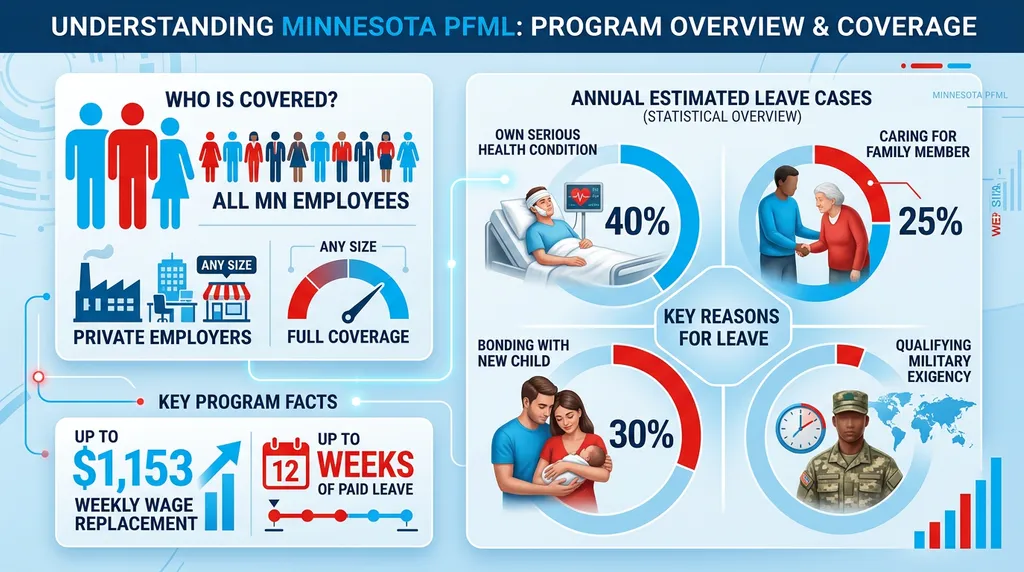
The program provides up to 20 weeks of paid leave each year. You can take 12 weeks for family leave and 12 weeks for medical leave. Eight weeks can overlap between the two types.
What Minnesota PFML Covers
You can use Minnesota paid leave benefits for several situations. These include:
-
Your own serious health condition that stops you from working
-
Caring for a family member with a serious health condition
-
Bonding with a new child through birth, adoption, or foster care
-
Qualifying military exigency when a family member deploys
-
Caring for a servicemember with a serious injury or illness
The program replaces a portion of your wages while you’re on leave. This makes it more than just job protection. You get actual income during your time away from work.
Who Administers the Program
The Minnesota Department of Employment and Economic Development runs the program. They handle applications, benefit payments, and employer compliance. Workers apply directly through the state system.
Funding comes from payroll premiums split between employers and employees. The total premium rate is 0.7% of wages. Both sides contribute to build the insurance pool that pays benefits.
Key Differences from FMLA
Federal FMLA only covers employers with 50 or more employees. Minnesota PFML covers businesses of all sizes. A company with five employees has the same obligations as one with 500.
FMLA provides unpaid, job-protected leave. Minnesota PFML adds wage replacement on top of job protection. This distinction matters when you compare how FMLA and PFML programs differ in practice.
The differences between state and federal leave laws create new compliance requirements for Minnesota employers. You must track both programs separately. An employee might qualify for one but not the other based on work history and employer size.
Employee Eligibility Requirements for Minnesota Paid Leave
Minnesota PFML sets clear standards for who can access paid leave benefits.
You don’t need to work full-time to qualify. The program looks at wages earned, not hours worked, which means part-time and gig workers have the same shot at benefits as anyone else.
Work History Requirements
You must earn at least $3,500 in Minnesota wages during your base period. Here’s how that works in practice: if you apply in October 2024, your base period covers the first four of the last five completed calendar quarters, so Q2 2023 through Q1 2024.
The quarter right before you apply (Q3 2024, in this case) doesn’t count yet.
-
No minimum hours worked requirement exists.
-
Part-time workers qualify if they meet the wage threshold.
This opens access to thousands of workers who previously had no paid leave options.
Workers who recently moved to Minnesota or changed jobs can still qualify. You can combine wages from multiple Minnesota employers to reach the $3,500 threshold.
According to employment law experts, this provision helps workers who hold multiple part-time positions.
Self-Employed and Gig Worker Coverage
Self-employed individuals and independent contractors can opt into Minnesota PFML voluntarily. You must register with the state and pay premiums based on your earnings. Once enrolled, you gain the same benefits as traditional employees.
Gig workers who receive 1099 forms can also participate. This includes rideshare drivers, freelancers, and contract workers. Registration takes effect after you complete the enrollment process and pay your first premium
Understanding employer FMLA obligations helps you know what protections apply alongside state benefits. Both programs can work together to provide comprehensive leave coverage.
Coordination with Federal FMLA Benefits
Minnesota PFML and federal FMLA work together to give you the most leave time possible.
FMLA provides up to 12 weeks of unpaid, job-protected leave per year. Minnesota PFML provides up to 20 weeks of paid leave in a 12-month period. You can use both programs for the same qualifying event, they run concurrently, not consecutively.
Here’s the practical impact: if you take 12 weeks under FMLA, you’re also using 12 of your Minnesota PFML weeks (if you qualify for paid leave).
Your remaining 8 weeks of PFML can be used later in the year for another qualifying event. You may also combine it with additional FMLA time if your employer allows it. The annual average weekly wage (AWW) updates each year, so your benefit amount may change from year to year, check the state’s website before filing to confirm the current maximum benefit.
Your employer must honor both programs and cannot force you to use one over the other. If you have questions about how your specific situation overlaps, contact the Minnesota Department of Employment and Economic Development for clarification.
Minnesota PFML Agency Contact
The Minnesota Department of Employment and Economic Development (DEED) administers the Minnesota PFML program.
For detailed program information, policy updates, and to file your claim, visit the Minnesota PFML portal. You can also request a paper application by mail if you prefer not to apply online. DEED staff can walk you through the base period calculation, benefit estimation, and claim filing process. Keep your employer’s
Qualifying Reasons and Leave Duration Under MN PFML
Minnesota PFML covers three distinct categories of leave. Each provides specific protections for workers facing different life circumstances. The program allows up to 20 total weeks when combining categories.
Family Leave Reasons (Up to 12 Weeks)
Family leave covers bonding with a new child through birth, adoption, or foster placement. You can take this leave within the first year after the child arrives. It also covers caring for a family member with a serious health condition.
Military family qualifying exigencies fall under this category too. This includes situations when a family member is deployed or called to active duty.
Medical Leave Reasons (Up to 12 Weeks)
Medical leave addresses your own serious health condition. This includes pregnancy complications, surgery recovery, and chronic conditions requiring ongoing treatment. The leave provides time to focus on recovery without job loss stress.
You can take medical leave continuously for major procedures. You can also use it intermittently for conditions requiring periodic treatment. Many workers find intermittent leave scheduling and documentation requirements helpful when managing chronic health issues.
Safety Leave Provisions
Safety leave protects employees experiencing domestic abuse, sexual assault, or stalking.
This applies to situations affecting you or your family members. The leave allows time for legal proceedings, medical care, or relocation.

Employees can combine family and medical leave for up to 20 total weeks. This happens when 12 weeks of each type overlap by 8 weeks. Leave can be taken continuously, intermittently, or on a reduced schedule basis depending on your qualifying reason.
Minnesota PFML Benefit Calculation: How Much You’ll Receive
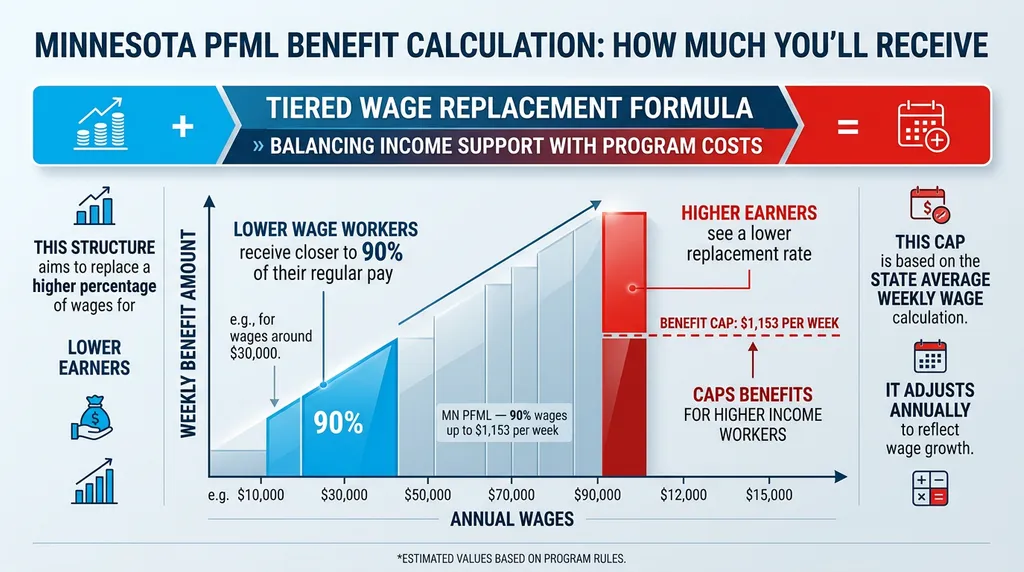
Minnesota PFML uses a two-tier formula to calculate your weekly benefit. Lower earners get a higher share of their wages replaced. Benefits for higher-income workers are capped. The calculation relies on the state average weekly wage (AWW), which is updated each year.
The dollar figures below apply to 2026 and will shift with future AWW adjustments.
Two-Tier Wage Replacement Formula
The first tier covers wages up to 50% of the state average weekly wage. You get 90% replacement for this portion. The second tier covers wages above that threshold. You get 66% replacement for this portion.
Here’s how this works for a mid-range earner. If the state average weekly wage is $1,400 and you earn $1,100 weekly, your first $700 (50% of AWW) is replaced at 90%, giving you $630.
The remaining $400 is replaced at 66%, adding $264. Your total weekly benefit would be $894, more than two-thirds of your regular pay.
This means lower-wage workers receive closer to 90% of their regular pay. Higher earners see a lower replacement rate due to the benefit cap. The formula balances income support with program costs.
For context, FMLA and state family leave programs differ in how they structure wage replacement. Minnesota PFML provides partial wage replacement, while federal FMLA offers unpaid leave only.
Maximum Weekly Benefit Amount
For 2026, the maximum weekly benefit is $1,153. This cap is based on the state average weekly wage calculation. It adjusts annually to reflect wage growth.
Workers earning above the cap receive the maximum amount. Those earning below it receive their calculated percentage. The cap prevents extremely high benefit payouts.
How Benefits Are Calculated
Your weekly benefit uses wages from your base period. That’s the first four of the last five completed calendar quarters. Minnesota calculates your average weekly wage from this period.
Here’s how it works in practice:
-
A worker earning $800 weekly receives approximately $720 weekly (90% of wages)
-
Someone earning $2,000 weekly receives the $1,153 maximum
-
Mid-range earners see blended rates between 66% and 90%
The calculation happens automatically when you apply. You’ll see your estimated benefit amount before approval. This helps you plan your finances during leave. These are benefits you receive without repayment, you don’t pay them back once you return to work.
Employer Obligations and Compliance Requirements
Minnesota PFML creates specific duties for employers across the state. These obligations start before the program launches and continue through every leave request. Missing a deadline or skipping a notice can expose your business to penalties.
Here’s what you need to do to stay compliant.
Registration and Premium Payment
All private employers must register with the Minnesota Department of Employment and Economic Development (DEED). Registration opens well before premium collection begins. You’ll need your federal employer identification number and basic business details.
Premium payments start once the program goes live. The total premium rate is 0.7% of each employee’s wages up to the Social Security wage base. Employers with 30 or more employees split this cost equally with workers. You pay 0.35%, and your employees pay 0.35%.
Employers with fewer than 30 employees don’t pay the employer portion. Your workers still contribute their 0.35%, but you’re exempt from the matching payment. This exemption helps small businesses manage costs while still providing leave benefits to staff.
You must withhold employee premiums from paychecks and remit them to DEED quarterly. Late payments trigger penalties and interest charges. Set up your payroll system to handle these deductions automatically.
Notice and Posting Requirements
You must display a workplace poster about Minnesota PFML rights. DEED provides free posters you can download and print. Place them where all employees can see them, such as break rooms or common areas.
Beyond posters, you must give written notice to employees. This notice explains how the program works, eligibility rules, and how to apply for benefits.
Provide this notice to new hires within 30 days of their start date.
Current employees need this notice too. Distribute it before premium collection begins. You can send it electronically if that’s how you normally communicate with staff.
Update your employee handbook to include Minnesota PFML information. Cover leave types, application procedures, and how paid leave interacts with other benefits. Clear documentation prevents confusion when employees need time off.
Job Protection and Benefit Maintenance
During paid leave, you must maintain health insurance benefits. Keep coverage on the same terms as if the employee continued working. This includes your contribution amounts and coverage levels.
Employees return to the same or an equivalent position after leave ends. You can’t demote them or cut their pay because they used Minnesota PFML. Retaliation or discrimination for taking protected leave violates the law.
You can’t force employees to burn through vacation or sick time before accessing Minnesota PFML. They can choose to supplement their benefits with accrued leave, but that’s their decision. Don’t make it a requirement.
Track leave usage carefully. Employees get up to 12 weeks for most qualifying reasons. Document when leave starts, how much time they use, and when they return. Accurate records protect you if questions arise later.
Conclusion
Minnesota PFML changes how workers access paid time off. The program covers family bonding, personal medical needs, and caregiving responsibilities. You can receive up to 20 weeks of benefits based on your earnings.
Understanding eligibility helps you plan ahead. You need 5.3 weeks of work in the past year. The benefit formula replaces a higher percentage of lower wages. This structure supports workers at all income levels.
Employers must register with the state. They pay premiums and provide employee notices. Non-compliance brings penalties and legal risks.
The Minnesota paid leave application process requires medical documentation for health-related claims. FMLADocs connects you with licensed healthcare professionals who complete your certification remotely. You get the documentation you need without in-person appointments.
This helps you access Minnesota PFML benefits faster and focus on what matters most.
Frequently Asked Questions
What is the maximum weekly benefit amount under Minnesota PFML?
Minnesota PFML pays up to $1,153 per week for qualifying leave. The program uses a two-tier formula that replaces more income for lower earners. Your actual benefit depends on your average weekly wage during the base period. The state calculates this using the first four of the last five completed calendar quarters before you apply. Higher earners receive a smaller percentage of their wages replaced, while lower earners get a larger percentage to protect their income.
How many weeks of paid leave can I take under Minnesota PFML?
You can take up to 20 weeks of paid leave each year. The program allows 12 weeks for family leave and 12 weeks for medical leave. Eight weeks can overlap between the two types. This means you could use leave for your own health condition and then bond with a new child in the same year. The overlap provision gives you flexibility when multiple qualifying events happen close together.
Do I need to work full-time to qualify for Minnesota paid leave benefits?
No, you don't need full-time status to qualify. The program focuses on wages earned, not hours worked. You must earn at least $3,500 in Minnesota wages during your base period. The base period covers the first four of the last five completed calendar quarters before you apply. Part-time workers who meet the wage threshold can access the same benefits as full-time employees. This makes the program more inclusive than many workplace policies.
What life events qualify me for Minnesota PFML benefits?
You can use Minnesota paid leave for several situations. These include your own serious health condition that stops you from working, caring for a family member with a serious health condition, and bonding with a new child through birth, adoption, or foster care. The program also covers qualifying military exigency when a family member deploys and caring for a servicemember with a serious injury or illness. Each reason has specific documentation requirements you must meet.
When did Minnesota PFML start accepting claims?
Minnesota PFML launched January 1, 2026. Workers can file claims for qualifying leave starting on that date. The program covers all private employers and employees in Minnesota, no matter how small the business. You should plan ahead if you expect to need leave in 2026. The state system handles applications directly, so you don't apply through your employer. Early preparation helps you avoid delays when you need to file your claim.
How does Minnesota PFML differ from federal FMLA?
Federal FMLA only covers employers with 50 or more employees. Minnesota PFML covers businesses of all sizes. A company with five employees has the same obligations as one with 500. FMLA provides unpaid, job-protected leave. Minnesota PFML adds wage replacement on top of job protection. You might qualify for one program but not the other based on work history and employer size. Employers must track both programs separately because they have different rules.
Who pays for Minnesota PFML benefits?
Funding comes from payroll premiums split between employers and employees. The total premium rate is 0.7% of wages. Both sides contribute to build the insurance pool that pays benefits. This state-run insurance program collects premiums through payroll deductions. The Minnesota Department of Employment and Economic Development manages the fund and distributes benefits to eligible workers. Your employer handles the deduction from your paycheck and sends it to the state.
Can I use Minnesota paid leave for childbirth and my own health condition in the same year?
Yes, you can use leave for multiple qualifying events in the same year. The program allows 12 weeks for family leave and 12 weeks for medical leave, with eight weeks that can overlap. This means you could take medical leave for pregnancy complications, then use family leave to bond with your new child. The overlap provision gives you up to 20 total weeks when events happen close together. You must meet the qualifying criteria for each type of leave you request.
Meet the author
Anam Moin
I'm Anam Moin, and my work at FMLADocs focuses on workplace leave and FMLA education. I cover certification, documentation, employee rights, and leave-related questions to provide readers with useful information when they need it most.
Get Your FMLA Certification Online in Minutes