
Michigan FMLA: Eligibility, Leave Rules, and How to Apply
 by Sahar Mustafa
Last updated:
Michigan FMLA protections come from two sources: federal law and state employment rules. When you need medical leave, both systems can apply at once. This creates confusion about which rules govern your situation. Most workers don’t know that Michigan’s Earned Sick Time Act runs alongside federal FMLA and missing a filing deadline can strip your job protection.
You need clear answers about FMLA eligibility Michigan requirements, what documentation your employer can demand, and how to apply without losing coverage. This guide breaks down Michigan FMLA qualification standards, walks you through the application process step by step, and explains precisely what your employer must do under federal and state law. You’ll learn how intermittent leave works, what certification requirements you must meet, and how to protect your rights when taking family medical leave.
We cover Michigan employer FMLA obligations, qualifying reasons for leave, and how to handle reduced-schedule arrangements. By the end, you’ll know precisely how to manage Michigan FMLA without risking your job.
Understanding FMLA Coverage in Michigan: Your Michigan FMLA Guide
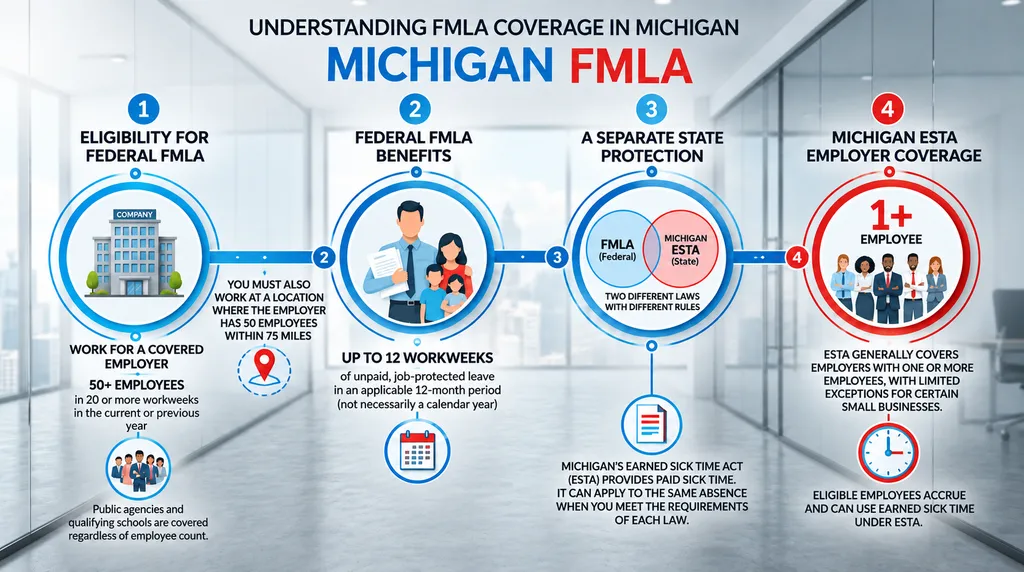
Michigan FMLA coverage operates under two distinct systems. Federal law provides one layer of protection. State law adds another. Both apply to Michigan workers, but they serve different purposes and cover different situations.
You need to know how these systems work together. That’s how you protect your rights when you need time off for medical or family reasons.
Federal FMLA Basics for Michigan Employers
The federal FMLA covers private employers with 50 or more employees in 20 or more workweeks in the current or previous calendar year. An employee must also work where the employer has 50 employees within 75 miles. This means smaller businesses don’t fall under federal FMLA requirements. The law gives eligible workers up to 12 weeks of unpaid, job-protected leave per year.
To qualify, you must work for a covered employer. You also need 12 months of service and 1,250 hours worked in the past year. Your worksite must have at least 50 employees within 75 miles.
Public sector employees face different rules. Federal agencies, state offices, and local governments are covered regardless of employee count. Schools also fall under FMLA coverage no matter how many people they employ.
Michigan Earned Sick Time Act (ESTA) Overview
Michigan’s Earned Sick Time Act (ESTA) took effect on February 21, 2025. It provides earned sick time under state law and applies to eligible employees of covered employers.
ESTA provides earned sick time, not federal FMLA leave. Employees generally accrue at least one hour of earned sick time for every 30 hours worked. The amount of paid sick time an employer must allow depends on the employer’s size and the applicable ESTA rules.
ESTA limits annual use to 72 hours for employers with 11 or more employees and 40 hours for small businesses, unless the employer allows more. This isn’t a state version of FMLA. It’s a separate protection with different rules and purposes.
How Federal FMLA and Michigan ESTA Apply Concurrently
When your leave qualifies under both laws, both apply at the same time. This is called concurrent coverage. Understanding what qualifies for FMLA leave helps you know when both protections kick in.
For example, you might take time off for surgery. If you meet FMLA requirements, federal law can protect your job. If ESTA also covers you, you may use earned sick time for the same absence.
You get protections from both systems when your situation meets each law’s requirements. Federal FMLA provides job protection and benefit continuation. ESTA may provide paid time through your accrued sick hours. Neither law reduces the other’s protections.
Your employer must track both separately. FMLA leave counts against your 12-week annual entitlement. ESTA usage counts against your earned sick time balance. Both run at the same time for qualifying absences.
Michigan FMLA Eligibility Requirements
Michigan workers seeking FMLA protection must meet federal standards. The law doesn’t create separate state-level eligibility rules. Instead, it applies the same four-part test used nationwide. Understanding these requirements helps you determine if you qualify for job-protected leave.
The Four-Part Federal Eligibility Test
You must satisfy all four criteria to qualify for Michigan FMLA. First, your employer must be covered under the law. This means they employ 50 or more workers in 20 or more workweeks during the current or previous calendar year.
Second, you need 12 months of service with your employer. These months don’t have to be consecutive. If you worked there previously, left, and returned, those earlier months may count. However, breaks in service lasting seven years or more typically reset the clock unless you were on military duty or had a written rehire agreement.
Third, you must have worked 1,250 hours in the 12 months before your leave starts. This averages to roughly 24 hours weekly. Only actual work time counts toward this total. Vacation days, sick leave, and holidays don’t add to your hour count.
Fourth, you must work at a location with 50 or more employees within a 75-mile radius. Distance is measured by surface miles using the shortest public route. For remote workers, your reporting location determines your worksite for this calculation.
Hours and Service Requirements for Michigan Workers
The 1,250-hour threshold creates challenges for part-time workers. You need proof of hours worked, not just time on payroll. The U.S. Department of Labor explains that the requirement is based on hours of service during the 12 months before FMLA leave starts. If your employer’s records are incomplete, the applicable FMLA rules determine how eligibility is established.
Overtime hours count toward your 1,250-hour total. So do hours worked as a temporary or seasonal employee. What doesn’t count: paid time off, unpaid leave, holidays, or any period when you weren’t actively working. If you’re returning from military service under USERRA, you receive credit for hours you would have worked during that time.
Many workers don’t realize how to apply for FMLA when their hours fluctuate significantly. If your schedule varies week to week, employers calculate your average based on the 12 months preceding your leave request. This protects workers whose hours change seasonally or due to business needs.
Special Considerations for Part-Time and Seasonal Employees
Part-time workers face unique challenges meeting the 1,250-hour requirement. Working 20 hours weekly for 52 weeks gives you only 1,040 hours. You’d need to work closer to 25 hours weekly to qualify. This means many part-time employees don’t reach the threshold despite working consistently.
Seasonal workers can combine hours across multiple seasons. If you work summers at a Michigan resort, your hours from previous summers count toward your 12-month service requirement. The law allows you to add up non-consecutive periods of employment. This helps seasonal workers who return to the same employer year after year.
For remote workers, the worksite is generally the office where you report or where your work is assigned. Your home is not usually the FMLA worksite.
Break-in-service rules matter for workers who leave and return. Gaps shorter than seven years don’t reset your eligibility clock. If you leave and return after a break of less than seven years, your previous months of employment generally still count toward the 12-month requirement. The exception: military service breaks or written agreements stating the employer will rehire you.
Qualifying Reasons for Leave in Michigan
Michigan workers can take FMLA leave for several protected reasons. Each category has specific requirements. Understanding these helps you know when you’re covered.

Standard FMLA Leave Categories
You can take up to 12 weeks of leave within a 12-month period for these reasons:
-
Birth and bonding: Time off after your child’s birth, up to 12 weeks within one year. This includes recovery, postpartum care, and bonding time.
-
Adoption or foster care: Placement of a child through adoption or foster care. You get the same 12 weeks to bond with your newly placed child.
-
Your serious health condition: When you can’t perform your job duties due to illness or injury. This covers hospital stays, ongoing treatment, and chronic conditions.
-
Family member care: When your spouse, child, or parent has a serious health condition requiring your care.
Federal FMLA protects eligible employees who need leave for qualifying family and medical reasons, including their own serious health condition or the serious health condition of a spouse, child, or parent. The U.S. Department of Labor explains the qualifying reasons for FMLA leave.
Military Family Leave Provisions
Military families get additional protections beyond standard leave. You can take time off when a family member serves on active duty.
Qualifying military exigency covers situations like short-notice deployment, military events, childcare arrangements, or financial planning when your spouse, child, or parent deploys. This applies to National Guard and Reserve members called to active duty.
Military caregiver leave provides up to 26 weeks in a single 12-month period. You can care for a covered servicemember with a serious injury or illness. This applies when you’re the spouse, parent, child, or next of kin.
Pregnancy and Childbirth Under FMLA
Pregnancy complications and prenatal care qualify as serious health conditions. You don’t need a separate category for pregnancy-related leave.
Michigan employers must treat pregnancy-related FMLA leave the same as other serious health conditions. This means equal access to job protection and benefit maintenance. For situations requiring flexible scheduling, understanding how intermittent FMLA works helps you manage prenatal appointments or recovery periods.
FMLA pregnancy protections differ from the Pregnancy Discrimination Act. FMLA gives you job-protected leave. The PDA prevents discrimination. Both laws work together to protect pregnant workers.
How to Apply for FMLA Leave in Michigan
Applying for Michigan FMLA starts the moment you know you need leave. The process protects your job while you handle serious health situations. You don’t need special forms to trigger your rights. A simple verbal notice to your employer starts the clock.
Michigan follows federal FMLA rules. No state-specific forms exist. Your employer must respond within strict deadlines once you notify them.
Notifying Your Michigan Employer
Give your employer 30 days’ advance notice when you can predict your leave need. This applies to planned surgery, childbirth, or scheduled medical treatments. The notice gives your employer time to arrange coverage.
For unexpected situations, notify your employer as soon as practicable under the circumstances and follow the employer’s usual call-in procedures. Medical emergencies don’t wait for perfect timing. Your employer can’t penalize you for short notice when circumstances make advance warning impossible.
You don’t need to use specific words or fill out forms. Tell your supervisor or HR department you need time off for a qualifying reason. Mention the condition generally. Say you need surgery, your parent has a serious illness, or you’re having a baby.
Your employer’s obligations start immediately after your notice. They must determine if your situation qualifies for FMLA protection. They can’t delay or ignore your request.
FMLA Notice Requirements and Timelines
Your employer must provide an Eligibility Notice within five business days of learning about your leave need. This notice tells you whether you qualify for FMLA protection. If you don’t qualify, the notice must explain why.
At the same time, your employer should give you a Rights and Responsibilities Notice. This document explains what you must do during your leave. It covers health insurance premiums, return-to-work requirements, and any fitness-for-duty certification needs.
After your employer confirms your leave qualifies, they must send a Designation Notice within five business days. This officially marks your time off as FMLA-protected. The notice states how much leave counts against your 12-week entitlement.
These deadlines protect you. Late notices can constitute interference with your FMLA rights. Track when you notified your employer and when you received each response.
Required Documentation and Certification
Your employer can request medical certification to verify your need for leave. You have 15 calendar days from the request to provide complete documentation. This timeline gives you reasonable time to see your doctor and get paperwork completed.
Michigan healthcare providers can complete the U.S. Department of Labor’s optional FMLA certification forms. Your healthcare provider must provide the information required to support the leave request. See the U.S. Department of Labor’s FMLA forms and certification resources. The form asks whether you can’t work or need to care for a family member.
If your first submission is incomplete, you get seven additional days to fix any problems. Your employer must tell you exactly what information is missing. Don’t ignore these requests. Missing the deadline without good reason means your employer can deny FMLA protection.
Understanding certification deadlines and submission requirements helps you avoid delays that could jeopardize your job protection.
Your direct supervisor cannot contact your healthcare provider. An employer may use an HR professional, leave administrator, management official, or healthcare provider to authenticate or clarify the certification, subject to applicable privacy requirements.
They can verify the form is authentic. They can ask for clarification about vague responses. But they can’t demand additional medical details beyond what the certification form requires.
Keep copies of everything you submit. Document when you sent certification forms and how you sent them. This creates a paper trail if disputes arise later. For a deeper look, see how intermittent FMLA works.
Michigan Employer Obligations Under FMLA
Michigan employers covered by the FMLA face strict notice and documentation requirements. Missing a deadline can trigger compliance issues. Here’s what you need to know.
Required Notices and Posting Requirements
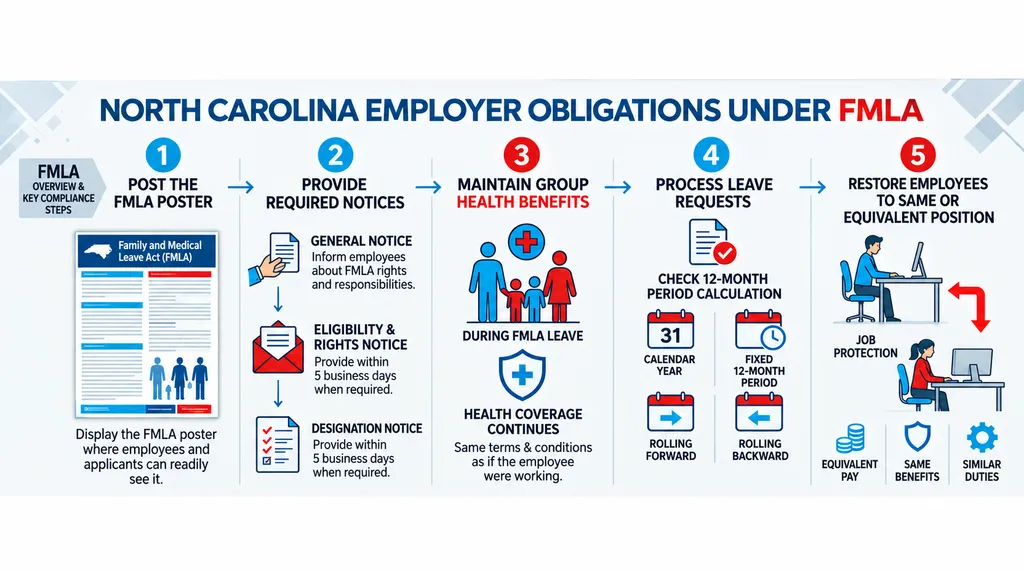
Michigan employers must display the FMLA poster in a visible location. This poster explains employee rights and complaint procedures. It must remain posted even when no employees currently qualify.
The poster should be:
-
Large enough to read easily
-
Placed where all employees and applicants can see it
-
Translated if a significant portion of workers don’t speak English
Willful violations can result in civil penalties. Employers should also provide written general notice through employee handbooks. If no handbook exists, distribute the notice to each new hire.
Eligibility, Rights and Responsibilities, and Designation Notices
Within five business days of learning about a leave need, employers must provide an Eligibility Notice. This tells the employee whether they qualify for Michigan FMLA protection. If they don’t qualify, include at least one reason why.
The Rights and Responsibilities Notice follows immediately after. This document details:
-
The 12-month period used to track leave usage
-
Whether medical certification is required
-
Premium payment requirements during unpaid leave
-
Consequences of failing to meet obligations
After determining leave qualifies, send a Designation Notice within five business days. This officially designates the leave as FMLA-protected. It must state how much leave counts against the employee’s entitlement.
Employers need only provide one Designation Notice per qualifying reason during the leave year. If circumstances change, update the employee in writing within five business days.
Health Insurance Continuation and Job Restoration Rights
Employers must maintain group health coverage during FMLA leave on the same terms. Employees continue paying their premium share. For unpaid leave, arrange payment methods before the employee departs.
Employees generally remain responsible for their normal share of health insurance premiums during FMLA leave. Employers must follow federal FMLA requirements if an employee fails to make required premium payments. The U.S. Department of Labor explains health benefit continuation during FMLA leave. Coverage must be restored when the employee returns.
Upon return, employees have the right to:
-
The same position they held before leave
-
An equivalent position with the same pay and benefits
-
The same working conditions and status
Michigan employers can’t retaliate against employees for taking protected leave. This includes using FMLA leave against them in employment decisions. Keep all FMLA documentation for three years. Store medical records separately from personnel files to maintain confidentiality.
Intermittent and Reduced Schedule Leave
Intermittent or reduced-schedule Michigan FMLA leave lets you take time off in smaller blocks. This works when you can’t predict when symptoms will flare up. You might need a few hours for treatment or a full day when pain becomes too severe to work.
When Intermittent Leave Is Allowed
You can take intermittent FMLA leave Michigan when medical necessity supports it. This applies to your own serious health condition or caring for a family member. Birth and bonding leave doesn’t qualify for intermittent use unless your employer agrees.
Medical treatment appointments count as intermittent leave. So do unpredictable episodes tied to chronic conditions. You take only the time you actually need. The rest of your 12-week entitlement stays available for future use.
Medical Necessity Requirements for Serious Health Conditions
Your doctor must establish that intermittent leave is medically necessary. For intermittent or reduced-schedule FMLA leave, the medical certification should explain the medical necessity of the schedule and provide information about the expected frequency and duration of the leave. The U.S. Department of Labor explains FMLA medical certification requirements.
Your healthcare provider completes this certification. It must show the condition prevents you from working continuously. Vague statements won’t meet Michigan employer FMLA obligations. The form needs concrete details about frequency and duration.
Scheduling Medical Treatment in Michigan
You must schedule foreseeable treatment to minimize disruption when possible. This means working with your employer to find times that work for both sides. Emergency situations get different treatment than planned appointments.
Leave gets taken in the smallest increment your employer uses for other leave types. That can’t exceed one hour. Only time you actually take counts against your 12-week entitlement. Your employer may transfer you to an alternative position temporarily during intermittent leave periods.
Michigan employers cannot require doctor’s notes for each intermittent absence after you submit complete certification. That would violate FMLA protections. One certification covers the entire leave period unless circumstances change significantly.
Conclusion
You now know how Michigan FMLA protections work under federal law. You understand eligibility requirements and qualifying reasons for leave. You’ve learned proper notification procedures and employer obligations. You also know how intermittent leave works when you need flexible scheduling.
Start by checking if you meet the 1,250-hour work requirement. Then review which qualifying reason applies to your situation. Notify your employer as soon as you know you need time off. This protects your rights from the start.
Medical certification can feel like a hurdle when you’re already dealing with health issues. That’s where FMLADocs helps. We connect you with licensed healthcare professionals who complete your FMLA certification requirements remotely. No office visits. No waiting rooms. Just fast, professional documentation that meets Michigan FMLA standards.
Check your eligibility and get started with your certification today. Protect your job while you focus on what matters most.
Frequently Asked Questions
What are the basic eligibility requirements for FMLA in Michigan?
You generally need 12 months of employment with your employer and at least 1,250 hours worked during the 12 months before your leave starts. You must also work at a location where your employer has at least 50 employees within 75 miles. Your employer must be covered by FMLA. Public agencies and qualifying schools are covered regardless of employee count.
How does Michigan's Earned Sick Time Act differ from federal FMLA?
Michigan's Earned Sick Time Act provides earned sick time under state law, while FMLA provides unpaid, job-protected leave under federal law. ESTA and FMLA have different eligibility requirements, purposes, and protections. ESTA can provide paid sick time that may apply during an FMLA-qualifying absence.
Can I use both federal FMLA and Michigan ESTA at the same time?
Yes. When an absence qualifies under both laws, FMLA and Michigan ESTA protections can apply to the same period of leave. FMLA may provide job protection while eligible employees can use available earned sick time under ESTA. Each law continues to follow its own eligibility and usage rules.
How many weeks of leave does Michigan FMLA provide per year?
Eligible employees can generally take up to 12 workweeks of FMLA leave during the employer's applicable 12-month leave period. Military caregiver leave can provide up to 26 workweeks in a single 12-month period. The 12-month period is not necessarily a calendar year because employers may use one of several permitted methods to calculate it.
Do small businesses in Michigan have to provide FMLA leave?
Private employers generally must have at least 50 employees in 20 or more workweeks during the current or preceding calendar year to be covered by FMLA. The 50-employee test also applies within 75 miles of the employee's worksite. Public agencies and qualifying schools are covered regardless of employee count. Michigan's Earned Sick Time Act may apply to smaller private employers under different rules.
What happens to my job protection when I take FMLA leave in Michigan?
Eligible employees generally have the right to return to the same or an equivalent position after FMLA leave. Group health benefits must generally continue during FMLA leave under the same conditions. Employers may not retaliate against or interfere with an employee's FMLA rights. Medical certification requirements should be completed according to the applicable deadlines when certification is requested.
How do I know if my Michigan employer is covered by federal FMLA?
For private employers, FMLA generally applies when the employer has 50 or more employees in 20 or more workweeks during the current or preceding calendar year, with at least 50 employees within 75 miles of the employee's worksite. Public agencies and qualifying schools are covered regardless of employee count. If a private employer is not covered by FMLA, Michigan's Earned Sick Time Act may still apply.
What documentation can my Michigan employer require for FMLA leave?
An employer may require medical certification when you request FMLA leave for your own serious health condition or to care for a spouse, child, or parent with a serious health condition. You generally must be given at least 15 calendar days to provide the certification. If the certification is incomplete or insufficient, the employer must explain what is missing and generally give you at least seven calendar days to correct it.
Meet the author
Sahar Mustafa
Hi, I'm Sahar. At FMLADocs, I write about FMLA eligibility, medical certification, intermittent leave, workplace documentation, and the steps employees may need to take when requesting leave. FMLA paperwork often shows up at a time when someone is already dealing with a health or family situation, so I try to make the information feel manageable instead of overwhelming. I enjoy breaking down forms, deadlines, and common questions into practical guidance.
Get Your FMLA Certification Online in Minutes