

FMLA Denial Consequences for Employers: Compliance Risk 2026
 by Anam Moin
Last updated:
A single wrongful FMLA denial can cost an employer six figures in legal fees, back pay, and damages before the case even reaches trial. FMLA denial consequences for employers go far beyond simple administrative mistakes and start with a clear grasp of employer FMLA obligations. They trigger Department of Labor investigations, private lawsuits, and expensive retaliation claims that can drain your budget for years.
Many employers deny FMLA requests without grasping the full legal exposure. Some denials stem from misreading eligibility rules. Others come from incomplete medical certification or rushed HR decisions. But intent doesn’t matter under federal law. Once you deny leave wrongfully, you face employer liability for denying FMLA that includes back pay, liquidated damages, attorney fees, and potential reinstatement costs.
This guide breaks down what happens if employer denies FMLA leave incorrectly.
You’ll learn
-
How DOL enforcement actions work,
-
What damages employees can recover in private lawsuits,
-
Why retaliation claims create the biggest financial risk,
-
Which compliance strategies actually prevent these problems
By the end, you’ll know how to spot denial risks before they become expensive legal battles and protect your organization from FMLA denial consequences for employers.
Lawful vs. Unlawful FMLA Denials
Understanding when employers can deny FMLA requests legally protects both parties from wrongful FMLA denial penalties. Employers face strict federal rules about what qualifies as a lawful denial.
Missteps trigger DOL FMLA enforcement actions and expensive litigation.
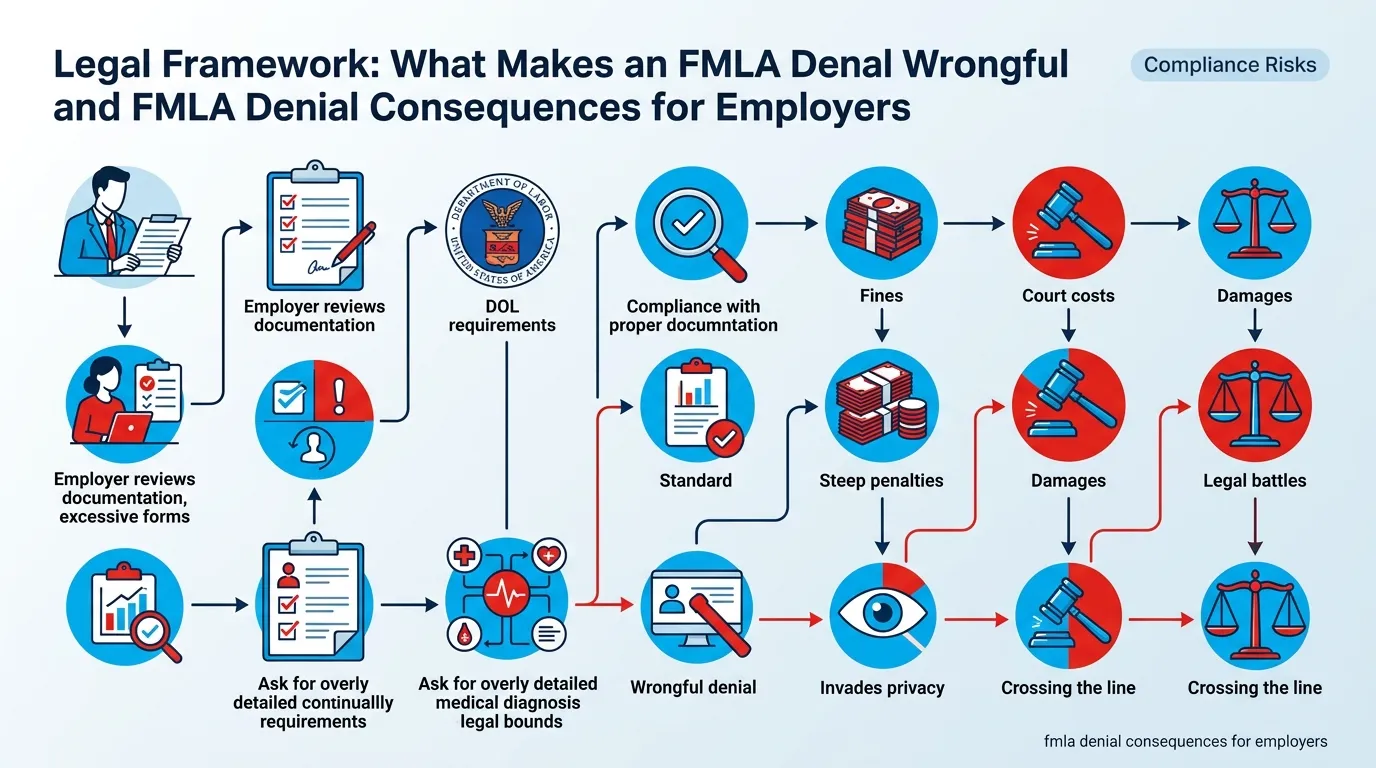
Valid Reasons Employers Can Deny FMLA
Employers can legally deny FMLA only in three specific situations. The employee hasn’t worked 12 months for the company. The employee hasn’t logged 1,250 hours in the past year. The worksite doesn’t have 50 employees within 75 miles.
Beyond eligibility, employers can deny when the reason doesn’t qualify under federal law. Personal illness that doesn’t meet the serious health condition standard gets denied. Caring for a grandparent or sibling isn’t covered. Routine medical appointments without incapacity don’t qualify.
Incomplete medical certification after opportunity to cure also justifies denial. The provider left required fields blank. The form doesn’t explain functional limitations. The certification lacks specific frequency or duration details.
Common Denial Mistakes That Violate Federal Law
Wrongful denials create employer liability for denying FMLA and trigger retaliation damages.
Rejecting leave for qualifying conditions like anxiety or migraines violates the law. Many employers wrongly assume mental health conditions aren’t serious enough.
Denying intermittent leave when medically necessary is another common violation. Employers denying FMLA even with proper medical certification face steep penalties. Requiring more documentation than DOL forms require crosses the line.
Asking for diagnosis details beyond what’s legally needed invades privacy.
Retaliation against employees who request leave triggers automatic violations. Demoting someone after they apply for FMLA is illegal. Cutting hours or changing shifts because of a leave request violates federal protection.
The Difference Between Denial and Delay
Delaying leave approval while requesting additional information differs from outright denial. Employers can ask for clarification on incomplete forms. They can request recertification for ongoing conditions. This process is legal when done properly.
This is covered in detail in when employers can deny FMLA.
However, excessive delays become constructive denial. Taking weeks to review complete paperwork violates the five-day response rule. Repeatedly requesting unnecessary documentation creates illegal barriers. These tactics expose employers to the same penalties as direct denial.
Employers must provide specific written reasons for denial within five business days. The notice must cite the exact regulation violated. Vague explanations like “doesn’t qualify” don’t meet legal standards.
This documentation requirement protects both parties from disputes.
DOL Wage and Hour Investigation Triggers
Employees can file complaints with the DOL Wage and Hour Division at no cost. This triggers an investigation of your FMLA practices. The process moves quickly once a complaint lands. You don’t get advance warning before investigators start asking questions.
How DOL Investigations Work
Once a complaint is filed, DOL investigators contact your HR department.
They request employee records, leave policies, and certification documents. Investigators interview managers and review your entire FMLA program. The scope often expands beyond the initial complaint.
What starts as one employee’s denial can become a full audit. Investigators look for patterns across your workforce. They check whether you’ve denied other employees improperly. They review how you handle intermittent leave requests.
They examine whether you’ve retaliated against employees who took FMLA leave.
Remedies: Reinstatement, Back Pay, Benefits Restoration
DOL can order multiple remedies when they find violations. Reinstatement puts wrongfully terminated employees back in their jobs. Back pay covers lost wages from the denial date through resolution. Restoration of benefits includes health insurance and retirement contributions you should have maintained.
You’ll also pay the employee’s out-of-pocket medical costs. Legal fees add up fast when employees hire attorneys. Willful violations carry civil penalties up to $2,374 per violation. That number adjusts annually for inflation.
Public Records and Repeat Offender Status
DOL maintains a public database of violators. Your company name appears in search results. Potential employees research your compliance history.
Clients and partners see your violations listed.
Repeat offenders face enhanced scrutiny and higher penalties. DOL flags your company for priority investigations. You may face debarment from federal contracts.
Government agencies won’t do business with companies showing patterns of FMLA violations and retaliation. That reputation damage lasts years beyond the initial penalty.
Private Lawsuits: What Employees Can Recover
When employers deny FMLA leave wrongfully, employees can file private lawsuits to recover damages. These cases often result in substantial financial penalties.
Understanding what employees can claim helps employers grasp the true cost of FMLA denial consequences for employers.
Types of Damages Available Under FMLA
Employees can sue for economic damages. This includes lost wages from the denial period. It also covers lost benefits like health insurance premiums or retirement contributions.
Out-of-pocket medical expenses caused by the denial are recoverable too.
Liquidated damages equal the economic damages amount. This essentially doubles the award. Employers can avoid liquidated damages only by proving they made a good faith effort to comply with FMLA. That’s a high bar to clear in court.
Emotional distress damages become available when denial involves discrimination or retaliation. If an employer denied leave because of pregnancy, disability, or to punish the employee, additional damages apply. These cases carry higher financial risk.
Real Settlement and Verdict Amounts
A wrongful FMLA denial settlements typically range from $25,000 to $150,000.
The amount depends on lost wages and circumstances. A three-month denial for someone earning $60,000 annually means $15,000 in lost wages. With liquidated damages, that becomes $30,000 before legal fees.
Jury verdicts can exceed $500,000 in severe cases. Pregnancy discrimination combined with FMLA denial often produces six-figure awards. Disability discrimination cases follow the same pattern.
Egregious retaliation cases where employers fired someone for requesting leave push verdicts even higher.
These amounts don’t include the employer’s defense costs. Legal fees add substantially to the total financial impact.
Legal Fees and Litigation Costs
Employers pay their own legal fees throughout the case. Defense costs typically run $50,000 to $150,000 for cases that go to trial. Even settlements require attorney time for negotiation and documentation.
When employees win, employers also pay the employee’s attorney fees.
This is mandatory under FMLA. Employee attorney fees add another $50,000 to $200,000 to the total cost. Combined with the judgment or settlement, total costs easily reach $200,000 to $400,000.
Employees who understand how to appeal an FMLA denial often pursue litigation when internal appeals fail. This makes proper initial handling a priority for employers.
Retaliation Claims: The Bigger Risk
FMLA denial consequences for employers extend far beyond the initial violation. FMLA retaliation claims create the most expensive exposure. These claims arise when you take adverse action against an employee who requested or used FMLA leave.
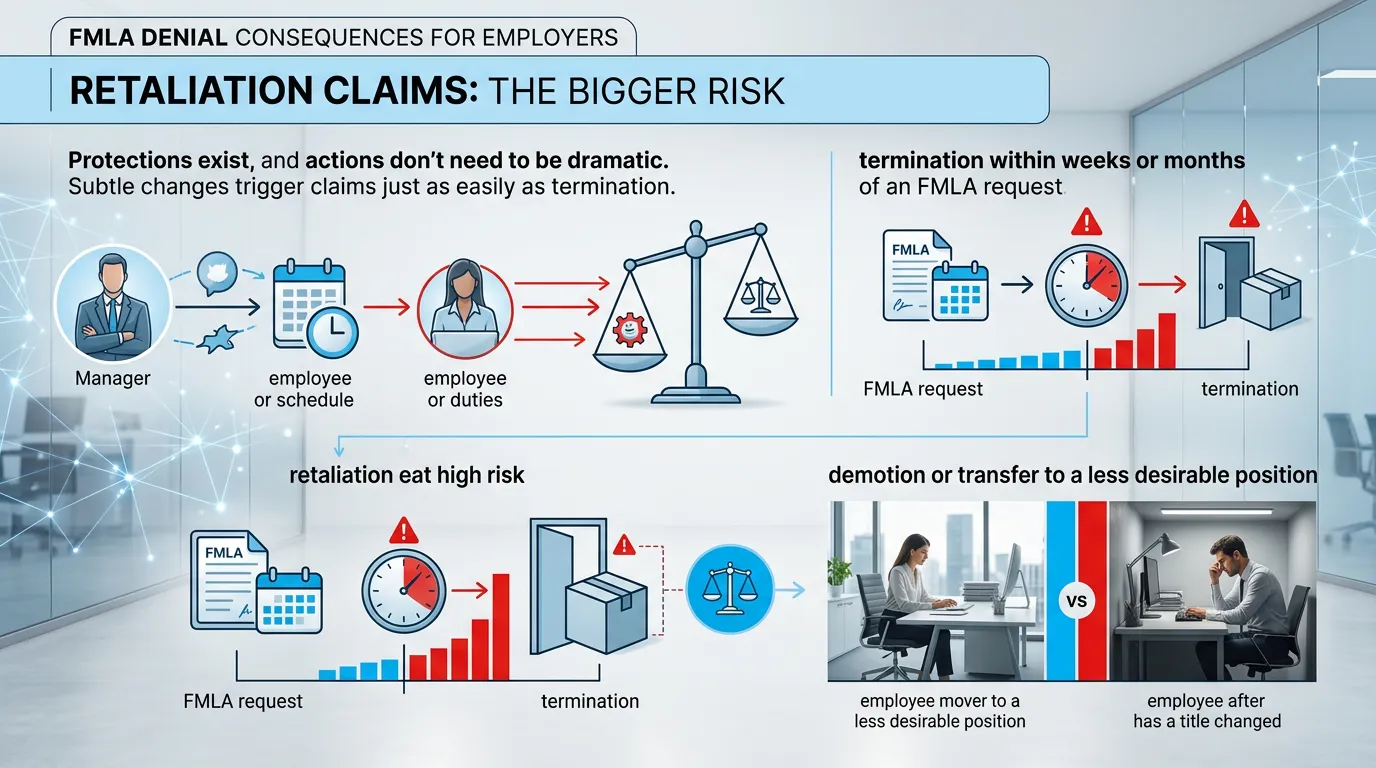
Retaliation and Interference Claims (Employee Perspective Summary)
Retaliation happens when you punish an employee for exercising federal protections under FMLA. The action doesn’t need to be dramatic. Subtle changes trigger claims just as easily as termination.
Common retaliation actions include:
-
Termination within weeks or months of an FMLA request
-
Demotion or transfer to a less desirable position
-
Reduced hours or shift changes that harm the employee
-
Negative performance reviews that didn’t exist before leave
-
Exclusion from meetings, projects, or advancement opportunities
Timing creates a strong inference of retaliation. If you fire someone two weeks after they return from FMLA leave, that pattern alone suggests wrongful intent. Courts scrutinize the proximity between protected activity and adverse action.
How Retaliation Claims Increase Damages
Retaliation claims are easier to prove than wrongful denial. Employees only need to show FMLA activity was a motivating factor. It doesn’t have to be the sole reason. This lower burden shifts the advantage to plaintiffs.
Standard FMLA violations allow back pay and lost benefits. Retaliation claims add compensatory and punitive damages on top. This can increase total exposure by three to five times the base amount.
Juries respond strongly to retaliation cases involving pregnancy, cancer treatment, or mental health conditions. These sympathetic fact patterns drive higher verdicts.
What starts as a $50,000 back pay claim becomes a $250,000 judgment after compensatory and punitive damages.
Compliance Strategies to Avoid Denial Consequences
Avoiding FMLA denial consequences for employers starts with smart prevention.
Most violations happen because HR teams rush decisions or misunderstand requirements. The good news is you can protect your organization with clear processes.
When in Doubt, Approve Conditionally
Never deny a request outright while waiting for complete paperwork. Approve leave conditionally instead. This protects you from interference claims if the employee later proves eligibility.
Give employees the full 15 days to submit medical certification. Don’t pressure them to rush. According to DOL compliance best practices, conditional approval while awaiting documentation is the safest approach. You can always revoke leave if certification never arrives.
Working With Medical Certification Issues
Incomplete certification is common. Don’t reject it immediately. Send a written notice specifying exactly what information is missing. Be specific about which fields need completion.
Give employees at least seven days to fix deficiencies. This cure period is required by law. Track these deadlines carefully. Document when you sent the notice and when the corrected form arrived. Share FMLADocs resources when requesting medical documentation so employees understand what’s needed.
Documentation HR Needs Before Denying Leave
Train HR staff and managers on FMLA basics. They need to recognize protected requests. They must avoid statements that could be construed as interference or retaliation.
Document every communication about FMLA requests. Record dates, times, what was discussed, and what documents were provided. This paper trail protects you in disputes.
Consult employment counsel before denying requests involving pregnancy, mental health, chronic conditions, or employees who complained about workplace issues.
These cases carry higher litigation risk. Consider using third-party FMLA administrators for complex cases. This creates separation between management and leave decisions, reducing bias claims.
Second and Third Opinion Processes Done Correctly
When medical certification raises questions, employers have the right to request a second opinion. This must be done carefully to avoid retaliation claims. The employee must be notified in writing of the reason for the second opinion request.
The second opinion physician must be selected by the employer but paid by the company, not the employee. The employee has the right to attend the appointment.
The results must be provided to the employee in writing within a reasonable timeframe.
If the first and second opinions conflict, a third opinion may be obtained. Again, the employer pays and the employee can attend. The third opinion is binding on both parties. This process, when followed correctly, protects your right to verify eligibility while respecting employee privacy and legal requirements.
Training Managers to Avoid Informal Denials
Many wrongful denials happen informally through manager conversations rather than official HR decisions. A manager might tell an employee “we can’t do that” without proper legal analysis. These casual denials create the same liability as formal rejections.
Train all managers on FMLA basics and the prohibition against informal denials. Managers must refer all leave requests to HR for formal evaluation. They cannot make eligibility determinations on their own. They cannot tell employees their requests are denied without HR involvement.
Establish a clear protocol: any manager receiving a leave request must forward it to HR within one business day. Create a template for this referral so nothing gets lost. Track these referrals to verify no requests fall through the cracks. Document that managers received training on this requirement.
When to Consult Employment Counsel
Not every FMLA question requires an attorney, but certain situations demand legal review before you act. Consult employment counsel when requests involve pregnancy, childbirth, or related medical conditions. These cases carry high litigation risk and discrimination exposure.
Mental health conditions, disability claims, and chronic illness requests also warrant legal review. Requests from employees who have filed complaints about workplace issues need counsel involvement. If you’re unsure whether a condition qualifies as serious health condition, consult before denying.
Having counsel review your denial decision before you send it to the employee can prevent costly mistakes. The cost of a quick legal consultation is minimal compared to litigation expenses. If you’ve already denied a request and now have doubts, consult counsel immediately about remediation options.
Conclusion
Wrongful FMLA denial creates serious financial and legal exposure. You face DOL enforcement, private lawsuits, and retaliation claims that can cost six figures or more.
The risks include back pay, liquidated damages, civil penalties, and attorney fees. Beyond direct costs, wrongful denial damages your reputation and invites DOL scrutiny of your entire program.
Most denial mistakes happen when employers misunderstand serious health conditions. Others rush to deny before employees complete certification. Some fail to recognize intermittent leave rights. These errors are preventable with proper training and careful documentation.
The best protection is to err on the side of approval when eligibility is unclear. Work with providers who understand FMLA requirements to prevent incomplete paperwork. This approach helps you avoid the employer liability for denying FMLA that leads to costly disputes.
We connect you with licensed healthcare professionals who complete certification correctly the first time. This prevents the documentation gaps that lead to wrongful denials and keeps your FMLA program compliant.
Frequently Asked Questions
What happens if an employer wrongly denies FMLA?
Potential DOL enforcement, lawsuits, reinstatement, and back pay.
Can employees sue over FMLA denial?
Yes in federal court after DOL process or direct suit where permitted.
Are managers personally liable?
Usually employer entity; retaliation still creates corporate liability.
What is FMLA interference?
Discouraging or preventing FMLA rights regardless of intent.
How should HR document denials?
Written eligibility/certification basis, dates, and cure opportunities offered.
Can denying leave be retaliation?
If motivated by protected activity, yes — separate from validity of denial.
Does partial approval reduce risk?
Designating only part of absence as FMLA still requires proper notices.
How can employers reduce denial disputes?
Employers should respond promptly to potential FMLA requests, provide Form WH-381 or an equivalent notice when required, explain certification deficiencies clearly, and give employees the required opportunity to correct them. HR should also apply leave policies consistently, train managers to recognize potential FMLA requests, and document the reason for every approval or denial. An employee does not always have to mention “FMLA” for the employer’s responsibilities to begin.

Meet the author
Anam Moin
I'm Anam Moin, and my work at FMLADocs focuses on workplace leave and FMLA education. I cover certification, documentation, employee rights, and leave-related questions to provide readers with useful information when they need it most.
Get Your FMLA Certification Online in Minutes