

FMLA Denial Consequences for Employers
 by Nida Hammad
Last updated:
FMLA denial consequences for employers can reach six figures before you ever enter a courtroom. A single wrongful denial triggers Department of Labor investigations, employee lawsuits, and federal penalties that compound fast. What starts as a rejected leave request can escalate into retaliation claims and years of litigation.
Employers face serious legal exposure when they deny FMLA leave improperly. Even well-intentioned HR decisions can violate federal law. The costs add up quickly: legal defense fees, back pay, damages, and reputational harm that extends far beyond the original leave request. Most companies don’t realize the full scope of employer liability for denying FMLA leave until investigators arrive or lawsuits get filed.
This guide breaks down the specific legal, financial, and operational risks you face after denying FMLA leave. You’ll learn when denials cross into unlawful territory, how interference and retaliation claims differ, what penalties and damages courts award, and how violations escalate into class actions. You’ll also get practical FMLA compliance strategies for businesses to protect your organization before violations happen.
Understanding FMLA denial consequences for employers helps you avoid costly mistakes that threaten your business and your employees’ rights.
FMLA Denial Consequences for Employers: What Happens After a Denial?
When you deny an employee’s FMLA request, the clock starts ticking on potential legal exposure. FMLA denial consequences for employers begin immediately. Employees have 30 days to file internal appeals or contact the Department of Labor. Many also consult employment attorneys during this window. Every email you send becomes part of a documentation trail. Every policy interpretation gets scrutinized. Every manager statement can surface in discovery if litigation follows.
The denial itself creates a paper trail that follows your organization. Courts examine how you applied FMLA criteria to this specific case. They compare your decision to how you’ve handled similar requests. Inconsistent application of policies becomes evidence of discrimination or retaliation. Understanding what happens after an FMLA denial helps you prepare for the scrutiny ahead.
The Immediate Aftermath of an FMLA Denial
Your HR team must act fast after denying leave. You’re required to provide written notice explaining the specific reasons for denial. This notice must cite which eligibility criteria the employee failed to meet. Vague explanations like “does not qualify” open you to wrongful FMLA denial penalties. The employee can challenge your reasoning immediately.
Many employees continue working after denial while documenting their health deterioration. They track symptoms, medical appointments, and functional limitations. This documentation strengthens damages claims if they’re later terminated or forced to resign. Some employees file internal grievances through your company’s complaint process. Others contact the Department of Labor’s Wage and Hour Division within days.
Employee Response Options Following Denial
Employees have multiple paths to challenge your decision. They can file a complaint with the Department of Labor, which triggers an investigation into your FMLA compliance practices. They can hire an employment attorney to review the denial for violations. They can also file a lawsuit in federal or state court within two years of the alleged violation.
Internal complaints about the denial create protected activity status. Any adverse action you take against the employee after they complain creates additional employer liability for denying FMLA leave. This includes discipline, demotion, schedule changes, or termination. Courts view these actions as potential retaliation, which carries separate damages beyond the original denial. Avoiding common FMLA mistakes during the application process reduces your exposure to these claims.
Timeline of Escalating Consequences
The first 30 days after denial are when most employees decide whether to pursue legal action. If they file a Department of Labor complaint, you’ll receive an investigation notice within 60-90 days. The DOL reviews your eligibility determination, certification requirements, and documentation. They interview the employee and examine your FMLA policies. If they find violations, they can require back pay, reinstatement, and policy changes.
FMLA violation lawsuits and damages can take 12-24 months to resolve. Discovery requires you to produce all communications about the denial. You’ll provide emails, text messages, meeting notes, and policy manuals. The employee’s attorney will depose HR staff and managers involved in the decision. Settlement discussions often begin after discovery reveals documentation problems. If the case goes to trial, you face potential damages including lost wages, benefits, liquidated damages equal to lost wages, attorney fees, and court costs.
FMLA Denial Consequences for Employers: Legal and Financial Risks
Wrongful FMLA denial penalties can devastate a business financially. Legal defense costs alone typically range from $75,000 to $250,000 even when employers win. Complex cases exceed $500,000 in legal fees. That’s before any settlement or verdict.
Employers can’t recover legal fees even after winning FMLA cases. This makes litigation expensive regardless of outcome. It also pushes many businesses toward early settlement to cut losses.
Direct Monetary Exposure From FMLA Violations
Settlement amounts for FMLA violations average between $50,000 and $150,000. Jury verdicts reach millions when cases involve clear retaliation or egregious conduct. According to a costly FMLA denial case, supervisors can face personal liability alongside their employers.
Employer liability for denying FMLA leave includes back pay, front pay, and liquidated damages. Liquidated damages equal the amount of wages lost. This doubles the financial hit. Courts also award attorney fees to winning employees.
Hidden Costs Beyond Settlement Amounts
FMLA violation lawsuits and damages extend beyond direct payments. Businesses face productivity losses during litigation. Management spends months in depositions and document review. Employee morale drops when coworkers see unfair treatment.
Department of Labor FMLA enforcement adds another layer. DOL investigations require extensive documentation and compliance audits. Repeat violations trigger increased scrutiny. Some businesses face ongoing monitoring requirements.
Insurance Coverage Limitations
Employment Practices Liability Insurance typically covers FMLA defense costs. But policies include deductibles ranging from $25,000 to $100,000 per claim. That’s out-of-pocket before coverage starts.
FMLA retaliation claims often fall outside standard coverage. Policies exclude willful violations and intentional misconduct. This leaves employers fully exposed for deliberate denials. The cost of FMLA litigation for employers becomes uninsured risk.
Smart FMLA compliance strategies for businesses start with proper training. HR teams need clear protocols for handling requests. FMLADocs helps businesses verify medical certifications quickly, reducing denial risks. Prevention costs far less than defending wrongful denial lawsuits.
FMLA Denial Consequences for Employers: When Is a Denial Unlawful?
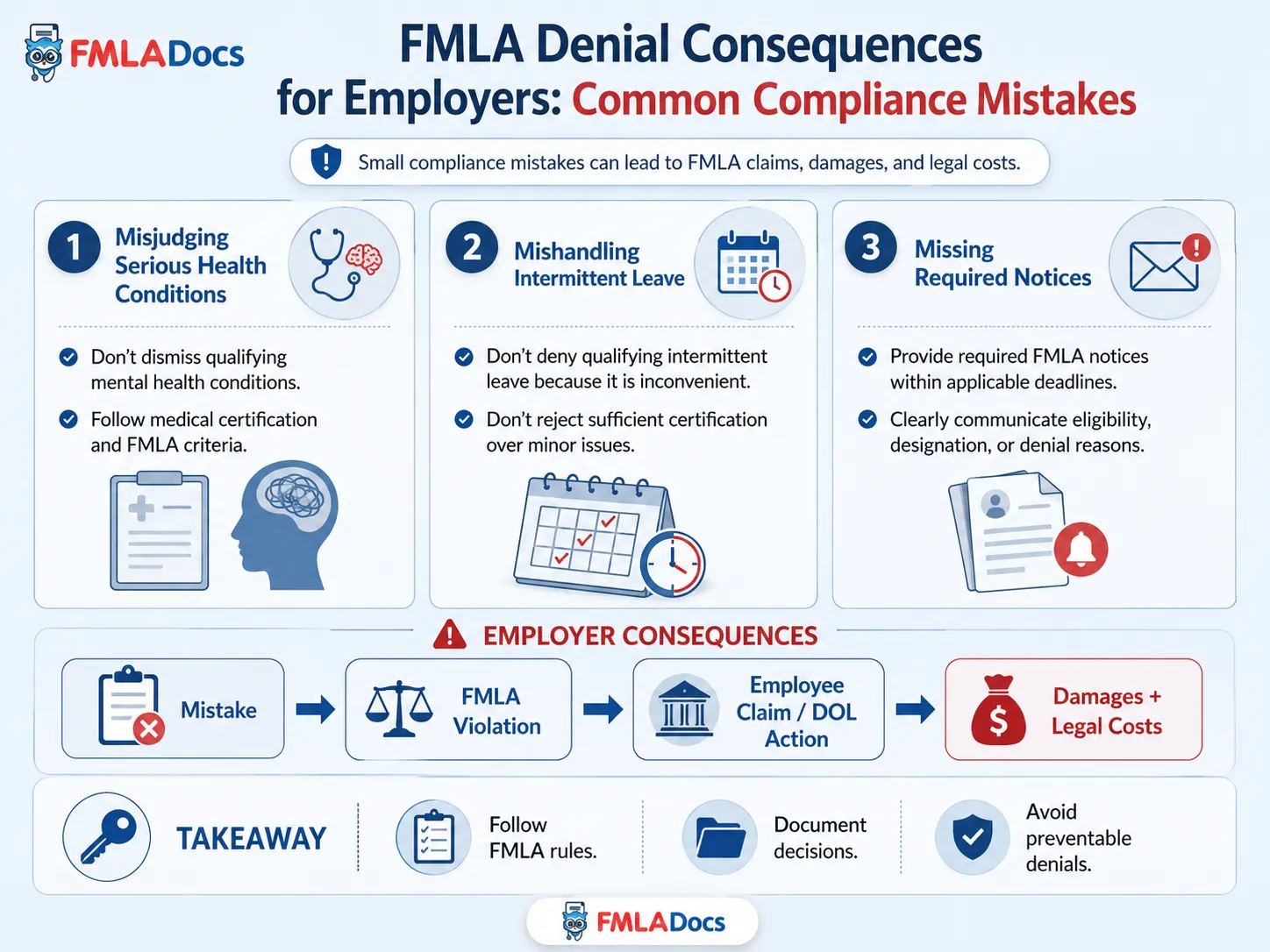
Understanding FMLA denial consequences for employers starts with knowing when a rejection crosses into unlawful territory. Wrongful denial occurs when employers reject valid requests without proper grounds. It also happens when they fail to provide required notices within five business days. Retaliation against employees for requesting leave violates federal law. So does interfering with FMLA rights through discouragement or misinformation.
These violations expose employers to Department of Labor FMLA enforcement actions. They also open the door to FMLA violation lawsuits and damages. The cost of FMLA litigation for employers can reach hundreds of thousands of dollars. That’s why understanding when employers can lawfully deny FMLA requests matters so much.
Federal Standards for Lawful FMLA Denials
Employers can only lawfully deny FMLA when specific conditions aren’t met. The employee must have worked for the employer at least 12 months. They must have logged 1,250 hours in the past 12 months. The employer must have 50 or more employees within 75 miles of the worksite.
Beyond eligibility, the reason for leave must qualify under federal law. Employees need a serious health condition or qualifying family situation. They must also provide adequate medical certification after reasonable opportunity. Denying leave because an employee doesn’t meet these thresholds is lawful.
Common Scenarios That Constitute Wrongful Denial
Denying leave for mental health conditions frequently constitutes wrongful denial. Anxiety, depression, and PTSD are serious health conditions under federal law. Rejecting intermittent leave requests without valid reasons also violates FMLA protections.
Challenging medical certifications for minor incompleteness is another common violation. Employers who demand excessive detail or reject forms over small gaps create employer liability for denying FMLA leave. FMLADocs helps businesses avoid these pitfalls by working with licensed healthcare professionals who complete certifications correctly the first time.
The Burden of Proof in FMLA Disputes
The burden of proof in FMLA cases often falls on employers. They must show they followed proper procedures. They must demonstrate they had legitimate, non-retaliatory reasons for adverse employment actions. This includes documenting why they denied leave or disciplined an employee.
FMLA retaliation claims arise when employers can’t prove their actions were unrelated to the leave request. Courts scrutinize timing closely. If discipline or termination happens shortly after an FMLA request, employers face an uphill battle. Strong FMLA compliance strategies for businesses include detailed documentation and consistent policy application across all employees.
Understanding FMLA Denial Consequences for Employers
FMLA denial consequences for employers extend far beyond simple policy violations. The law creates a framework where mistakes can cost companies hundreds of thousands in damages. Understanding these risks helps you build better compliance systems.
The Legal Framework Behind FMLA Protections
FMLA provides job-protected leave for up to 12 weeks annually. This covers serious health conditions, childbirth, adoption, and military family needs. According to federal FMLA protections, violations carry both civil and criminal penalties under federal law.
Employers must respond to requests within five business days. You can’t require employees to meet standards beyond federal requirements. Company-specific forms don’t replace DOL certification forms.
Why FMLA Violations Carry Severe Penalties
Congress designed FMLA penalties to be employee-friendly and strictly enforced. Workers facing serious health conditions are vulnerable to employer pressure. The law recognizes this power imbalance.
Wrongful FMLA denial penalties include back pay, lost benefits, and liquidated damages. Liquidated damages equal the amount of lost wages and benefits. This doubles your financial exposure immediately.
Employer liability for denying FMLA leave also covers attorney fees and court costs. These expenses add up fast during litigation. Many cases settle for six figures before trial.
How Courts Interpret Employer Obligations
Courts interpret FMLA broadly in favor of employees. You must err on the side of granting leave when questions arise. Eligibility or certification doubts don’t justify automatic denial.
FMLA retaliation claims succeed when employees show adverse action after requesting leave. Timing matters here. A termination two weeks after an FMLA request raises red flags.
The cost of FMLA litigation for employers goes beyond damages. Your reputation suffers. Employee morale drops. Department of Labor FMLA enforcement investigations disrupt operations for months.
FMLA Denial Consequences for Employers: Interference and Retaliation
FMLA denial consequences for employers fall into two distinct legal categories. Interference claims and retaliation claims carry different burdens of proof. Both can result in costly litigation and damages.
Distinguishing Interference From Retaliation Claims
Interference occurs when employers prevent employees from exercising FMLA rights. This includes denying leave requests, failing to restore employees to equivalent positions, or blocking access to benefits. Employees must prove the employer violated a substantive FMLA provision.
Retaliation happens when employers take adverse actions against employees for FMLA-related activities. This includes requesting leave, filing complaints, or participating in proceedings. The burden of proof is lower. Employees need only show FMLA activity was a motivating factor in the adverse action.
The distinction matters for damages. Interference claims typically result in lost wages and benefits. Retaliation claims can include emotional distress and punitive damages in some jurisdictions.
How Retaliation Claims Arise After Denial
According to employment attorneys analyzing ways employers deny medical leave, retaliation scenarios follow predictable patterns. Termination shortly after FMLA requests is the most common. Demotions or reduced hours following leave also trigger claims.
Other scenarios include negative performance reviews tied to absences. Hostile work environments after return from leave create additional liability. These actions often trigger discrimination claims under ADA or state laws.
Employer liability for denying FMLA leave extends beyond federal penalties. Multiple claims can stack. A single wrongful denial can result in FMLA retaliation claims, disability discrimination, and state law violations.
Protected Activities Under FMLA
Employees are protected when they request FMLA leave, even if denied. Filing complaints with the Department of Labor is protected. Participating in FMLA-related investigations or proceedings also qualifies.
Protected activities include:
-
Requesting information about FMLA eligibility
-
Submitting medical certification forms
-
Opposing unlawful FMLA practices
-
Testifying in FMLA proceedings
The cost of FMLA litigation for employers includes legal fees, settlement payments, and reputational damage. Retaliation damages often exceed interference damages. Emotional distress awards can reach six figures. Punitive damages multiply total liability.
FMLA compliance strategies for businesses must address both interference and retaliation risks. Training managers on protected activities reduces exposure. Clear documentation of performance issues unrelated to leave provides defense.
FMLA Denial Consequences for Employers: Potential Penalties and Damages
When employers deny valid FMLA requests, they face serious legal and financial risks. The consequences range from federal fines to costly lawsuits. Understanding these penalties helps businesses avoid violations that can damage both finances and reputation.
Civil Monetary Penalties From the Department of Labor
The Department of Labor enforces FMLA posting requirements strictly. Employers must display official FMLA notices where employees can see them. Failing to post these notices triggers civil penalties up to $228 per violation.
Each day without proper posting counts as a separate violation. This means fines can climb into tens of thousands of dollars quickly. A business that goes six months without required notices faces over $40,000 in potential penalties.
Beyond posting violations, the DOL investigates complaints about wrongful FMLA denial penalties. When investigations reveal violations, employers must correct them immediately. The agency can also pursue back pay and reinstatement for affected workers.
Employee Lawsuit Damages and Remedies
Workers have the right to sue when employers violate FMLA protections. According to Find Law, employees can recover multiple types of damages through these lawsuits. Lost wages and benefits form the foundation of most claims.
Courts can order reinstatement to the employee’s former position. When reinstatement isn’t possible, front pay compensates for future lost earnings. Employees also recover attorney’s fees and court costs. This shifts the entire litigation expense to the employer.
The financial exposure doesn’t stop there. Liquidated damages can double the total award. This makes employer liability for denying FMLA leave far more expensive than simply approving valid requests.
Liquidated Damages That Double Financial Exposure
Liquidated damages equal the amount of lost wages and benefits. They’re presumed in FMLA cases unless employers prove good faith. The employer must show they had reasonable grounds to believe their conduct was lawful.
This standard is difficult to meet. Courts rarely accept ignorance of FMLA requirements as good faith. Even unintentional violations often result in doubled damages. A $50,000 lost wage claim becomes $100,000 with liquidated damages added.
Willful violations carry even harsher consequences. When employers show intentional disregard for FMLA requirements, criminal prosecution becomes possible. Responsible corporate officers can face fines up to $10,000. They can also receive imprisonment for up to six months. These criminal penalties apply when violations demonstrate deliberate defiance of federal law.
How FMLA Denial Consequences for Employers Can Escalate
A single wrongful denial can spiral into far more serious legal exposure. What starts as one employee’s complaint can grow into class action litigation. When FMLA violations affect multiple workers, damages multiply fast. Legal costs can jump from thousands to millions.
From Single Denial to Class Action Exposure
Class actions emerge when patterns of FMLA denial consequences for employers become clear. One denied request might reveal systemic policy failures. Other employees with similar experiences join the case. Each plaintiff adds separate damages to the total.
Employers face exposure on multiple fronts. Back pay covers lost wages during denied leave. Liquidated damages can double that amount. Attorney fees pile on top. When ten employees join a class action, a $50,000 individual case becomes a $500,000 problem.
Compounding Liability Through Retaliation
Retaliation claims make bad situations worse. After denying leave, some employers discipline the employee. Others cut hours or reassign duties. Each adverse action creates a separate violation.
According to the EEOC guidance on FMLA and employment discrimination laws, wrongful FMLA denial penalties compound when retaliation intersects with discrimination claims. An employee denied leave for pregnancy complications can file both FMLA interference and sex discrimination charges. Someone with cancer faces disability discrimination on top of FMLA violations.
Each claim carries its own damages calculation. The employer liability for denying FMLA leave grows with every additional charge. What began as one denial becomes three or four separate legal theories.
Media Attention and Public Relations Damage
FMLA violation lawsuits and damages become public record. Court filings name the employer and describe the denial. Sympathetic plaintiffs attract media coverage. Stories about cancer patients losing jobs or new parents fired after childbirth spread fast.
Social media amplifies the damage. Former employees share their experiences online. Current workers see the posts. Job candidates research the company and find the lawsuit. The cost of FMLA litigation for employers extends beyond legal fees into recruitment challenges and customer backlash.
Avoiding FMLA Denial Consequences for Employers
Employers face serious legal and financial risks when they deny FMLA leave improperly. Wrongful FMLA denial penalties include back pay, damages, and attorney fees. The best defense is a proactive approach that prevents violations before they happen.
Strong policies, trained staff, and careful documentation protect your business from costly mistakes.
Implementing Robust FMLA Policies and Procedures
Your written FMLA policy should exceed minimum federal requirements. It must clearly define eligibility criteria, qualifying reasons, and notice procedures. Include specific examples of conditions that qualify under FMLA.
Review your policy annually with employment counsel. Regulations change, and outdated policies create gaps in compliance. Your policy should address intermittent leave, military family leave, and coordination with state laws.
Make sure your policy explains how employees request leave. Outline what happens after a request is submitted. Clarify timelines for employer response and certification deadlines. Understanding employer FMLA obligations under federal law helps you build policies that actually protect your organization.
Training HR Staff and Managers on FMLA Requirements
Regular training prevents the most common denial mistakes. HR staff and managers need to understand eligibility criteria, notice requirements, and certification standards. They must know intermittent leave rules and how to avoid retaliation.
Use scenario-based exercises during training. Present real situations your team might face. Walk through proper responses step by step. This builds confidence and reduces errors when actual requests arrive.
Train managers to recognize FMLA-qualifying situations even when employees don’t mention FMLA by name. Someone saying they need time off for chemotherapy triggers FMLA obligations. So does an employee mentioning anxiety treatment or a parent’s hospitalization.
Documentation Best Practices for FMLA Administration
Document every communication about leave requests. Save emails, notes from phone calls, and copies of all forms. When you deny leave, include specific regulatory citations explaining why.
Keep contemporaneous notes about certification reviews and restoration decisions. Write down what you observed and when. These records protect you if a dispute arises later.
When certification appears incomplete, don’t immediately deny the request. Identify specific deficiencies in writing. Give the employee a reasonable opportunity to cure the problem. This approach shows good faith and reduces your liability risk.
How Employers Can Prevent FMLA Denial Consequences
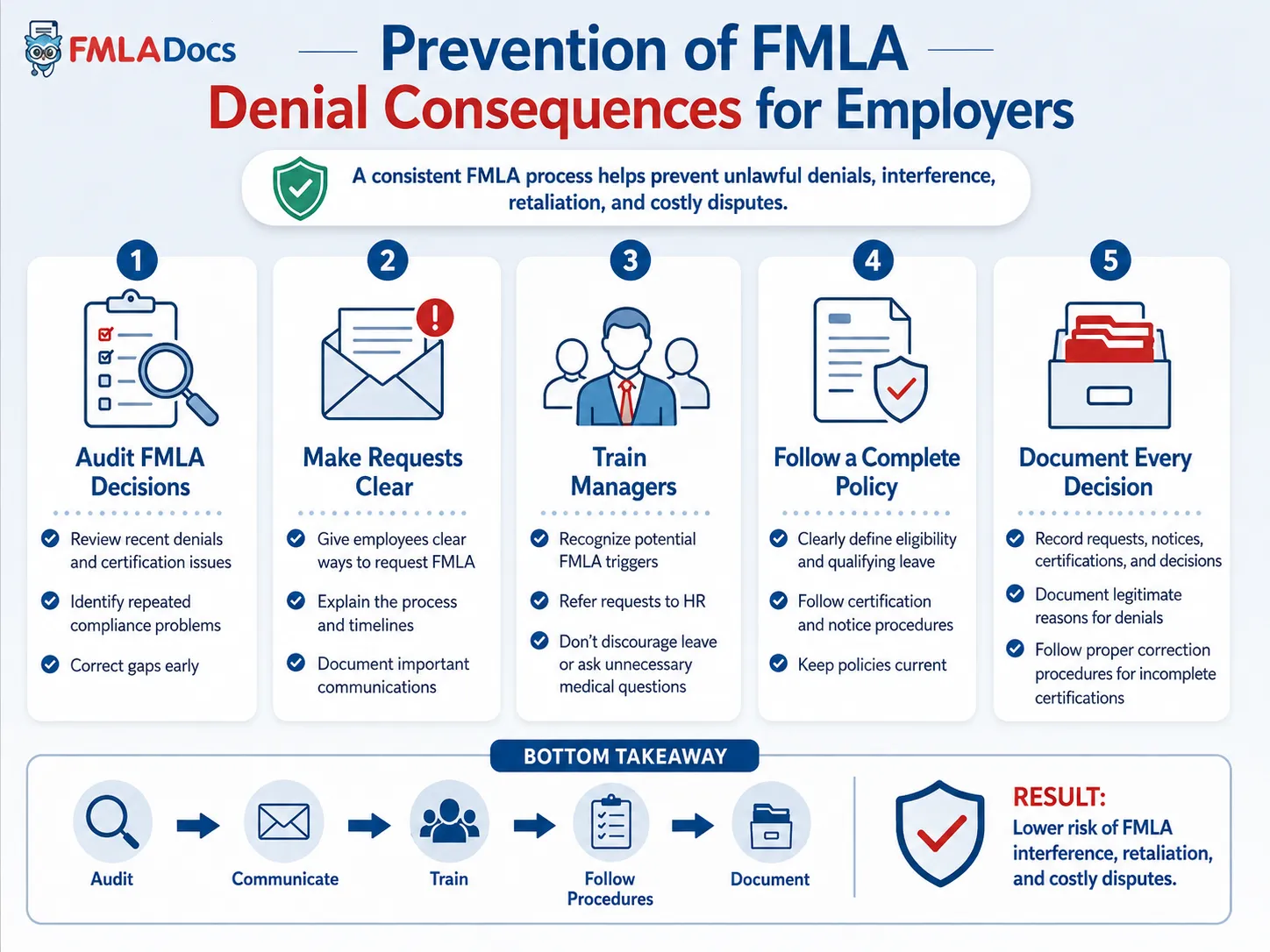
Avoiding FMLA denial consequences for employers starts with proactive compliance. Companies that wait for lawsuits to identify gaps pay far more than those who audit regularly. Prevention costs less than litigation.
Conducting Periodic FMLA Compliance Audits
Employers should review FMLA processes quarterly. This catches problems before they become lawsuits. Audits should examine recent leave requests, denial patterns, and return-to-work outcomes.
Look at employee complaints too. Patterns reveal where your process breaks down. Did three employees in one department get denied in six months? That signals a manager problem.
-
Review all denials from the past 12 months
-
Check certification forms for completeness
-
Verify managers followed proper referral procedures
-
Document gaps and create action plans
Track how long certification reviews take. Delays often indicate understaffing or unclear procedures. Fix these before they cause wrongful FMLA denial penalties.
Establishing Clear Communication Channels
Employees need safe ways to ask FMLA questions. Fear of retaliation stops many from requesting leave they qualify for. That creates liability when they take unprotected time off instead.
Create multiple contact points. Some employees prefer email. Others want phone calls. A few need in-person meetings. Offer all three options.
Train HR staff on permissible employer inquiries during FMLA requests to avoid violations. Staff must know what they can and can’t ask. Overstepping creates retaliation claims.
Document every interaction. Written records protect both parties. They prove you provided information when disputes arise later.
Creating a Culture That Supports Leave Requests
Organizational culture drives how managers respond to FMLA requests. Companies that treat leave as a burden create legal exposure. Those that normalize it reduce risk.
Train managers to recognize FMLA-qualifying situations immediately. They should refer employees to HR, not make decisions themselves. Front-line supervisors lack the expertise to evaluate medical conditions.
Stop managers from asking medical questions. That’s HR’s job. Manager involvement in medical discussions creates employer liability for denying FMLA leave.
Treat FMLA requests as routine business processes. Don’t make employees feel guilty for using legal protections. Guilt-tripping is retaliation, and it’s expensive when employees sue.
FMLA Denial Consequences for Employers: What HR Teams Need to Know
HR teams face serious liability when they mishandle FMLA requests. Understanding FMLA denial consequences for employers starts with knowing what triggers legal exposure. Most violations stem from eligibility miscalculations or procedural errors that could have been avoided.
Critical Compliance Knowledge for HR Professionals
HR must calculate eligibility carefully. You need to verify 12 months of employment, 1,250 hours worked in the past year, and 50+ employees within 75 miles. Getting any of these wrong creates liability in both directions.
Denying someone who qualifies opens you to wrongful FMLA denial penalties. Approving someone who doesn’t qualify creates internal policy issues. Both scenarios cause problems.
You also need to recognize what counts as a serious health condition. Mental health conditions, chronic illnesses, and pregnancy complications all qualify. Many HR teams wrongly assume only major surgeries or hospitalizations meet the threshold. That assumption leads to unlawful denials when employees present qualifying conditions like anxiety or migraines that require intermittent leave.
Common HR Mistakes That Lead to Liability
Using company-specific forms instead of DOL forms is a common error. The law requires WH-380-E or WH-380-F. Your custom forms don’t satisfy federal requirements.
Requesting excessive medical information also creates problems. You can ask about functional limitations and treatment schedules. You can’t demand full medical records or detailed diagnosis explanations beyond what the DOL forms request.
Another mistake: failing to designate leave as FMLA-protected when criteria are met. Some HR teams wait for perfect paperwork before providing protection. That delay violates the law when employees give enough notice to trigger FMLA obligations.
Resources and Tools for FMLA Administration
The Department of Labor provides free compliance assistance that HR teams should use. Opinion letters address specific scenarios. Fact sheets explain complex regulations. These resources help you handle novel situations correctly.
Keep FMLA administration separate from performance management. When you discipline someone shortly after they request leave, it looks like retaliation even if the issues are unrelated. Document performance problems before leave requests to protect against FMLA retaliation claims.
Don’t make assumptions when facing unusual situations. Check DOL guidance first. The cost of FMLA litigation for employers far exceeds the time spent verifying compliance upfront.
FMLA Denial Consequences for Employers After an Employee Files a Claim
When employees file complaints with the Department of Labor, the stakes for employers rise sharply. FMLA denial consequences for employers extend beyond initial penalties. They trigger investigations, workplace disruption, and legal exposure that can last years.
Responding to Department of Labor Investigations
DOL complaints require immediate employer response. You must answer information requests within specified timeframes. Failure to cooperate brings additional penalties for obstruction.
Investigations can result in orders requiring back pay. Employers may face reinstatement demands. Benefit restoration becomes mandatory. Compliance programs with ongoing monitoring can extend for years.
That said, many employers underestimate investigation scope. The DOL reviews not just the denied claim. They examine your entire FMLA program. One complaint can expose systemic issues across your workforce.
According to common employer FMLA mistakes, documentation failures and policy inconsistencies trigger the most severe findings. These patterns show wrongful FMLA denial penalties apply broadly when investigators find repeated violations.
Managing Workplace Dynamics During Litigation
Ongoing litigation creates tension in your workplace. This happens when the plaintiff remains employed. It also occurs when they seek reinstatement.
You must manage these situations carefully. Additional retaliation claims arise easily. Supervisors need clear guidance on appropriate interactions. Coworkers may feel caught in the middle.
What’s more, employer liability for denying FMLA leave grows when workplace treatment appears retaliatory. Document every interaction. Train managers on prohibited conduct. Monitor for subtle forms of retaliation.
Preservation of Evidence and Legal Hold Procedures
You must implement legal hold procedures immediately. This starts when an employee files a complaint. Preserve all documents related to the leave request. Include the denial and any subsequent employment actions.
Spoliation sanctions punish evidence destruction. Courts view missing documents as proof of wrongdoing. The cost of FMLA litigation for employers multiplies when you can’t produce requested records.
In short, preserve emails, personnel files, and policy documents. Save manager notes and communication logs. Keep medical certification forms and denial letters. This evidence protects you during Department of Labor FMLA enforcement actions.
FMLA Denial Consequences for Employers: DOL Complaints and Legal Claims
When employers wrongfully deny FMLA leave, they face serious legal exposure. Employees have multiple paths to pursue claims. Each route brings different risks and costs for businesses.
The DOL Complaint Investigation Process
Employees can file complaints with the DOL Wage and Hour Division at no cost. This triggers investigations that examine not just the specific denial but broader FMLA compliance practices.
The DOL reviews your entire FMLA program during investigations. They look at policies, training records, and past leave decisions. One complaint can expose systemic problems you didn’t know existed.
Investigations typically take three to six months. The DOL can order back pay, reinstatement, and policy changes. They can also assess civil penalties up to $27,000 per violation for willful failures.
Private Lawsuits Versus DOL Enforcement
Employees can also file private lawsuits in federal or state court. They don’t need to file DOL complaints first. Many choose litigation for access to jury trials and potentially higher damages.
Private lawsuits allow employees to recover lost wages, benefits, and liquidated damages equal to the amount owed. According to FMLA retaliation damages data, settlements often reach six figures when retaliation is proven.
Employees can also recover attorney fees if they win. This makes it easier to find legal representation. Employers pay their own legal costs regardless of the outcome.
Statute of Limitations for FMLA Claims
The statute of limitations for FMLA claims is two years from the violation date. For willful violations, it extends to three years. This means employers face potential liability for past denials even after employees have left.
DOL enforcement has increased in recent years with larger penalties. More aggressive investigation tactics make proactive compliance more important than ever. Don’t wait for a complaint to fix your FMLA processes.
FMLA Denial Consequences for Employers: Employee Lawsuits and Remedies
When employers wrongfully deny FMLA leave, they face serious legal exposure. Employees can file lawsuits seeking multiple forms of compensation. These cases often cost employers far more than the original leave would have.
Types of Damages Available in FMLA Lawsuits
FMLA lawsuits allow employees to recover economic damages. This includes lost wages, lost benefits, and out-of-pocket medical expenses. But the financial hit doesn’t stop there.
Courts also award liquidated damages that double the economic award. According to Nolo’s analysis of money damages in FMLA cases, this doubling happens unless the employer proves good faith. That’s a high bar to clear.
Employees can also recover attorney’s fees and court costs. This means employers pay their own legal bills plus the employee’s. A $50,000 economic loss becomes $100,000 in liquidated damages, plus legal fees on both sides.
The Discovery Process and Its Costs
Discovery is where FMLA litigation gets expensive fast. Employers must review years of personnel files, emails, policies, and communications. This often requires outside e-discovery vendors.
Costs for e-discovery alone can reach $50,000 to $100,000. That’s before trial preparation even begins. Small businesses find these costs particularly crushing.
HR staff spend hundreds of hours gathering documents and sitting for depositions. This pulls them away from daily operations. The indirect costs add up quickly.
Settlement Negotiations and Trial Outcomes
Most FMLA cases settle before trial. Settlement negotiations typically occur after initial discovery. Both sides understand the strength of evidence by then.
High litigation costs drive settlements. So do unpredictable jury outcomes. Employers weigh the cost of continuing versus settling.
Jury verdicts in FMLA cases are unpredictable. Awards can reach millions when cases involve sympathetic plaintiffs. Clear violations make matters worse. Evidence of callous disregard for employee health needs inflames juries.
Smart employers avoid this exposure through proper FMLA compliance. Working with licensed healthcare professionals like FMLADocs helps employees get proper medical certification. This reduces wrongful denials and the lawsuits that follow.
FMLA Denial Consequences for Employers: Common Compliance Mistakes
FMLA denial consequences for employers often stem from compliance mistakes that seem minor but carry serious legal risks. Many violations happen because HR teams misunderstand what qualifies as a serious health condition. Others fail to handle intermittent leave properly. Some miss required notice deadlines. Each mistake opens the door to Department of Labor investigations and employee lawsuits.
These errors cost companies thousands in back pay, damages, and legal fees. Worse, they damage employee trust and workplace culture. The good news is most mistakes are preventable with proper training and clear procedures.
Misunderstanding What Qualifies as Serious Health Conditions
Employers frequently deny leave for mental health conditions like anxiety and depression. They assume these aren’t legitimate medical issues. That’s wrong. Mental health conditions qualify as serious health conditions under FMLA when they meet the continuing treatment standard.
According to FMLA enforcement mechanisms, denying leave for documented mental health conditions violates federal law. Depression requiring ongoing therapy and medication qualifies. Panic disorder causing periodic incapacity qualifies. PTSD requiring regular treatment qualifies.
The mistake happens when managers apply their own judgment instead of following medical certification. A doctor says the condition is serious. The employer disagrees. That’s not how the law works. Medical professionals determine what qualifies, not HR staff.
Improper Handling of Intermittent Leave Requests
Intermittent leave for chronic conditions gets denied when employers misunderstand the rules. FMLA protects unpredictable absences, not just continuous blocks of time. Employers cannot require minimum absence increments like four-hour blocks.
Some companies deny intermittent leave because they find it disruptive. Others reject it because tracking is complicated. Neither reason is legally valid. If medical certification supports intermittent leave, employers must approve it.
Another common mistake: rejecting medical certifications for minor incompleteness. Employers violate FMLA when they demand excessive additional information after the certification substantially meets requirements. If the form includes diagnosis, treatment frequency, and functional limitations, it’s complete enough.
Failing to Provide Required Notices
Employers who fail to provide eligibility notices within five business days create procedural violations. The same applies to designation notices. These must go out within five business days of receiving sufficient information.
Missing these deadlines supports employee claims even when the underlying leave request had issues. Courts view notice failures as separate violations. They show the employer didn’t follow proper procedures from the start.
Many companies skip notices entirely when they plan to deny leave. That’s backwards. Employees need written explanations of denial reasons. Without proper notices, employees can’t correct problems or appeal decisions. The lack of documentation also weakens the employer’s defense if the case goes to court.
FMLA Denial Consequences for Employers: How to Reduce Legal Exposure
Employers face serious FMLA denial consequences when they reject leave requests without proper justification. Wrongful denial lawsuits can cost hundreds of thousands in damages, legal fees, and settlements. The best defense is building systems that prevent bad decisions before they happen.
Developing Clear Decision-Making Frameworks
You need specific criteria for evaluating FMLA requests. A framework removes guesswork and keeps decisions consistent across departments. Without one, managers make arbitrary calls that create liability.
Your framework should include eligibility verification steps, medical certification review standards, and approval authority levels. Document every decision point. This creates a paper trail that protects you if a denial is challenged later.
Train all managers on the same criteria. When everyone follows the same process, you avoid the situation where one department approves requests another would deny. That inconsistency is what plaintiffs’ attorneys love to find.
Consulting Employment Counsel Before Denials
Legal review costs far less than defending a wrongful denial lawsuit. According to FMLA compliance pitfalls identified by employment law experts, many denials that seemed justified turn out to violate federal requirements. A quick attorney consultation catches these issues before you communicate the denial.
This is cost-effective risk management. You might spend $500-1,000 for legal review. Compare that to $50,000-200,000 in litigation costs if the denial was wrong. The math is simple.
Implementing Second-Review Processes
Senior HR or legal should review all FMLA denials before you tell the employee. This catches mistakes that front-line managers miss. It also makes sure decisions align with federal requirements and your own policies.
The second reviewer checks documentation completeness, verifies the stated reason matches the facts, and confirms the denial won’t create retaliation claims. When facing questionable requests, err on the side of granting leave. Providing leave costs less than litigation almost every time.
Conclusion
Wrongful FMLA denial creates serious legal and financial risks for employers. This article covered how denials trigger federal liability, what makes a rejection unlawful, and how interference differs from retaliation. You learned about potential damages, DOL enforcement actions, and how single denials can escalate into class actions.
The financial exposure is real. Defense costs typically exceed $100,000. Damages can reach millions when multiple employees are affected. Department of Labor FMLA enforcement has become more aggressive in recent years.
Your best protection is prevention. Review your FMLA policies now. Train managers on proper leave administration. Document every decision carefully. When requests seem questionable, consult employment counsel before denying.
For employees, incomplete medical certifications often lead to denials. FMLADocs connects you with licensed healthcare professionals who complete FMLA certifications quickly and accurately. This helps you meet tight deadlines and avoid FMLA denial consequences for employers that stem from documentation issues. Get your certification done right the first time.
Frequently Asked Questions
What legal actions can employees take after you deny their FMLA request?
Employees can file complaints with the Department of Labor's Wage and Hour Division, which triggers investigations into your FMLA practices. They can hire employment attorneys to review your denial for violations. They can also file lawsuits in federal or state court within two years of the alleged violation. Internal complaints about the denial create protected activity status. Any adverse action you take after they complain creates additional liability. This includes discipline, demotion, schedule changes, or termination. Courts view these actions as potential retaliation, which carries separate damages beyond the original denial.
How quickly do FMLA denial consequences for employers begin after rejecting a leave request?
FMLA denial consequences for employers start immediately after you reject a request. Employees have 30 days to file internal appeals or contact the Department of Labor. Many consult employment attorneys during this window. Every email you send becomes part of a documentation trail. Every policy interpretation gets scrutinized. Every manager statement can surface in discovery if litigation follows. The denial itself creates a paper trail that follows your organization. Courts examine how you applied FMLA criteria to this specific case. They compare your decision to how you've handled similar requests.
What documentation must employers provide when denying FMLA leave?
You must provide written notice explaining the specific reasons for denial. This notice must cite which eligibility criteria the employee failed to meet. Vague explanations like 'does not qualify' open you to wrongful FMLA denial penalties. The employee can challenge your reasoning immediately. Your HR team must act fast after denying leave. Courts examine this documentation closely. Inconsistent application of policies becomes evidence of discrimination or retaliation. The written notice becomes part of the paper trail that follows your organization through any subsequent legal proceedings.
Can FMLA denial consequences for employers reach six figures before going to court?
Yes, FMLA denial consequences for employers can reach six figures before you ever enter a courtroom. A single wrongful denial triggers Department of Labor investigations, employee lawsuits, and federal penalties that compound fast. What starts as a rejected leave request can escalate into retaliation claims and years of litigation. The costs add up quickly through legal defense fees, back pay, damages, and reputational harm. This extends far beyond the original leave request. Most companies don't realize the full scope of employer liability for denying FMLA leave until investigators arrive or lawsuits get filed.
Why do employees document their health after you deny FMLA leave?
Many employees continue working after denial while documenting their health deterioration. They track symptoms, medical appointments, and functional limitations. This documentation strengthens damages claims if they're later terminated or forced to resign. The paper trail shows how their condition worsened while you denied them protected leave. Courts use this evidence to calculate damages and assess whether your denial caused harm. Some employees file internal grievances through your company's complaint process. Others contact the Department of Labor's Wage and Hour Division within days of the denial.
How do well-intentioned HR decisions lead to FMLA violations?
Even well-intentioned HR decisions can violate federal law when denying FMLA leave. Employers face serious legal exposure when they deny FMLA leave improperly. Courts scrutinize how you applied FMLA criteria to each specific case. They compare your decision to how you've handled similar requests from other employees. Inconsistent application of policies becomes evidence of discrimination or retaliation. Your policy interpretations get examined closely. Manager statements during the denial process can surface in discovery. What seemed like a reasonable decision at the time can appear discriminatory when examined by investigators or courts.
Meet the author
Nida Hammad
I am a professional writer with over five years of experience creating clear, engaging, and well-researched content. I specialize in healthcare topics, helping readers understand complex information in simple wording. Currently, I write for FMLA DOC, where I focus on producing accurate and trusted guides for people seeking support with FMLA and medical needs.
Get Your FMLA Certification Online in Minutes