

How to Talk to HR about FMLA absences (without oversharing)
 by Anam Moin
 Last updated:
Knowing how to talk to HR about FMLA protects your job when you need medical leave. You don’t have to share your diagnosis. You don’t need to justify why you’re sick.
Federal law gives you clear rights, but most employees don’t know what to say or how to talk to HR about FMLA without oversharing. This creates anxiety that delays requests and puts job protection at risk.
This guide gives you word-for-word scripts for your initial conversation with HR. You’ll get email templates for requesting FMLA leave that create a paper trail. You’ll learn exactly what information you must share versus what’s optional.
We’ll show you how to handle pushback, follow call-in procedures correctly, and navigate intermittent leave conversations. You’ll also see how medical certification removes the burden of explaining your condition verbally.
Whether your leave is planned or unexpected, you’ll know exactly what to say to HR about FMLA. Let’s start with what you’re legally required to disclose.
What You’re Required to Share With HR And How to Talk to HR About FMLA
When you talk to HR about FMLA, you don’t need to reveal your diagnosis. Federal law protects your medical privacy. You must state you need leave for a qualifying reason. That’s it.

Minimum Information Required by Law
Your initial notice to HR requires just a few details. You must say you need leave for a serious health condition. This applies to your own health or a family member’s condition.
You must provide approximate timing if you know it. For planned surgery, give 30 days’ notice. For unexpected illness, notify HR within one to two business days.
Expected duration matters too. Say “approximately six weeks” or “intermittent leave for three months.” Vague statements like “as long as needed” don’t meet the standard.
The phrase “I need leave for a serious health condition” is sufficient. You don’t use the term “FMLA” initially. HR can ask if you’re requesting FMLA specifically. But you’re not required to know the legal terminology.
What HR Cannot Legally Ask You
HR cannot ask about your specific diagnosis. They can’t request treatment details or your prognosis. These questions violate what employers can legally ask during FMLA requests.
Medical certification goes to your healthcare provider, not HR’s casual questions. Your doctor completes DOL Form WH-380-E or WH-380-F. These forms provide all medical details HR needs.
HR can verify you meet FMLA eligibility requirements and qualifying conditions. They can confirm you worked 1,250 hours in 12 months. They can ask about your expected return date.
Word-for-Word Scripts for Your Initial HR Conversation
Knowing how to talk to HR about FMLA starts with having the right words ready. These scripts give you clear language for different situations. You don’t need to share your full medical history. You just need to provide enough information to start the process.
Each script below includes only what’s required. You protect your privacy while meeting your employer’s needs.
Script for Planned Medical Leave
Use this when you know your leave date in advance. Surgery, scheduled procedures, and planned treatments fall into this category.
What to say: “I’m scheduled for surgery on [date] and will need medical leave starting [date]. I expect to be out about [duration]. I believe this qualifies for FMLA and would like to start that process.”
This script works because it gives your employer three key facts. They know when you’ll be gone, how long you’ll be out, and that you’re requesting FMLA protection. You don’t need to explain what surgery is or why you need it.
According to the official Department of Labor guidance, employees should provide 30 days’ notice for foreseeable leave. This script meets that standard while keeping your medical details private.
Script for Unexpected Health Crisis
Use this when you need immediate leave. Sudden illness, accidents, or emergencies require different language.
What to say: “I’m experiencing a serious health condition that needs immediate medical attention. I need to take leave starting today and expect to be out for about [duration if known]. I’ll provide more information as soon as I can.”
You might not know how long you’ll be out. That’s fine. Give your best estimate and update HR when you know more. The key is notifying them as soon as possible.
Script for Intermittent Leave (Chronic Conditions)
Use this for conditions that cause periodic absences. Migraines, anxiety episodes, chronic pain, and similar conditions qualify.
What to say: “I have a medical condition that causes periodic episodes requiring me to miss work. I’d like to apply for Intermittent FMLA Leave. I expect to need time off about [frequency] for [duration] each time.”
Be specific about frequency. “Two to three times per month” or “once weekly” helps HR understand your needs. FMLADocs can help you get the medical certification completed quickly, often within 24-48 hours.
Script for Pregnancy and Maternity Leave
Use this when planning leave for childbirth and recovery. Start this conversation in your second trimester.
What to say: “I’m pregnant with a due date of [date]. I’d like to discuss FMLA leave for the birth and recovery period. I’m planning to take [duration] starting around [date].”
You can adjust your dates as your due date gets closer. The goal is to start the paperwork process early so everything’s ready when you need it.
Email Templates for Requesting FMLA Leave
Putting your FMLA request in writing protects your rights. Email creates a paper trail that documents when you notified your employer. This matters if disputes arise later about timing or approval.
Send your request to both HR and your direct supervisor. This dual notification ensures someone receives it even if one person is out. It also prevents miscommunication between departments.
Initial Request Email Template
For planned leave, use this structure:
Subject: FMLA Leave Request – [Your Name]
Body: I am writing to formally request FMLA leave for a serious health condition. My anticipated leave will begin on [date] and last approximately [duration]. Please provide me with the necessary eligibility notice and medical certification forms.
Keep it brief. Don’t explain your diagnosis or share medical details. State the start date, expected duration, and that you’re requesting FMLA protection. That’s all HR needs initially.
Follow-Up After Verbal Conversation
After discussing leave by phone, send this same day:
Subject: Confirming Our FMLA Discussion – [Date]
Body: Per our conversation today at [time], I’m confirming my FMLA leave request beginning [date]. You mentioned the certification forms would arrive by [date]. Please let me know if you need anything else from me.
This creates written proof of what was discussed. It prevents “he said, she said” situations if details get disputed later.
Emergency Leave Notification Email
When you can’t call in person, email immediately:
Subject: Emergency FMLA Leave Notification – [Your Name]
Body: I am unable to work today due to a serious health condition. I am requesting FMLA protection for this absence. I will follow up within 24-48 hours with more information and will complete any required certification.
Send this within one to two business days of the absence. According to Legal Aid at Work, prompt notification is critical even during emergencies.
Save copies of all emails to your personal account. Don’t rely solely on work email, which your employer controls. Forward each FMLA-related message to a personal Gmail or similar account immediately after sending.
How Medical Certification Supports Your Conversation
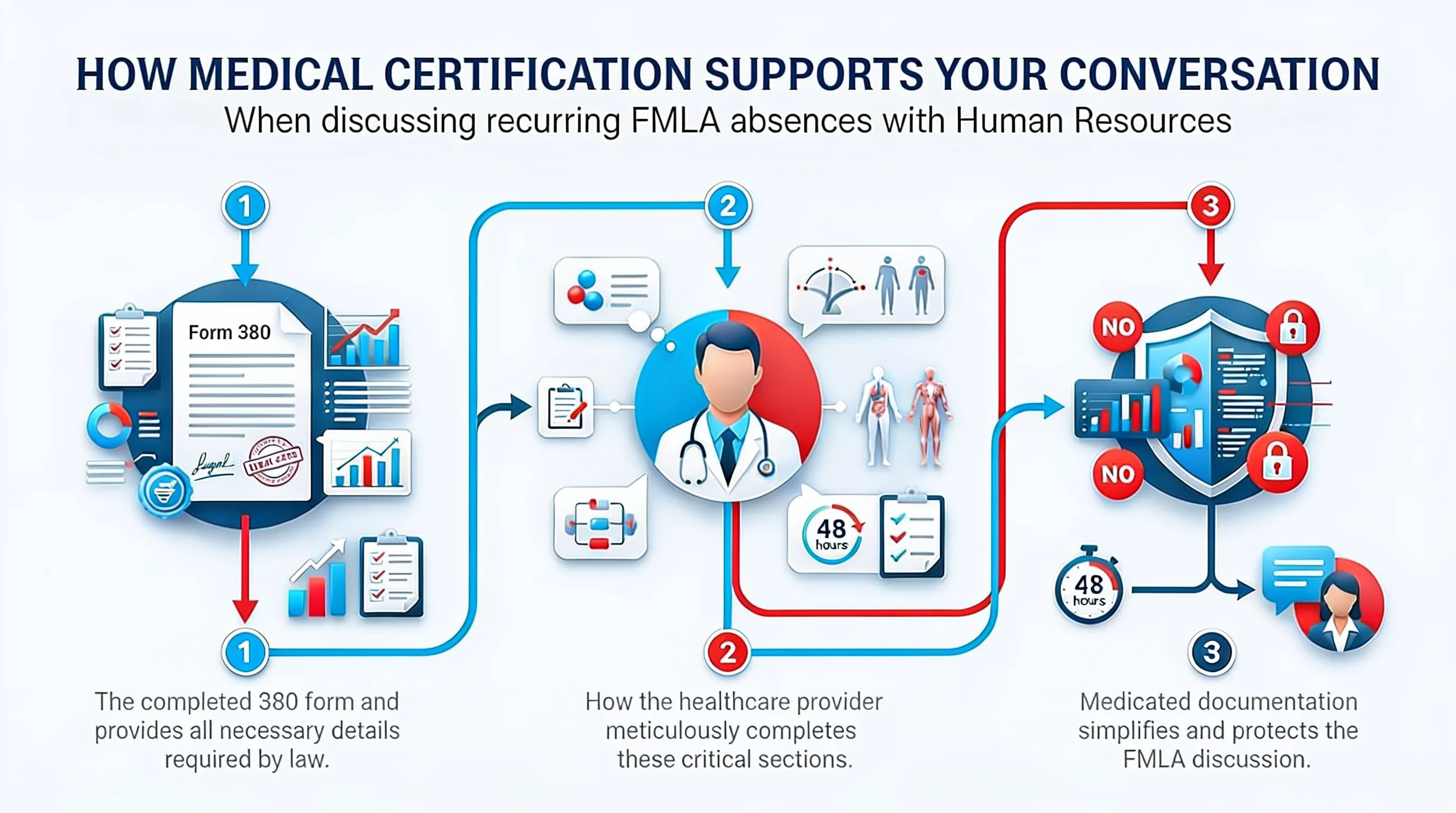
Medical certification removes the burden of explaining your health condition verbally. The DOL WH-380 form provides all medical details your employer legally needs. Your doctor completes sections about diagnosis, treatment, and functional limitations. This formal documentation protects you from oversharing personal health information during your FMLA conversation.
What the Certification Form Accomplishes
The certification establishes everything your employer can legally request. It documents the date your condition began and expected duration. It confirms whether you need inpatient care or continuing treatment. It explains how your condition affects your ability to perform job functions.
For intermittent leave, certification establishes frequency and duration. Your doctor specifies how often episodes occur and how long each lasts. This creates a clear schedule your employer must honor. Once submitted, you reference the certification instead of re-explaining your situation.
Redirecting HR Questions to Certification
When HR asks for medical details during your conversation, redirect them professionally. Use this script: “My healthcare provider will complete the medical certification with all necessary details.” This protects your privacy while confirming you’ll provide required documentation.
You’re not required to discuss symptoms, medications, or treatment plans verbally. The certification handles those details. Keep your conversation focused on logistics like leave dates and work coverage. Save medical specifics for the official form.
Avoiding Conflict: How to Handle Pushback From HR
When you talk to HR about FMLA, you might face questions that cross legal boundaries. Some HR staff don’t understand what they can ask. Others push back because they’re skeptical or want you back sooner. Knowing how to respond protects your rights without creating unnecessary conflict.
Stay calm and professional. Redirect inappropriate questions to proper documentation channels. You’re not refusing to cooperate. You’re following the legal process.
When HR Asks Inappropriate Questions
HR might ask what’s wrong with you or demand specific medical details. These questions violate your privacy rights. Your diagnosis and treatment plan belong in the medical certification form, not casual conversation.
If HR asks what’s wrong with you, respond with this: “I have a serious health condition that qualifies for FMLA. My healthcare provider will complete the medical certification with the necessary details.”
If they ask about specific treatment, say: “My treatment plan will be documented in the medical certification form. I’m not comfortable discussing medical details, but the certification will provide what’s legally required.”
These responses redirect the conversation without sounding defensive. You’re not hiding anything. You’re following proper procedure.
Special Situations: Intermittent and Recurring FMLA Conversations
Intermittent FMLA covers recurring absences for chronic conditions. Migraines, anxiety, Crohn’s disease, and diabetes complications all qualify. Many employees don’t realize their unpredictable episodes qualify for job protection.
This type of leave works differently than continuous time off. You take FMLA-protected time in separate blocks rather than one extended period. Your 12 weeks can stretch across an entire year.
How to Explain Unpredictable Episodes
When you talk to HR about intermittent leave, be direct about your situation. Here’s what to say: I have a chronic condition that causes unpredictable episodes requiring me to leave work or miss entire days. I’d like to apply for intermittent FMLA to protect these absences.
You don’t need to share your exact diagnosis. Focus on how your condition affects your ability to work. Describe the frequency and duration of episodes without oversharing medical details.
According to SHRM’s FMLA management toolkit, employees must provide enough information to establish medical necessity without disclosing private health details. Your medical certification will handle the clinical specifics.
Setting Expectations for Recurring Absences
Your medical certification must specify estimated frequency and duration. For example, 2-4 times per month for frequency and 4-8 hours or 1-2 days for duration. These details establish your intermittent leave schedule.
Intermittent leave only uses FMLA time for actual hours absent. A four-hour migraine uses four hours of your entitlement, not a full day. This means your protection lasts much longer than continuous leave.
One common mistake: employers cannot require you to take continuous leave instead of intermittent if your condition requires flexibility. Your medical provider determines what type of leave your condition needs.
Managing Ongoing Communication
Once approved, you don’t need to re-explain your condition each time you call out. Simply reference your approved FMLA leave when notifying your supervisor. You still follow normal call-in procedures each time you use intermittent leave.
Keep records of every absence you designate as FMLA-protected. Track dates, hours missed, and confirmation from HR. This documentation protects you if disputes arise later about how much leave you’ve used.
Conclusion
You now have the precise scripts and strategies for how to talk to HR about FMLA without revealing private medical details. The law requires minimal information from you, just the timing, duration, and that your leave qualifies.
Your healthcare provider’s certification handles the rest.
Three actions protect your rights: start the conversation early, document everything in writing, and follow your company’s call-in procedures for each absence. Most denials happen because of missed deadlines or incomplete paperwork, not because employees didn’t share enough personal information.
The 15-day certification deadline creates the biggest risk to approval.
FMLADocs solves this by connecting you with board-certified physicians who complete FMLA forms daily. Our providers know precisely what documentation employers require and typically deliver certifications within 24-48 hours. This removes the most common barrier to getting your leave approved.
When you know how to talk to HR about FMLA correctly, you protect both your job and your health. You’re not asking for permission; you’re exercising a legal right.
State your need clearly, provide the required information, and let the medical certification speak for itself. That’s how you get the time off you need while keeping your medical situation private.
Frequently Asked Questions
What information am I legally required to give HR when requesting FMLA leave?
You must state you need leave for a serious health condition. You don't need to reveal your diagnosis. Provide approximate timing if you know it. For planned surgery, give 30 days' notice. For unexpected illness, notify HR within one to two business days. Include expected duration like 'approximately six weeks' or 'intermittent leave for three months.' The phrase 'I need leave for a serious health condition' is sufficient. You don't need to use the term 'FMLA' initially. HR can ask if you're requesting FMLA specifically, but you're not required to know the legal terminology.
Can HR ask me about my specific diagnosis or treatment details?
No. HR cannot ask about your specific diagnosis. They can't request treatment details or your prognosis. These questions violate federal privacy protections. Medical certification goes to your healthcare provider, not HR's casual questions. Your doctor completes DOL Form WH-380-E or WH-380-F. These forms provide all medical details HR needs. HR can verify you meet eligibility requirements. They can confirm you worked 1,250 hours in 12 months. They can ask about your expected return date. But they can't ask why you're sick at the medical level.
How much notice do I need to give HR when talking to them about FMLA?
For planned medical leave like surgery, give 30 days' notice. For unexpected illness or emergencies, notify HR within one to two business days. The timing depends on whether your leave is foreseeable. If you know about your need in advance, federal law requires 30 days' notice when possible. For sudden health issues, you must inform HR as soon as practicable. This usually means within one to two business days of when the need arises. Delayed notification can put your job protection at risk.
What should I say to HR about mental health conditions when requesting FMLA?
Say 'I have a serious health condition requiring treatment.' Don't explain your therapy sessions or medication. Draw the line at functional impact versus medical details. HR needs to know you can't perform job functions. They don't need to know why at the cellular level. Your certification form handles medical details. Let your doctor explain frequency, duration, and functional limitations. That's their job, not yours during the initial conversation. Federal law protects your medical privacy. You must state you need leave for a qualifying reason. That's it.
Do I need to use the term 'FMLA' when I first talk to HR about needing leave?
No. You're not required to use the term 'FMLA' initially. You don't need to know the legal terminology. HR can ask if you're requesting FMLA specifically. But your job is simply to state you need leave for a serious health condition. The phrase 'I need leave for a serious health condition' is sufficient. HR is trained to recognize FMLA-qualifying situations. They should guide you through the formal process once you provide basic information. Most employees don't know what to say or how much detail HR actually needs. This creates anxiety that delays requests.
What details about pregnancy do I have to share with HR when requesting FMLA?
State 'I have a pregnancy-related condition requiring leave.' Skip the clinical specifics. You don't need to explain complications or medical procedures. Draw the line at functional impact versus medical details. HR needs to know you can't perform job functions. They don't need to know why at the medical level. Your doctor completes the medical certification form. That form provides all medical details HR needs. For pregnancy complications, your healthcare provider explains frequency, duration, and functional limitations. Federal law protects your medical privacy during this conversation.

Meet the author
Anam Moin
I'm Anam Moin, and my work at FMLADocs focuses on workplace leave and FMLA education. I cover certification, documentation, employee rights, and leave-related questions to provide readers with useful information when they need it most.
Get Your FMLA Certification Online in Minutes