

Rhode Island PFML — RI TDI and PFML — 60% wages
 by Anam Moin
Last updated:
Rhode Island PFML operates through two separate programs that work together to protect your income when you need time off. The state’s Temporary Disability Insurance covers medical leave.
Its paid family leave program handles caregiving needs.
You can receive up to four weeks of benefits for family leave and up to 30 weeks for temporary disability, with payments replacing about 60% of your wages.
Here’s the challenge: most employees don’t know which program applies to their situation. Employers struggle to track dual filing requirements and contribution calculations. Missing a deadline or filing under the wrong program means denied claims and lost income. Compliance mistakes can trigger penalties that cost your business thousands.
This guide shows you precisely how Rhode Island PFML works in practice. You’ll learn who qualifies for RI TDI benefits and paid family leave, how to calculate your benefit amount, when and where to file your claim, and what employers must do to stay compliant.
We’ll also explain how Rhode Island’s system compares to federal FMLA protections. Whether you’re planning leave or managing a team, you’ll get clear answers to every Rhode Island PFML question.
Understanding Rhode Island PFML Leave: TDI and Paid Family Leave
Rhode Island PFML operates through two distinct programs that work together to provide comprehensive leave coverage.
The state splits its paid leave system into Temporary Disability Insurance (TDI) and Paid Family Leave. Each program serves different purposes but shares similar benefit structures. Both provide partial wage replacement when you need time away from work.
Temporary Disability Insurance (TDI) for Medical Leave
TDI covers employees who can’t work due to their own serious health conditions. This includes pregnancy, childbirth recovery, surgery, or any medical issue that prevents you from doing your job.
The program has been around since 1942, making it one of the oldest state disability programs in the country.
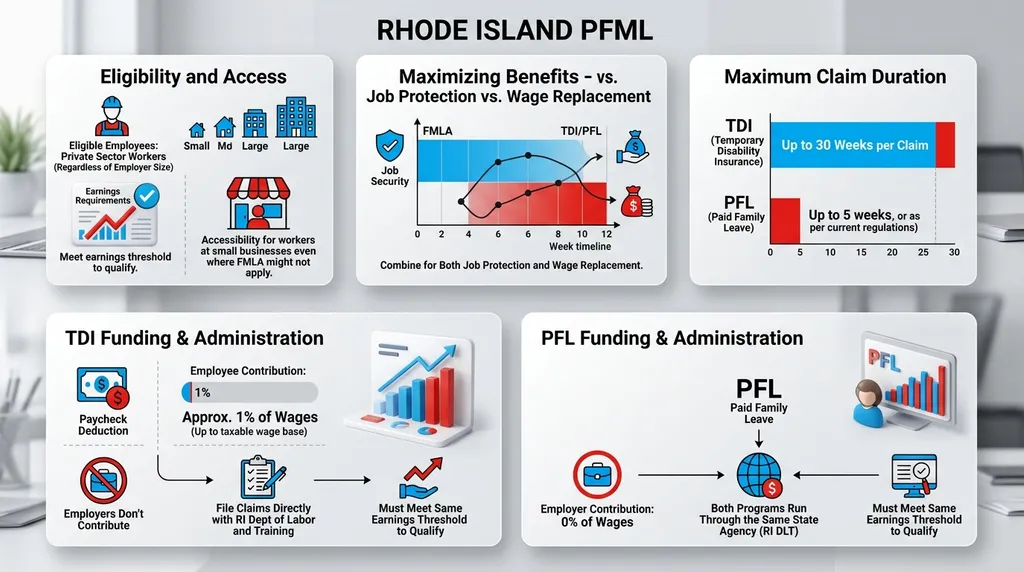
You qualify for RI TDI benefits after earning at least $14,700 in your base period. The program pays approximately 60% of your average weekly wages. Maximum weekly benefits cap at $1,007 in 2026. You can receive TDI for up to 30 weeks per claim.
The state funds TDI through employee payroll contributions. Workers pay 1.1% of wages up to the taxable wage base. Employers don’t contribute to this program. You file claims directly with Rhode Island’s Department of Labor and Training.
Paid Family Leave for Caregiving
Rhode Island paid family leave covers time off to care for seriously ill family members or bond with new children. This includes newborns, adopted children, or foster placements.
You can also use it to care for a spouse, parent, child, grandparent, or domestic partner with a serious health condition.

The benefit structure mirrors TDI: 60% wage replacement with the same maximum cap. You can take up to five weeks of paid family leave per year. The program started in 2014, expanding Rhode Island’s leave protections beyond medical disability.
Like TDI, employees fund this program through payroll deductions. The contribution rate is 1.0% of wages. Both programs run through the same state agency.
You must meet the same earnings threshold to qualify.
How Rhode Island PFML Differs from Federal FMLA
The biggest difference: Rhode Island PFML provides paid benefits while federal FMLA provides unpaid job protection. These programs often run at the same time. When you take leave, you might use both simultaneously if you qualify for each.
FMLA requires employers to have 50 or more employees within 75 miles. Rhode Island temporary disability insurance and paid leave cover most private-sector employees regardless of employer size.
You just need to meet the earnings requirements. This means workers at small businesses can access paid leave even when FMLA doesn’t apply.
Understanding how FMLA and state paid leave programs interact helps you maximize your benefits. FMLA protects your job for up to 12 weeks. Rhode Island’s programs provide income during that time. You can combine them for both job protection and wage replacement.
Another difference: state family leave programs vary significantly in coverage and benefits compared to federal standards. Rhode Island’s system is more generous than FMLA in some ways. It covers more workers and provides actual income. However, it offers fewer total weeks than FMLA’s 12-week protection period.
Employee Eligibility Requirements for Rhode Island PFML Benefits
Rhode Island PFML covers two distinct programs. Temporary Disability Insurance (TDI) helps when you can’t work due to your own health condition.
Paid Family Leave supports time away to care for family members or bond with a new child.
Both programs protect your job and provide partial wage replacement. But each has specific rules about who qualifies and when you can use benefits.
Earnings and Work History Requirements
You must meet minimum earnings to qualify for Rhode Island PFML. The state requires at least $14,700 in wages during your base period. This base period covers the first four of the last five completed calendar quarters before you file.
For example, if you file a claim in March 2026, your base period runs from October 2024 through September 2025. The state calculates your benefit amount based on these earnings.
Higher wages during this period mean higher weekly benefits, up to the state maximum.
Covered Employment Types
Both full-time and part-time employees qualify when they meet earnings requirements.
Self-employed workers can opt into coverage by paying quarterly contributions. This gives independent contractors and business owners the same protections as traditional employees. You must enroll and pay into the system before you need benefits.
Most private sector employees in Rhode Island are automatically covered. Your employer withholds contributions from your paycheck. Federal employees and some other groups may have different rules.
Qualifying Reasons for Leave
TDI covers pregnancy, childbirth recovery, surgery, serious illnesses, injuries, and mental health conditions. You must be unable to perform your regular job duties. The condition must require time away from work, certified by a healthcare provider.
Paid Family Leave covers bonding with newborns or newly adopted children. It also applies when caring for seriously ill family members, including your spouse, parent, child, grandparent, or domestic partner. Military family leave qualifies too.
The key difference between programs matters. Understanding FMLA vs short-term disability helps you choose the right benefit. TDI addresses your own health needs. Paid Family Leave supports caregiving and bonding time.
You can’t work while receiving TDI benefits. The program replaces lost wages when you’re medically unable to perform job duties. Your healthcare provider must certify this inability through required medical documentation.
Calculating Your Rhode Island PFML Benefit Amount and Duration
Rhode Island PFML provides income replacement when you can’t work due to medical leave or family caregiving needs. Your benefit amount depends on your earnings history. The state calculates this using your base period wages.
Weekly Benefit Calculation Method
Your weekly benefit equals about 60% of your average weekly wage during the base period. The state divides your total base period earnings by the number of weeks you worked. This gives your average weekly wage.
The base period covers the first four of the last five completed calendar quarters before your claim starts. For example, if you file in July 2026, your base period runs from April 2025 through March 2026.
Rhode Island TDI benefits work differently than some other programs. Understanding how state and federal leave programs compare helps you plan your time off more effectively.
The calculation method stays consistent across different leave types.
Maximum Benefit Amounts and Duration Limits
The maximum weekly benefit in 2026 is capped at $1,007. This amount adjusts annually based on the state average weekly wage. Even if your calculation exceeds this cap, you can’t receive more than the maximum.
TDI benefits cover up to 30 weeks in a benefit year for medical leave.
This includes recovery from surgery, illness, or injury. Paid Family Leave provides up to 6 weeks for caregiving or bonding. Bonding with newborns is limited to 5 weeks.
A seven-day waiting period applies before benefits begin. You can use accrued paid time off during this period. The waiting period doesn’t count toward your benefit duration. Benefits start on the eighth day of your leave.
For pregnancy-related leave, you can combine TDI and Paid Family Leave. Many workers use TDI for recovery, then transition to Paid Family Leave for bonding. This approach mirrors how maternity leave under FMLA provides job protection at the federal level.
Coordination with Other Income Sources
Your benefits may be reduced if you receive other income during your leave. Workers’ compensation payments can affect your Rhode Island PFML amount. The state reduces your benefit to prevent duplicate payments for the same condition.
Unemployment insurance also impacts your benefit calculation. You can’t receive both unemployment and PFML benefits simultaneously.
Employer-provided wage continuation programs may reduce your state benefit amount.
Rhode Island PFML benefits are subject to federal income tax. However, they’re exempt from state income tax. You’ll receive a 1099-G form at year-end for tax reporting. Plan accordingly when filing your federal return.
How to Apply for Rhode Island TDI and Paid Family Leave Benefits
Filing Your Initial Claim
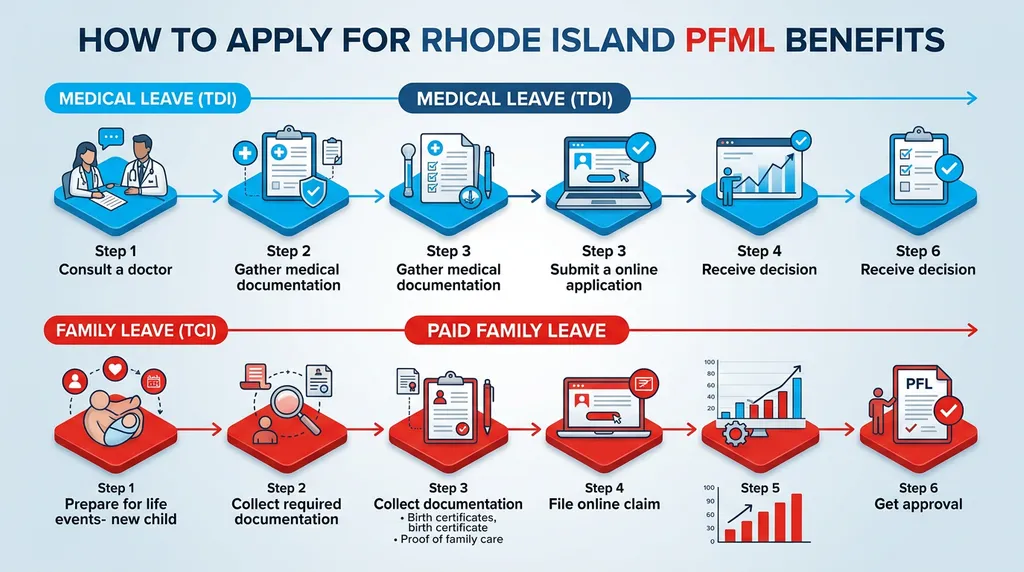
Start by visiting the Rhode Island Department of Labor and Training online portal. You can also file by mail using form TDI-1 for medical leave or TCI-1 for family leave.
Submit your claim within 30 days of your leave start date. Missing this deadline can delay or deny your benefits entirely. You can explore this further in Rhode Island Department of Labor.
The online portal walks you through each step. You’ll enter your employer information, leave dates, and reason for time off.
Required Documentation and Medical Certification
Medical certification from a licensed healthcare provider is mandatory for TDI claims. Your doctor must include your diagnosis, treatment plan, and expected duration of leave.
Family leave claims need proof of your relationship to the person you’re caring for. You’ll also need documentation showing why they need care.
Keep copies of all documents you submit. This helps if you need to reference them during the review process.
Claim Processing Timeline and Appeals
Complete claims typically process within 7-10 business days. Incomplete submissions take longer and may get denied.
If denied, you have 10 days to request reconsideration. You can appeal to the Board of Review if reconsideration doesn’t work.
File weekly or biweekly certifications during your leave. These ongoing submissions keep your benefits flowing without interruption.
Employer Obligations Under Rhode Island PFML Law
Rhode Island employers face specific duties under the state’s paid family and medical leave program. These obligations span registration, payroll contributions, workplace notices, and leave request management. Understanding these requirements helps you avoid penalties and support employees properly.
Registration and Contribution Requirements
All employers with Rhode Island employees must register with the Department of Labor and Training. This applies regardless of company size or location. You must withhold TDI contributions from employee wages at 1.1% of wages up to the taxable wage base of $84,000 in 2026.
The withholding process runs through your standard payroll system. You submit these contributions quarterly to DLT. Missing deadlines or incorrect calculations can result in penalties and interest charges.
Private disability insurance plans may substitute for state TDI if approved by DLT. Your plan must provide equal or better benefits than the state program. You need formal approval before switching from state coverage.
Notice and Posting Requirements
You must post official Rhode Island TCI and TDI programs notices in conspicuous workplace locations. These posters must be visible to all employees and applicants. Digital workplaces need electronic posting that meets accessibility standards.
Provide employees with written information about PFML rights at hire. You must also give this information when employees request leave. The notice should explain eligibility, benefits, and how to file claims.
Keep these notices current as program rules change. DLT updates official posters when benefit amounts or contribution rates adjust. Replace outdated posters promptly to maintain compliance.
Managing Employee Leave Requests
You cannot retaliate against employees for using PFML benefits or filing claims. Retaliation includes termination, demotion, reduced hours, or hostile treatment. Document all employment decisions carefully during leave periods.
Job protection provisions require you to restore employees to the same or comparable positions after leave. The position must have equivalent pay, benefits, and working conditions. You can’t use leave as a factor in performance reviews or promotion decisions.
You may require employees to use accrued paid time off concurrently with PFML benefits. This must be stated clearly in your leave policy. Employees should know whether vacation or sick time runs alongside state benefits.
Maintain confidentiality of employee medical information obtained during leave administration. Store medical documents separately from personnel files. Limit access to HR staff who need the information for leave processing.
Conclusion
Rhode Island PFML gives workers access to paid leave through two programs. TDI covers medical conditions. Paid family leave supports caregiving and bonding time. Both programs replace up to 60% of your wages when you meet the earnings threshold.
Start by checking your base period earnings now. Gather medical documentation before your leave begins. File your claim as soon as your leave starts.
Don’t wait. Delays can reduce your benefit payments or cause denials.
Employers must register with DLT and withhold the correct payroll amounts. Post required notices in your workplace. Stay current on RI PFML eligibility requirements to avoid penalties.
Workers who need FMLA job protection alongside Rhode Island PFML benefits can connect with licensed doctors through FMLADocs.
Get your medical certification completed remotely. Protect your job while you access your state benefits.
Frequently Asked Questions
How much of my wages does Rhode Island PFML replace when I take leave?
Rhode Island PFML replaces about 60% of your average weekly wages. The maximum weekly benefit caps at $1,007 in 2026. This rate applies to both TDI and paid family leave programs. You receive the same percentage whether you take medical leave or family caregiving leave. The state calculates your benefit amount based on wages earned during your base period. You must have earned at least $14,700 in that period to qualify for benefits.
What's the difference between Rhode Island TDI and paid family leave?
TDI covers time off for your own serious health conditions like surgery or pregnancy recovery. Paid family leave covers time off to care for seriously ill family members or bond with new children. TDI has been around since 1942 and provides up to 30 weeks of benefits. Paid family leave started in 2014 and provides up to five weeks per year. Both programs pay 60% of your wages. Employees fund both through separate payroll deductions totaling 2.1% of wages.
Can I use Rhode Island PFML and federal FMLA at the same time?
Yes, you can use both programs at the same time if you qualify for each. Rhode Island PFML provides paid benefits while FMLA provides unpaid job protection. These programs often run together during the same leave period. FMLA requires your employer to have 50 or more employees within 75 miles. Rhode Island programs cover most private-sector workers regardless of employer size. You just need to meet the earnings threshold of $14,700 in your base period.
Who pays for Rhode Island PFML benefits?
Employees fund both Rhode Island leave programs through payroll deductions. Workers pay 1.1% of wages for TDI and 1.0% for paid family leave. This totals 2.1% of your wages up to the taxable wage base. Employers don't contribute to these programs. The state collects contributions through payroll withholding. These deductions appear on your pay stub as separate line items. Rhode Island's Department of Labor and Training manages both programs and processes all benefit payments.
How many weeks of leave can I take under Rhode Island PFML?
You can take up to 30 weeks of TDI benefits for your own medical conditions per claim. Paid family leave provides up to five weeks per year for caregiving or bonding with new children. These are separate benefit pools. You could potentially use both in the same year if you have different qualifying reasons. For example, you might take TDI for childbirth recovery and then paid family leave for bonding. The programs don't reduce each other's available weeks.
What family members can I care for under Rhode Island paid family leave?
You can use paid family leave to care for a spouse, parent, child, grandparent, or domestic partner with a serious health condition. The program also covers bonding time with newborns, adopted children, or foster placements. This includes biological and adoptive parents. Domestic partners must meet Rhode Island's registration requirements. The family member must have a serious health condition that requires your care. You can't use this program for your own medical needs. That falls under TDI instead.
Do small business employees qualify for Rhode Island PFML?
Yes, most private-sector employees qualify regardless of employer size. You don't need to work for a large company to access Rhode Island TDI or paid family leave. The only requirement is earning at least $14,700 in your base period. This differs from federal FMLA, which only covers employers with 50 or more workers. Small business employees can receive paid benefits even when FMLA job protection doesn't apply. You file claims directly with the state, not through your employer.
Where do I file my Rhode Island PFML claim?
You file claims directly with Rhode Island's Department of Labor and Training. Both TDI and paid family leave claims go through the same state agency. You can't file through your employer. The state processes all applications and pays benefits directly to you. You need to submit medical documentation or proof of family relationship depending on your leave type. Missing filing deadlines can result in denied claims and lost income. The state provides specific forms for each program on their website.
Meet the author
Anam Moin
I'm Anam Moin, and my work at FMLADocs focuses on workplace leave and FMLA education. I cover certification, documentation, employee rights, and leave-related questions to provide readers with useful information when they need it most.
Get Your FMLA Certification Online in Minutes