
FMLA Fraud: Warning Signs, Rights & Employer Rules
 by Nida Hammad
 Last updated:
Employees commit FMLA fraud when they lie about health issues. They do this to get protected leave from work. It’s not a misunderstanding or poor communication. True fraud requires deliberate lies about qualifying health issues. The Department of Labor reports rising FMLA complaints. Many involve disputed fraud claims. Both sides face serious risks. Employers who investigate too aggressively can trigger costly retaliation lawsuits. Employees accused falsely can lose their jobs and face damaged reputations.
This guide explains what counts as FMLA fraud. You’ll learn what employers can check. You’ll also learn how to protect yourself. You’ll learn what counts as true intermittent leave. You’ll learn when to ask for new forms. You’ll learn what papers you need to keep. You’ll learn how to avoid raising red flags. Understand these boundaries to stay compliant. They also keep you protected.
Need help determining whether your situation qualifies for FMLA protection? Get started with an FMLA to understand your options and prepare your leave request. Check Your Eligibility.
What Actually Constitutes FMLA Fraud
FMLA fraud requires intentional deception about a qualifying condition or need for leave. It’s not just poor communication or misunderstanding. The law protects employees who legitimately need time off. The law punishes people who lie to get leave they don’t deserve.
The distinction matters. Many employees worry their legitimate condition will be labeled fraud. Others face false accusations based on suspicion rather than evidence. Understanding what actually crosses the legal line protects both sides.
Legal Definition of FMLA Fraud
Federal law says FMLA fraud means giving false facts to get leave. This means you deliberately lied about your medical situation. Honest mistakes don’t count. Miscommunication doesn’t count. The deception must be intentional.
Common fraud scenarios include providing false information on medical certification forms. This might mean forging a doctor’s signature or lying about symptoms. Working another job during leave while claiming total incapacity is fraud. So is fabricating a medical condition entirely when no serious health condition under FMLA actually exists.
Using leave for non-covered purposes crosses the line too. Taking FMLA time for vacation while claiming a serious health condition is fraud. Going to a concert when you said you’d be bedridden is fraud. The key is the gap between what you claimed and what you actually did.
Common Fraud Scenarios Employers Investigate
Employers typically investigate when they spot patterns that suggest abuse. Frequent Monday or Friday absences raise flags. Holiday-adjacent leave draws scrutiny. But these patterns alone don’t prove fraud without additional evidence.
Employers watch for social media posts that show different activities. These posts contradict the claimed health limits. Surveillance footage of employees doing physical work while on leave for incapacity. Witness reports of employees working elsewhere during FMLA time. Tips from coworkers about suspicious behavior.
The investigation process matters. Employers have rights to request recertification every 30 days for ongoing conditions. They can require second or third medical opinions. They can ask for clarification on vague certifications. But they can’t deny leave based purely on suspicion.
What Isn’t Fraud But Looks Suspicious
Many legitimate FMLA uses look suspicious to employers who don’t understand how intermittent FMLA works. Employees can engage in normal activities during leave without it being fraud. Your condition might allow intermittent functioning.
Someone with severe migraines might feel fine between episodes. They can grocery shop on good days. A person with depression might attend social events when symptoms improve. Someone recovering from surgery might walk their dog. They still cannot work full shifts.
The medical certification determines what you can and can’t do. If your doctor says you can’t sit for extended periods but can walk, then walking isn’t fraud. If your condition causes unpredictable episodes, then unpredictable absences aren’t suspicious. They’re exactly what the certification described.
Legitimate Intermittent FMLA Leave Patterns
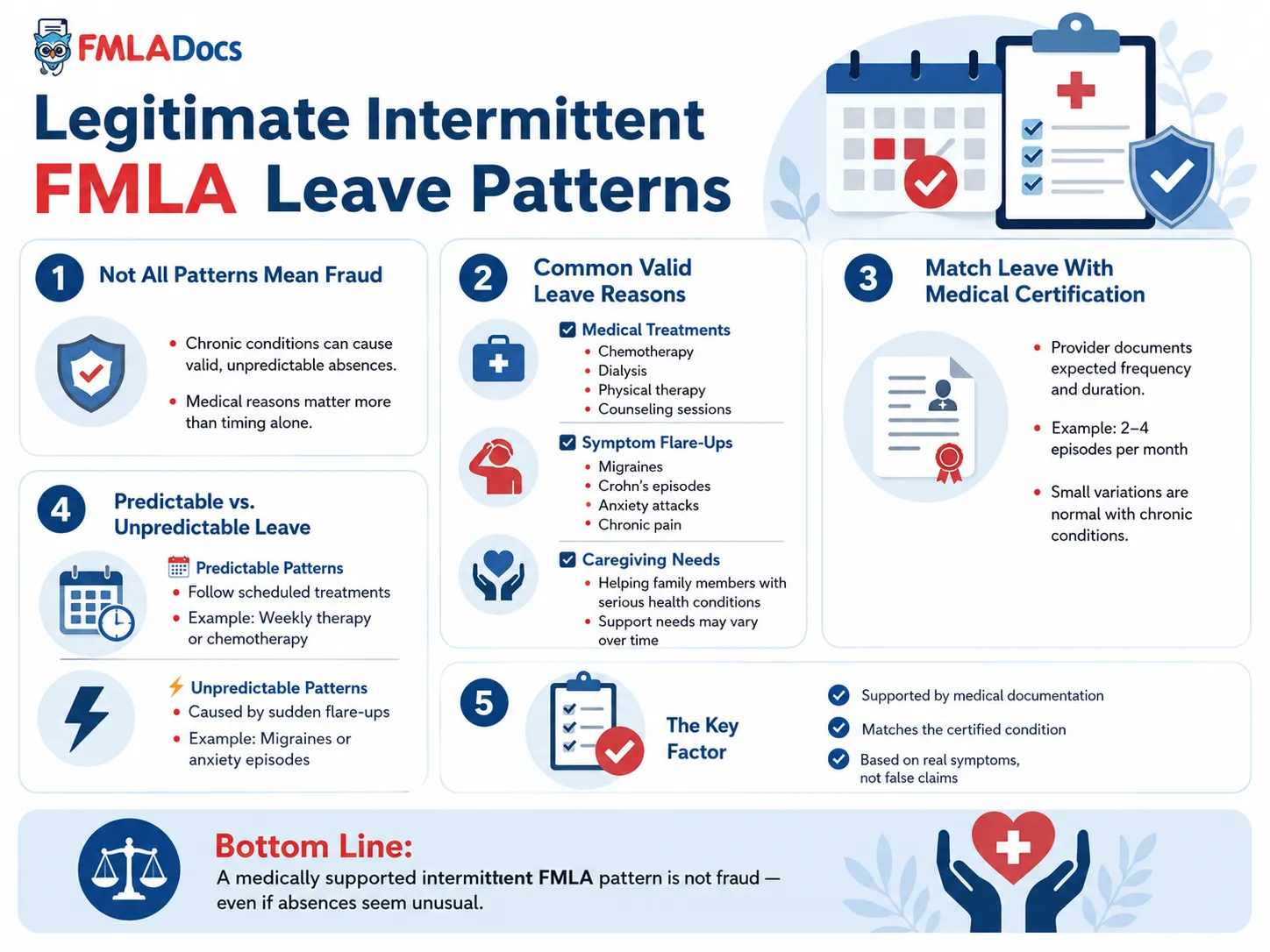
Not all intermittent leave patterns signal FMLA fraud. Many chronic conditions create unpredictable absences that look suspicious but are medically valid. Understanding what qualifies helps both employees and employers avoid false accusations.
What Qualifies as Valid Intermittent Leave
Recurring medical treatments create legitimate intermittent patterns. Chemotherapy sessions happen on fixed schedules. Dialysis requires regular appointments. Physical therapy follows treatment plans. Mental health counseling occurs weekly or biweekly.
Unpredictable symptom flare-ups also qualify. Migraines strike without warning. Crohn’s disease causes sudden episodes. Anxiety disorders worsen unexpectedly. Chronic pain flares up unpredictably. These conditions don’t follow convenient schedules.
Periodic caregiving needs create valid patterns too. A family member with a serious health condition may need episodic assistance. Care demands vary based on symptom severity. Some weeks require more support than others.
Matching Leave to Medical Certification
Leave patterns must align with medical certification estimates. Your healthcare provider documents expected frequency and duration. If certification says two to four episodes monthly, that’s your baseline. Actual usage should stay within that range.
According to HR Dive, certification estimates aren’t guarantees since chronic conditions are unpredictable. Some months bring more episodes. Other months bring fewer. This variation is medically normal.
Medical certification must explain why intermittent FMLA leave is medically necessary. It should estimate frequency but acknowledge unpredictability. Providers document symptom patterns based on medical history.
Unpredictable vs. Predictable Patterns
Some conditions create predictable patterns. Physical therapy happens every Tuesday. Chemotherapy follows a set schedule. These absences are foreseeable and documented.
Other conditions create unpredictable patterns that still qualify. Migraines triggered by stress may occur more on high-pressure days. Anxiety may worsen at week’s start. These patterns have medical explanations even if they seem convenient.
The key difference is medical documentation. Predictable patterns match treatment schedules. Unpredictable patterns align with symptom triggers and flare-up history. Both are legitimate when properly certified.
When Employers Can Request Recertification
Employers can’t request updated medical certification whenever they feel like it. Federal law sets clear limits on when and how often they can ask for new paperwork. Know these rules to block bad requests. They help you stay within the law.
Most confusion around recertification stems from not knowing the timing rules. Employees often assume their original certification covers them indefinitely. That’s not how it works. The duration specified by your healthcare provider determines when your protection expires.
Timing Requirements for Recertification Requests
Your original certification includes an expected duration for your condition. Once that period ends, your employer can request updated documentation. Your doctor certified you for six months. After six months pass, your employer can ask for recertification.
For ongoing conditions requiring intermittent leave, the rules get more specific. According to the Department of Labor, employers can request recertification every 30 days if the minimum duration from your original certification has passed. Employers can’t ask for updates every week. They still get to watch ongoing health needs.
The 30-day minimum is firm. Your employer can’t ask for new paperwork every two weeks. Frequent leave use is not a valid reason. That violates federal guidelines and creates unnecessary administrative burden.
Valid Reasons to Request Updated Certification
Beyond the standard expiration timeline, employers can request recertification when circumstances change significantly. You use much more leave than your cert showed. This gives your boss the right to ask for new cert. Your cert showed two absences per month. You took six days off instead. That’s a valid reason for your employer to request updated documentation.
Changes in absence patterns also matter. If your leave shifts from set to random, your employer can ask for new cert. If episodes last much longer, your employer can ask for new cert too. Your employer can ask for new cert if they doubt your reason. They can also ask if they doubt your condition is real.
When you use more leave than approved, ask for new cert. Provide updated time frames with your request. This prevents fmla fraud suspicions and shows you’re managing your leave responsibly. Many workers use FMLADocs to get new certs fast. Their condition changes, so they avoid gaps in coverage.
Limits on Recertification Frequency
The 30-day rule is your primary protection against excessive recertification requests. Your employer cannot ask for new paperwork every 30 days. They can only ask more often if your condition changes. This includes understanding when additional medical documentation is required versus when your existing certification remains valid
Even when circumstances change, the request must be reasonable. Your employer cannot use recertification to harass you. They cannot try to stop you from taking leave. Your employer should not ask for recertification more than every 30 days. If this happens, save all records and call the DOL.
Keep copies of all certifications you submit. Track when you provided documentation and when new requests arrive. This record protects you if disputes arise. It shows whether recertification requests were too frequent or lacked valid cause.
Employer Investigation Rights and Documentation Requirements
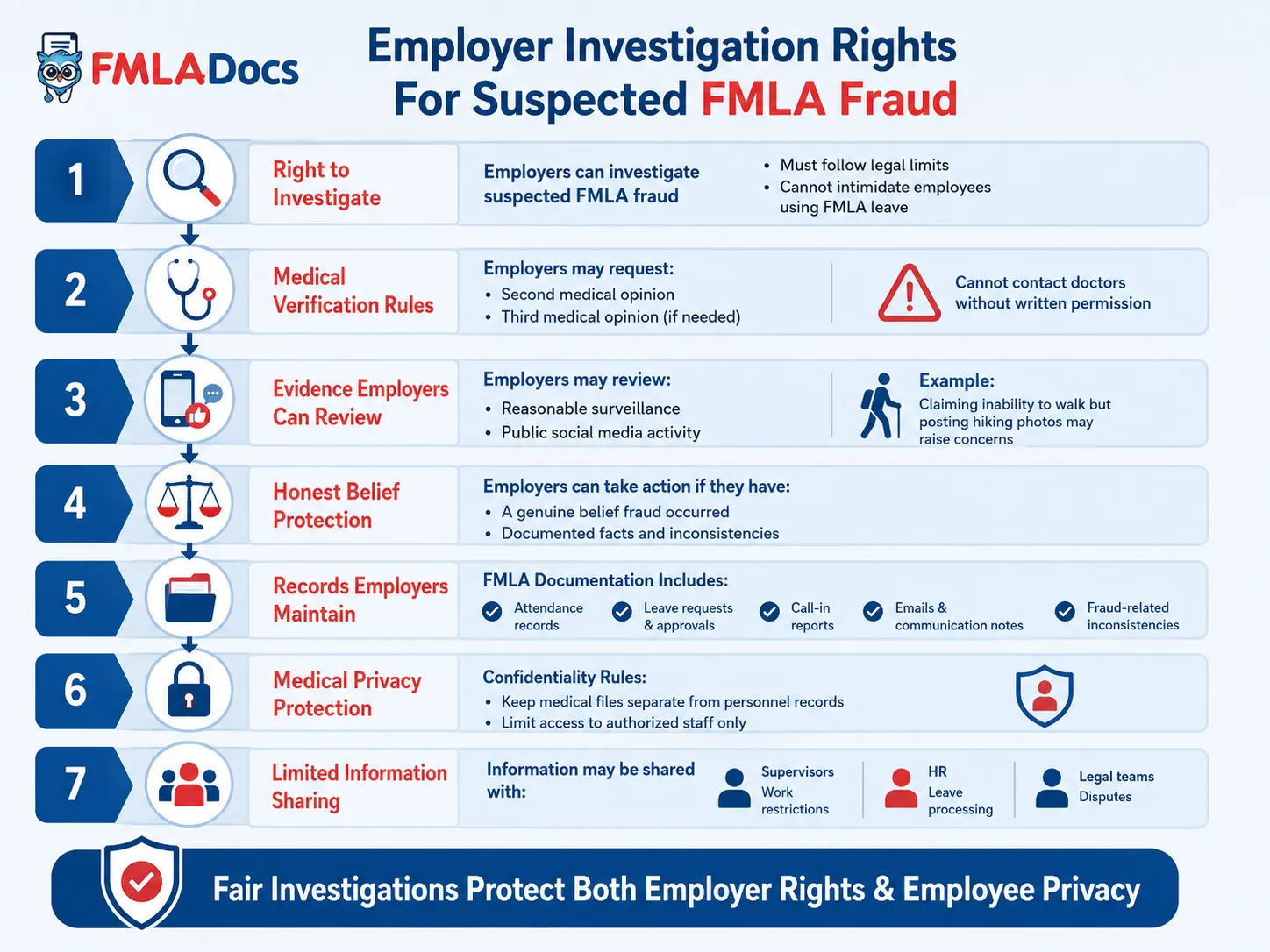
Employers can investigate suspected FMLA fraud. But the law sets strict limits on what they do. Understanding what employers can and cannot do protects both parties from violations. The investigation process must balance legitimate business interests with employee privacy rights.
What Employers Can Legally Investigate
Employers can request second and third medical opinions under specific DOL procedures. However, they cannot directly contact your healthcare provider without written authorization. This protects your medical privacy while allowing verification of legitimate claims.
Surveillance is legal but must be conducted reasonably. According to employer rights during fraud investigations, surveillance cannot be used to intimidate employees from exercising FMLA rights. Social media posts showing activities inconsistent with claimed limitations can support investigations. Posting hiking photos while claiming you can’t walk raises red flags. Employers notice this gap between your posts and your claims.
Your employer can fire you under the honest belief rule. They need a real, fair belief that fraud took place. This applies even if later proven wrong. But documentation of specific inconsistencies is critical to defend this decision.
Types of Records Employers May Maintain
Employers may maintain several types of records related to your FMLA leave. These records help track usage and identify potential abuse patterns.
-
Attendance logs showing dates and times of absences
-
Leave request forms and approval documentation
-
Call-in records documenting when and how you reported absences
-
Communications related to FMLA leave including emails and notes from conversations
-
Documentation of specific inconsistencies between certified limitations and observed activities
Confidentiality Requirements and Limits
Keep medical certifications and recertifications in separate files. Store them apart from personnel records. Only authorized personnel can access these documents. This protects your medical information from unnecessary disclosure.
However, confidentiality has limits. Supervisors may receive information about necessary work restrictions and accommodations. HR can share information needed to process leave requests. And legal counsel may review records if disputes arise.
Employee Best Practices to Avoid Fraud Accusations
Protecting yourself from fraud accusations starts with following proper procedures. These practices keep your leave legitimate and well-documented.
Following Proper Call-In Procedures
Always follow your company’s call-in procedures for reporting absences. This applies even during FMLA-protected leave. For a deeper look, see combatting FMLA fraud and abuse.
Failure to call in properly can result in discipline. Your FMLA protection doesn’t override basic attendance policies.
Call your supervisor at the required time each day you take leave. Use the designated phone number or reporting system your employer specifies.
Some companies require calls before shift start. Others accept text messages or online submissions. Know your company’s specific requirements.
Maintaining Personal Documentation
Keep copies of all FMLA paperwork in a personal file. This includes your original request, medical certifications, and employer notices.
Save every recertification document you receive. These prove your ongoing need for leave if questions arise later.
Document every leave date you take. Record the reason, duration, and any relevant symptoms or appointments.
Create a personal log that matches your usage. This becomes critical evidence if your employer challenges your leave pattern.
Take photos of appointment cards or parking receipts. These small details can verify your medical visits if needed.
Using Intermittent Leave Appropriately
Use intermittent leave only for certified medical reasons. Your healthcare provider’s documentation specifies these reasons.
Don’t take FMLA time for personal errands or non-medical activities. This constitutes fraud and can cost you your job.
If your condition changes, contact your healthcare provider immediately. Update your certification rather than exceeding certified limits.
Communicate promptly with supervisors about schedule changes. Share return dates or updates that affect your leave needs.
Working with FMLADocs ensures your certification includes specific functional details. Complete documentation reduces fraud suspicions from the start.
Conclusion
FMLA fraud accusations create stress for both employers and employees. Most cases stem from misunderstandings rather than intentional deception. Legitimate intermittent leave patterns often trigger suspicion when they follow predictable schedules. Employers have investigation rights including recertification requests and documentation reviews. However, they must exercise these rights carefully to avoid retaliation claims.
Employees can protect themselves by following proper procedures from the start. Maintain detailed personal records of your condition and treatments. Use leave only for certified medical reasons. Work with healthcare providers who understand FMLA requirements thoroughly. Complete medical certifications should explain functional limitations clearly and include accurate frequency estimates.
The best defense against false FMLA fraud accusations is proper documentation. Your medical certification must satisfy legal standards and answer employer questions upfront. Incomplete paperwork invites scrutiny and follow-up requests. Clear communication between you, your doctor, and your employer prevents most issues.
FMLADocs connects you with licensed physicians who complete FMLA certifications correctly the first time. Our doctors know employer FMLA rights. They document your health to meet legal rules. Get your certification done in 24-48 hours without incomplete paperwork or fraud concerns.
Frequently Asked Questions
What legally qualifies as FMLA fraud?
FMLA fraud requires intentional deception about a qualifying condition or need for leave. Federal law defines it as knowingly providing false information to obtain leave benefits. This means you deliberately lied about your medical situation. Honest mistakes don't count as fraud. Miscommunication doesn't count either. The deception must be intentional. Common examples include forging a doctor's signature, working another job during leave while claiming total incapacity, or fabricating a medical condition entirely. Taking FMLA time for vacation while claiming a serious health condition also crosses the line.
Can employers investigate employees they suspect of FMLA fraud?
Employers can investigate when they spot patterns suggesting abuse. They have rights to request recertification every 30 days for ongoing conditions. They can require second or third medical opinions. They can ask for clarification on vague certifications. Employers typically look for social media posts showing activities inconsistent with claimed limitations. They might use surveillance footage or witness reports. However, they can't deny leave based purely on suspicion. Employers who investigate too aggressively can trigger costly retaliation lawsuits. The investigation process must follow legal boundaries.
What patterns make employers suspicious of FMLA abuse?
Frequent Monday or Friday absences raise red flags for employers. Holiday-adjacent leave draws scrutiny too. But these patterns alone don't prove fraud without additional evidence. Employers also watch for social media posts showing activities inconsistent with claimed limitations. Surveillance footage of employees doing physical work while on leave for incapacity triggers investigations. Witness reports of employees working elsewhere during FMLA time create suspicion. Tips from coworkers about suspicious behavior prompt reviews. Still, legitimate FMLA uses can look suspicious to employers who don't understand how intermittent leave works.
Can I do normal activities during FMLA leave without it being fraud?
You can engage in normal activities during leave without it being fraud. Your condition might allow intermittent functioning. Many legitimate FMLA uses look suspicious to employers. Someone with severe migraines might feel fine between episodes. They can grocery shop on good days. A person with depression might attend social events when symptoms improve. The key is whether your activities contradict your claimed limitations. Going to a concert when you said you'd be bedridden is fraud. But doing light activities during recovery from a serious condition isn't deceptive.
What happens if I'm falsely accused of FMLA fraud?
Employees accused falsely can lose their jobs and face damaged reputations. Both sides face serious risks in fraud disputes. The Department of Labor reports that FMLA-related complaints have risen sharply. Many involve disputed fraud allegations. If you're accused, documentation becomes critical. You need proper medical certifications that support your leave. Your records must show the condition qualifies under FMLA. Honest mistakes and miscommunication don't constitute fraud. The employer must prove you deliberately lied about your medical situation. Without evidence of intentional deception, the accusation won't hold up legally.
How do I protect myself from false FMLA fraud accusations?
Understanding legal boundaries keeps you compliant and protected. Get proper documentation from your healthcare provider. Make sure medical certifications clearly explain your qualifying condition. Follow recertification timing requirements when your employer requests updates. Don't post social media content that contradicts your claimed limitations. Be honest about your symptoms and restrictions. Keep records of all medical appointments and treatments. Respond promptly to employer requests for clarification. Know that legitimate intermittent leave patterns are protected. Your condition might allow some normal activities between episodes. This doesn't make your leave fraudulent.
Can an employer deny FMLA leave if they suspect fraud?
An employer generally cannot deny protected FMLA leave based only on suspicion. However, if there is credible evidence that an employee provided false information, misrepresented a medical condition, or is misusing approved leave, the employer may investigate and take appropriate action according to FMLA rules and company policies.
Can social media posts be used as evidence of FMLA fraud?
Yes, employers may review publicly available social media content if they believe it provides evidence of possible FMLA abuse. However, a single post or photo usually does not prove fraud because employees on FMLA leave may still participate in activities that are consistent with their medical restrictions or caregiving responsibilities. Context matters when evaluating whether leave was misused.
Meet the author
Nida Hammad
I am a professional writer with over five years of experience creating clear, engaging, and well-researched content. I specialize in healthcare topics, helping readers understand complex information in simple wording. Currently, I write for FMLA DOC, where I focus on producing accurate and trusted guides for people seeking support with FMLA and medical needs.
Get Your FMLA Certification Online in Minutes