
Can Employer Change My Job While on FMLA? Know Your Rights
 by Nida Hammad
 Last updated:
Can employer change my job while on FMLA? Yes, but only under specific conditions. Federal law protects your right to return to the same position or an equivalent one. Many employers violate these FMLA job protection rights by demoting workers, cutting pay, or shifting schedules after medical leave. You need to know what changes are legal and what crosses the line into retaliation.
This guide breaks down the FMLA equivalent position requirement, shows you how to spot illegal job changes versus legitimate business decisions, and walks you through filing a DOL complaint if your rights were violated. You’ll learn what documentation protects you, which red flags signal retaliation, and exactly what steps to take if your employer changed your role while you were on leave. If you need help securing proper FMLA certification before your leave starts, FMLADocs connects you with licensed physicians who complete medical certifications correctly, typically within 24 to 48 hours.
Understanding can employer change my job while on FMLA protections helps you recognize violations early and take action fast. Let’s start with what federal law actually requires from your employer.
Understanding the FMLA Equivalent Position Requirement Can Employer Change My Job While on FMLA?
When you return from FMLA leave, federal law requires your employer to restore you to your original position or an equivalent one. This protection exists to prevent retaliation and ensure your leave doesn’t cost you your career. But what does “equivalent” actually mean under the law?
What ‘Same or Equivalent Position’ Actually Means Under Federal Law
The FMLA equivalent position requirement protects you from being demoted or reassigned to a worse job when you return. Your employer must give you the same position you held before leave. If that’s not possible, they must provide an equivalent position.
Equivalent doesn’t mean identical. Minor differences are acceptable if the position is substantially similar in all material respects. Your employer can’t claim a position is equivalent if it pays less, requires different skills, or changes your work location.
The burden of proof falls on your employer. They must show any changes meet the equivalence standard. If they can’t, they’ve violated your FMLA restoration rights under federal law.
The Four Criteria for Position Equivalence
Federal regulations establish four specific criteria for determining position equivalence. All four must be met for a position to qualify as equivalent.
| Criterion | What It Means |
|---|---|
| Pay and Benefits | Same salary, bonuses, health insurance, retirement contributions, and other benefits |
| Duties and Responsibilities | Substantially similar job functions, authority level, and reporting structure |
| Shift and Schedule | Same work hours, shift timing, and schedule pattern (day/night/weekend) |
| Geographic Location | Same worksite or one with no significant increase in commute time |
Your employer can’t move you from day shift to night shift and call it equivalent. They can’t reduce your supervisory responsibilities or change your commute from 15 minutes to 90 minutes. These changes violate the equivalence standard.
Documentation of your pre-leave position is critical for proving violations later. Save your job description, pay stubs, and any performance reviews before taking leave. If you return to find changes that don’t meet these four criteria, you may have grounds to file a complaint.
Why This Protection Exists
The FMLA equivalent position requirement exists to prevent employers from punishing employees who exercise their legal right to medical leave. Without this protection, employers could demote workers, cut their pay, or reassign them to undesirable positions as retaliation.
This protection ensures you can take necessary medical leave without fear of losing your career progress. It recognizes that serious health conditions and family caregiving responsibilities shouldn’t derail your professional life. The law acknowledges that employees who need leave are already dealing with significant stress.
If your employer violates this requirement, understanding what happens when employers deny FMLA rights helps you take appropriate action. You can file a complaint with the Department of Labor or pursue legal remedies through the court system.
When Job Changes Are Legitimate vs. FMLA Retaliation
Not every job change during FMLA leave violates your rights. Your employer can make legitimate business decisions that affect your position. The key is understanding when those changes cross the line into illegal retaliation.
The ‘Would Have Happened Anyway’ Test
Courts apply a simple test to distinguish legal restructuring from retaliation. Would this change have happened if you hadn’t taken FMLA leave? If your position was eliminated as part of company-wide layoffs affecting multiple employees, that’s typically legal. If only your role disappeared while you were out, that raises serious questions.
According to Batey Law, employers must prove the change was planned and documented before your leave began. Timing matters critically. Changes implemented during your leave or announced while you’re out trigger red flags. You must still receive an equivalent position if one exists, even if your exact role was eliminated.
Legitimate Business Restructuring Scenarios
Department closures or genuine business necessity can justify position elimination. But documentation is everything. Your employer needs proof the restructuring was planned before your leave. Meeting notes, budget reports, and executive decisions dated before your FMLA request support their case.
Key employees face different rules. The Department of Labor allows employers to deny restoration to the highest-paid 10% if their absence causes substantial economic injury. This exception is rare and requires specific proof of financial harm.
Red Flags That Indicate Retaliation
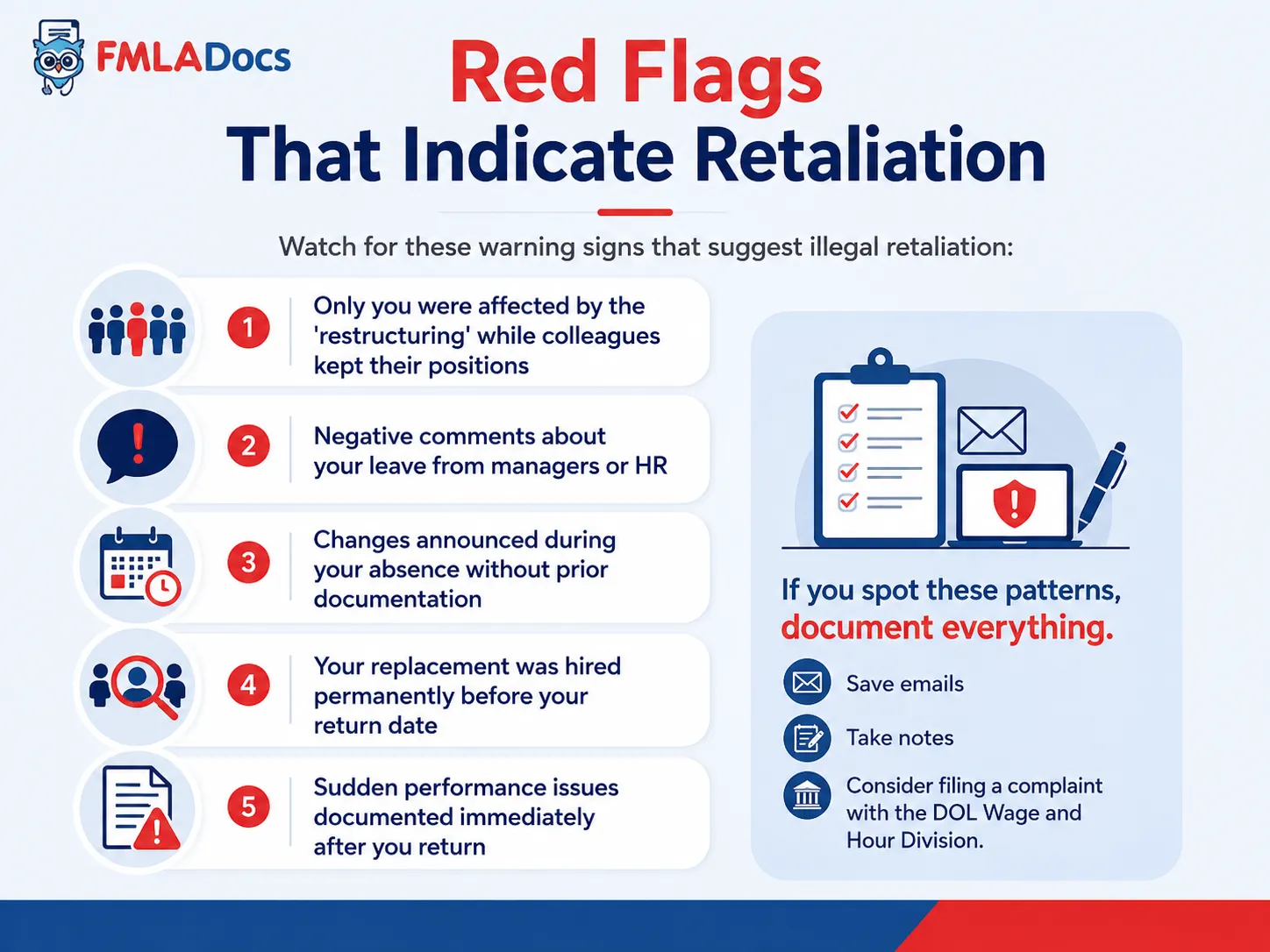
Watch for these warning signs that suggest illegal retaliation:
-
Only you were affected by the ‘restructuring’ while colleagues kept their positions
-
Negative comments about your leave from managers or HR
-
Changes announced during your absence without prior documentation
-
Your replacement was hired permanently before your return date
-
Sudden performance issues documented immediately after you return
If you spot these patterns, document everything. Save emails, take notes, and consider filing a complaint with the DOL Wage and Hour Division.
Common Illegal Job Changes Employers Make After FMLA Leave
When you return from FMLA leave, your employer must restore you to the same position or an equivalent one. Many employers violate this requirement through subtle changes that reduce your pay, responsibilities, or working conditions. These violations often appear legitimate on the surface but break federal law.
Pay and Compensation Violations
Reducing your pay after FMLA leave is illegal. Even a small cut violates your restoration rights. The only exception is company-wide pay reductions affecting all employees.
Employers also violate the law by eliminating bonus eligibility. If you qualified for quarterly bonuses before leave, you must remain eligible after. Removing commission opportunities works the same way. Taking away overtime access reduces your earning potential and breaks employer FMLA obligations to restore equivalent conditions.
Some companies cut benefits instead of base pay. They might drop you from profit-sharing plans or reduce 401(k) matching. These changes violate your rights just as much as direct pay cuts.
Schedule and Shift Changes
Moving you from day shift to night shift is not equivalent. Your schedule is part of your position. Changing you from full-time to part-time status violates federal law. According to illegal demotion and reassignment guidance, these changes constitute unlawful retaliation.
Geographic changes matter too. Moving you to a less desirable location breaks equivalence rules. Requiring a significantly longer commute violates your restoration rights. One employee returned to find their office role moved to a warehouse across town.
Responsibility and Authority Reductions
Removing supervisory duties constitutes an illegal demotion. If you managed a team before leave, you must manage a team after. Taking away direct reports reduces your authority and violates the law.
Subtle demotions happen through responsibility changes. Employers remove key accounts from your portfolio. They exclude you from important meetings you attended before. They reassign your major projects to other employees. One manager returned to find their role changed to individual contributor with no team.
Documentation Required to Protect Your FMLA Rights
Solid documentation is your best defense if your employer changes your job while on FMLA. Most disputes come down to what you can prove about your position before leave started. Start building your paper trail the moment you decide to request leave.
What to Document Before Taking Leave
Get your current job description in writing before leave starts. Request an official copy from HR. Many employers don’t maintain updated descriptions, so this step matters.
Document your current pay, benefits, schedule, responsibilities, and reporting relationships in detail. Save your most recent pay stub. Screenshot your benefits portal showing coverage levels. Note your work schedule, shift times, and any flexibility arrangements.
-
Take photos of your workspace and organizational charts
-
Save any materials showing your role and authority level
-
Document who reports to you and who you report to
-
Keep copies of recent performance reviews or commendations
Save all FMLA paperwork requirements including eligibility notice, designation notice, and medical certification. Keep personal copies of everything. Don’t rely on work email or computers that your employer controls.
Records to Keep During Your Leave
Forward all work-related emails to your personal account during leave. This includes any messages about restructuring, position changes, or organizational updates. You need access to these communications even after your work account is locked.
Keep a simple log of any contact from your employer. Note the date, time, who reached out, and what was discussed. This becomes critical if disputes arise about what was communicated during your absence.
Evidence to Gather Upon Return
Document all differences between your old and new position immediately upon return. According to the federal equivalent position regulations, your restored position must match your previous role in pay, benefits, and working conditions. Compare everything systematically.
Request a written explanation from HR about why changes were made and when they were decided. Ask specific questions about timing. Were decisions made before, during, or after your leave?
-
Compare current and previous pay stubs side by side
-
Review benefits statements for any coverage changes
-
Document differences in job duties, schedule, location, and authority
-
Save all emails, texts, and communications about changes to your personal account
This evidence becomes essential if you need to file a complaint or challenge the changes legally.
How to File a DOL Complaint for FMLA Violations
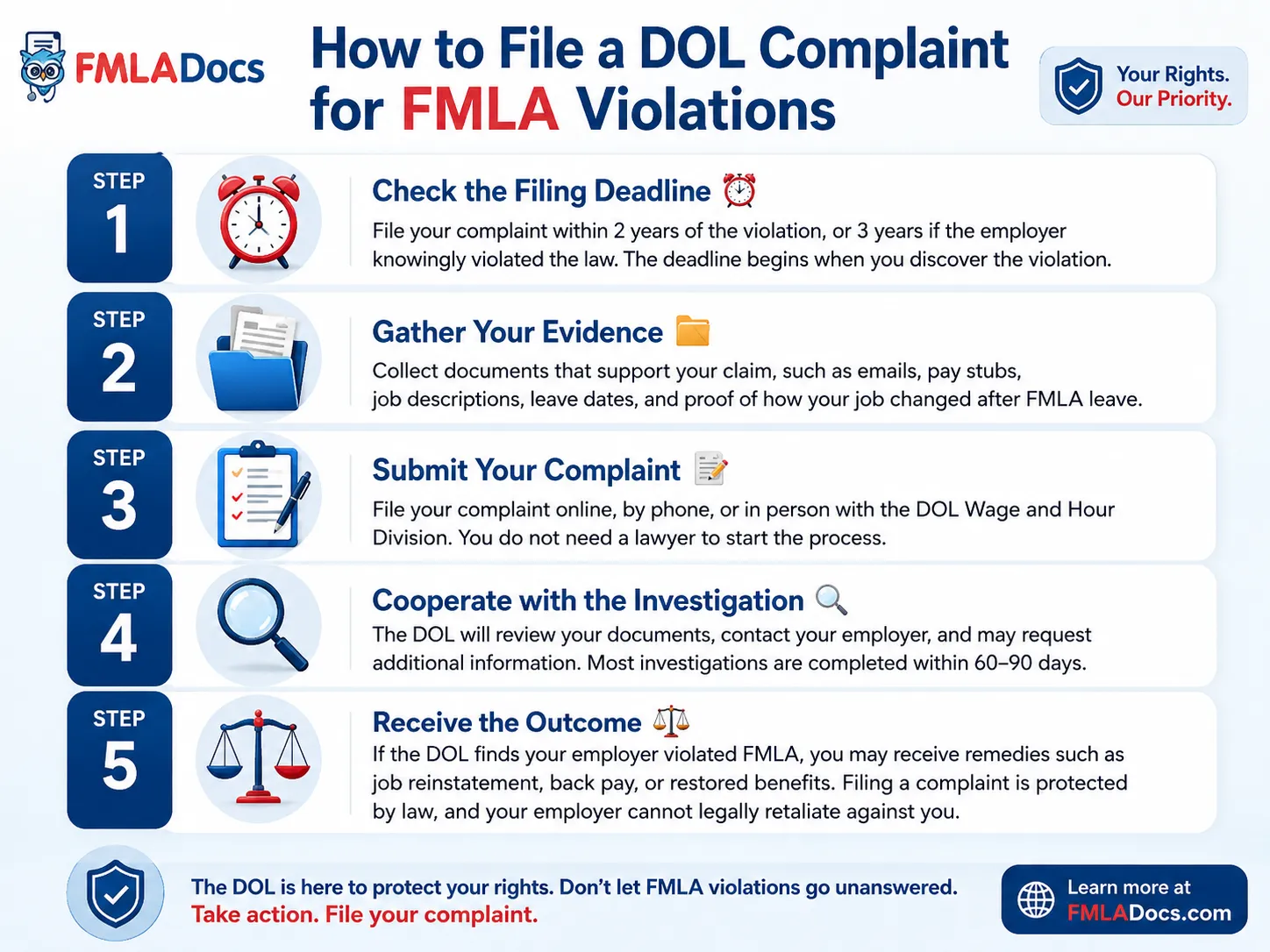
If your employer changed your job while on FMLA in ways that violate your restoration rights, you can file a complaint with the Department of Labor. You don’t need a lawyer to start this process. The DOL Wage and Hour Division handles FMLA enforcement and investigates violations at no cost to you.
When to File a Complaint
You must file within two years of the violation. If the violation was willful, you have three years. The clock starts when you discover the violation, not when you returned from leave.
Common violations include being assigned to a different shift with worse hours, receiving reduced pay or responsibilities, or being placed in a position requiring different skills or qualifications. According to legal guidance on employer job changes after leave, these changes violate your right to an equivalent position.
The DOL Wage and Hour Division Process
You can file online through the DOL website, by phone at 1-866-487-9243, or in person at your local WHD office. No lawyer is required for the initial complaint.
Your complaint should include your contact information, employer details with company name and location, a clear description of the violation, dates of your leave and return, and documentation of position changes. Attach any emails, job descriptions, pay stubs, or other evidence showing how your job changed.
What Happens After You File
The DOL investigates by reviewing your documentation and interviewing your employer. They may request additional records from both parties. Most investigations take 60-90 days but can extend longer for complex cases.
If the DOL finds violations, they can order remedies. These include reinstatement to your proper position, back pay for lost wages, and compensation for lost benefits. The Code of Federal Regulations outlines specific restoration requirements employers must follow.
Filing a complaint is protected activity. Your employer cannot retaliate against you for filing. You can also file a private lawsuit in addition to or instead of a DOL complaint. Consult an employment attorney for complex situations or significant damages.
Conclusion
Your employer cannot legally demote you, cut your pay, or move you to a worse position simply because you took FMLA leave. The law requires restoration to the same or an equivalent job with the same pay, benefits, and working conditions. While legitimate business restructuring can sometimes result in position changes, your employer must prove those changes would have happened regardless of your leave.
Documentation protects your fmla job protection rights more than anything else. Gather evidence before, during, and after your leave. If you return to find your job changed in ways that feel like punishment, you have legal recourse through the DOL complaint process.
Don’t wait to take action if you face illegal job changes. Document everything immediately and request written explanations from HR. File a complaint with the DOL Wage and Hour Division if your fmla restoration rights violation isn’t resolved internally. Violations can result in reinstatement, back pay, and damages.
To protect your leave from the start, FMLADocs connects you with licensed physicians who complete FMLA certifications correctly the first time. Our board-certified doctors understand exactly what employers need to see and complete every required field with specific information. Most certifications are finished within 24 to 48 hours, so your application doesn’t get delayed or rejected. This ensures your employer can’t question whether you qualify when you ask can employer change my job while on fmla.
Frequently Asked Questions
Can my employer legally change my job while I'm on FMLA leave?
Yes, but only under specific conditions. Federal law protects your right to return to the same position or an equivalent one. Your employer can't demote you, cut your pay, or shift your schedule as retaliation for taking leave. They must restore you to your original position when you return. If that's not possible, they must provide an equivalent position that meets four specific criteria: same pay and benefits, substantially similar duties, same shift and schedule, and same geographic location. Any changes that don't meet these standards violate your FMLA job protection rights.
What does 'equivalent position' mean when I return from FMLA leave?
An equivalent position must be substantially similar to your original job in all material respects. It doesn't need to be identical, but minor differences are only acceptable if the position meets four federal criteria. You must receive the same pay, bonuses, health insurance, and retirement contributions. Your duties and responsibilities must be substantially similar with the same authority level. Your shift and schedule must match your pre-leave pattern. Your work location must be the same or have no significant increase in commute time. Your employer bears the burden of proving any position they offer meets this equivalence standard.
Can my employer move me from day shift to night shift after FMLA leave?
No, your employer can't change your shift from day to night and call it equivalent. Federal regulations require your employer to restore you to the same shift and schedule pattern you had before leave. This includes day, night, or weekend shifts. A shift change that alters your work hours or timing violates the FMLA equivalent position requirement. Even if the pay and duties stay the same, changing your shift pattern fails one of the four mandatory criteria for position equivalence. This type of change could be grounds for filing a DOL complaint.
What documentation should I save before taking FMLA leave to protect myself?
Save your job description, pay stubs, and any performance reviews before taking leave. This documentation proves your pre-leave position and helps you identify violations when you return. You need evidence of your salary, bonuses, benefits, job duties, authority level, shift schedule, and work location. If your employer changes any of these elements after your leave, you'll need this documentation to file a complaint. The burden of proof falls on your employer to show changes meet the equivalence standard, but having your own records strengthens your case if you need to challenge illegal job changes.
Why does federal law require employers to restore my position after FMLA leave?
The FMLA equivalent position requirement exists to prevent employers from punishing employees who exercise their legal right to medical leave. Without this protection, employers could demote workers, cut their pay, or reassign them to undesirable positions as retaliation. This protection ensures you can take necessary medical leave without fear of losing your career progress. It prevents retaliation and ensures your leave doesn't cost you your career. The law recognizes that employees need medical leave for serious health conditions and shouldn't face job penalties for taking legally protected time off.
Can my employer reduce my supervisory responsibilities when I return from FMLA leave?
No, your employer can't reduce your supervisory responsibilities and claim the position is equivalent. Federal regulations require substantially similar job functions, authority level, and reporting structure. If you supervised a team before leave, you must return to a position with similar supervisory duties. Reducing your authority or removing direct reports changes the nature of your job and violates the equivalence standard. This type of change fails the duties and responsibilities criterion, which is one of four mandatory requirements. Your employer must prove any position offered is equivalent in all material respects.
What should I do if I think my employer changed my job in violation of the FMLA?
Start by requesting the change in writing, if you haven't already, and compare it against your documented pre-leave role, pay, and schedule. You can raise the issue directly with HR, file a complaint with the U.S. Department of Labor's Wage and Hour Division, or consult an employment attorney to review your options. Acting promptly matters, since there are time limits for filing a claim.
Does it matter if my employer says the job change is "temporary"?
A change labeled "temporary" doesn't automatically make it lawful. What matters is whether the change happened because of your leave and whether it affects your pay, benefits, duties, or status. Even a short-term reassignment could raise concerns if it doesn't meet the equivalent-position standard when you're restored.
Meet the author
Nida Hammad
I am a professional writer with over five years of experience creating clear, engaging, and well-researched content. I specialize in healthcare topics, helping readers understand complex information in simple wording. Currently, I write for FMLA DOC, where I focus on producing accurate and trusted guides for people seeking support with FMLA and medical needs.
Get Your FMLA Certification Online in Minutes