

Can employer ask for more medical information for FMLA?
 by Nida Hammad
 Last updated:
Can employer ask for more medical information for FMLA? Yes, but only within strict legal limits. Employers can request clarification or authentication of your initial certification. They cannot demand your complete medical records or diagnosis details beyond what DOL forms require. The law protects you through the minimum necessary information standard.
Many workers don’t know why employers ask for more medical details. This happens after they submit their FMLA forms. You might wonder if you must comply or if the request crosses legal boundaries. You risk sharing too much health information without knowing what’s right. You might also refuse valid requests and delay your leave.
This guide breaks down exactly what medical information employers can and cannot request under federal law. You’ll learn the minimum necessary information standard, how HIPAA and FMLA work together to protect your privacy, and when additional documentation requests are justified. We’ll show you how to push back professionally on inappropriate requests and when to escalate concerns to the Department of Labor.
Know these limits. You protect your rights this way. You also keep a good work bond with your boss. Let’s start with the legal framework that governs can employer ask for more medical information for FMLA situations.
Can Employer Ask for More Medical Information for FMLA? The Minimum Necessary Standard
FMLA regulations require only the minimum information necessary to establish that leave qualifies under the law. This standard protects your privacy while giving employers enough detail to verify legitimacy. You don’t need to share your complete medical history. You just need to prove your condition meets federal requirements.
The balance matters. Too little information gets your certification rejected. Too much information exposes private details you’re not required to share. Understanding what’s actually required helps you navigate this process without oversharing.
Need help getting your certification done right the first time? Start your FMLA certification with FMLAdocs
The Standard DOL Certification Forms (WH-380-E and WH-380-F)
Employers must use DOL Form WH-380-E for your own serious health condition. They use Form WH-380-F when you’re caring for a family member. These forms define exactly what information employers can request. Nothing more, nothing less.
The forms ask about diagnosis date and how long the condition lasts. They ask about treatment visits and what tasks you cannot do. Healthcare providers must explain why leave is medically necessary. For intermittent leave, they must estimate frequency and duration of episodes. This structure ensures employers get what they need without overstepping.
Many employees don’t realize they need more than a simple doctor’s note for FMLA certification requirements to meet federal standards.
Required Information vs. Optional Details
Required information includes when your condition began and how long it will last. Providers must state whether you need inpatient care or continuing treatment. They must explain how your condition affects your ability to perform job functions. For intermittent leave, they must estimate how often episodes occur and how long each lasts.
Employers do not need detailed diagnosis notes. They do not need full treatment records. They do not need test results or lab work. They do not need therapy notes or drug lists. Employers cannot request these items. If they do, they’re exceeding the minimum necessary standard.
The certification process balances employer’s need to verify legitimacy with employee’s privacy rights under federal law. Stick to what the forms actually ask. Don’t volunteer extra information thinking it will strengthen your case. It won’t. It just exposes private details you’re legally entitled to protect.
What Employers Can Request: The Legal Scope of WH-380 Forms
When you request FMLA leave, your employer can require initial certification using official DOL forms. These forms ask specific questions about your condition. They must include your healthcare provider’s contact information, credentials, and signature with date. The forms set strict legal limits to protect your privacy. They give employers the info they need to approve leave.
Information Permitted on Initial Certification
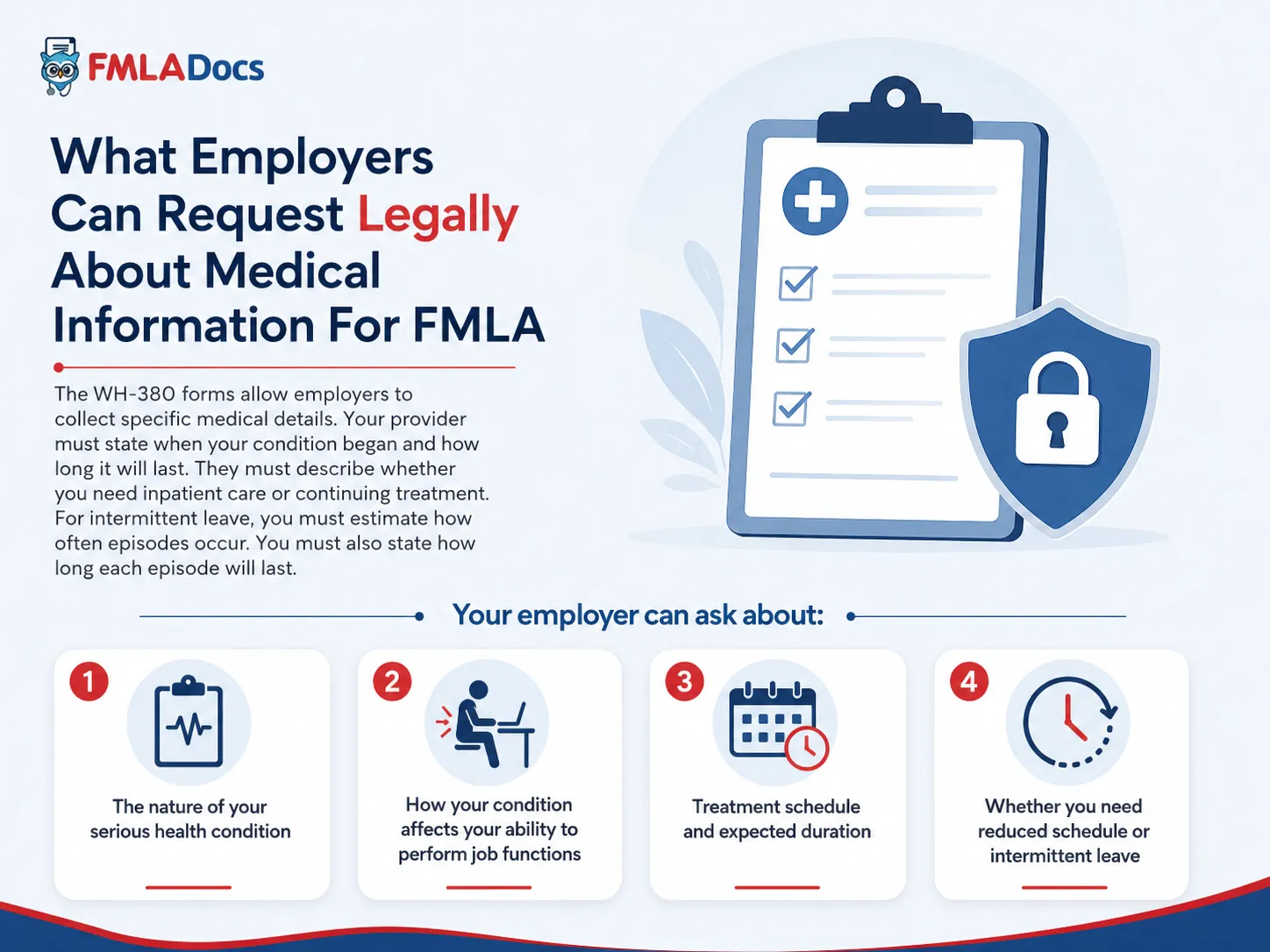
The WH-380 forms allow employers to collect specific medical details. Your provider must state when your condition began and how long it will last. They must describe whether you need inpatient care or continuing treatment. For intermittent leave, you must estimate how often episodes occur. You must also state how long each episode will last.
Your employer can ask about:
-
The nature of your serious health condition
-
How your condition affects your ability to perform job functions
-
Treatment schedule and expected duration
-
Whether you need reduced schedule or intermittent leave
What they cannot ask goes beyond these forms. Understanding what employers can and can’t ask on FMLA paperwork helps you protect your privacy rights while meeting certification requirements.
Clarification Requests for Incomplete Forms
Employers can request clarification when certification is incomplete, vague, or contains inconsistencies. This happens often when providers leave sections blank or give unclear answers. Additional information requests must relate to gaps in the original certification. They cannot expand beyond form requirements or ask for your complete medical records.
Common reasons for clarification requests include:
-
Missing dates or duration estimates
-
Vague descriptions like “ongoing” without specifics
-
Incomplete provider credentials or contact information
-
No explanation of how condition affects work capacity
Your employer must specify exactly what information is insufficient and why. Generic requests for “more information” don’t meet legal standards.
The Seven-Day Cure Period
Employers must give you at least seven calendar days to cure deficiencies in certification. This period starts when they notify you about incomplete or insufficient information. You have this full week to get corrections from your provider and resubmit.
The cure period protects you from immediate denial. Your employer cannot reject your leave request before this seven-day window closes. Use this time to contact your provider immediately and explain what specific information the employer needs.
HIPAA vs. FMLA: Understanding the Privacy Framework
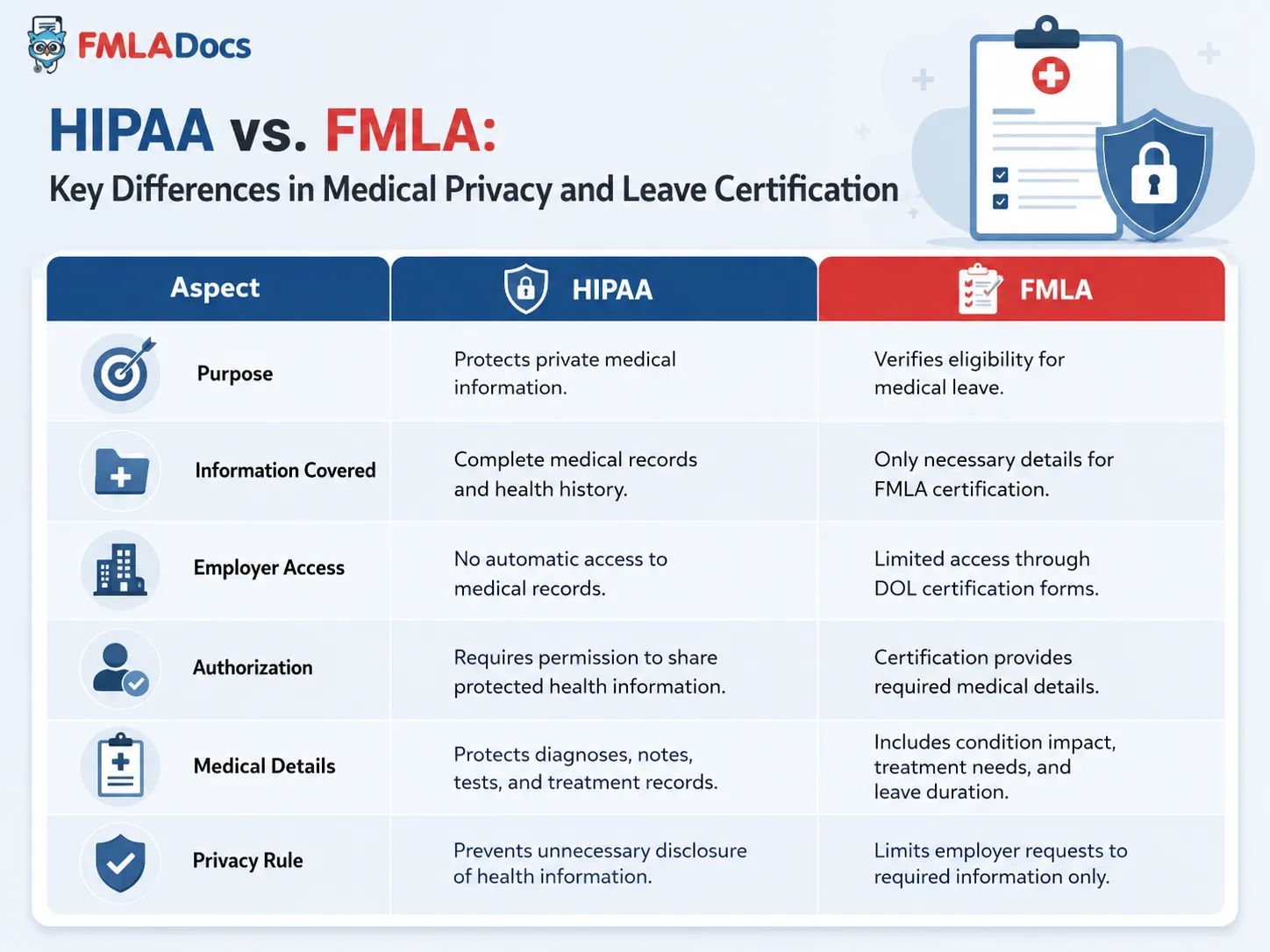
When your employer asks for medical information for FMLA, two federal laws shape what they can request. HIPAA protects your complete medical records. FMLA creates a narrow exception for certification. Understanding where these laws intersect protects your privacy rights.
How HIPAA Protects Your Medical Records
HIPAA (Health Insurance Portability and Accountability Act) safeguards your complete medical history. Your healthcare provider must get your written okay first. They cannot share your full records with your boss. This protection covers diagnoses, treatment notes, test results, and provider communications.
According to the Department of Health and Human Services, employers don’t have automatic access to your health information just because you work for them. Your medical records stay private unless you explicitly consent to their release.
FMLA’s Narrower Information Window
FMLA certification forms request only what’s needed to verify leave eligibility. These DOL forms ask about your condition’s impact on work ability, treatment frequency, and expected duration. They don’t require your full diagnosis or detailed medical history.
Your provider completes the certification with minimum necessary information. You give enough detail to prove a serious health condition. You don’t share your full medical past. The forms are designed to balance employer verification needs with your privacy rights.
Where the Two Laws Intersect
FMLA doesn’t override HIPAA protections. Your employer cannot use FMLA to get protected health info. They can only ask for what the law requires. If they request information beyond DOL forms, they may violate both FMLA regulations and HIPAA privacy rules.
You can authorize your provider to speak with your employer. But you’re not required to do so. The certification form itself provides all legally required information. Employers must follow strict rules when asking for more medical files. They can only request what the law allows.
What Employers Cannot Request Under Federal Law
Federal law sets clear boundaries on what medical information employers can request during the FMLA process. These limits protect your privacy while still giving employers enough information to verify your need for leave.
Protected Medical Information
Your employer can’t demand your complete medical records. They can’t ask for psychiatric treatment notes or detailed diagnosis explanations beyond what the DOL certification form requires.
You don’t have to share your diagnosis. The certification form can explain your limits instead. Your doctor can describe anxiety episodes that limit focus. If this happens 4-6 hours twice weekly, that works. Your employer doesn’t need to know whether you have generalized anxiety disorder, panic disorder, or PTSD.
Employers can’t ask about genetic information, HIV status, or other protected health details not relevant to leave necessity. These requests violate both FMLA regulations and potentially HIPAA privacy rules.
Prohibited Documentation Requests
Requests for information beyond DOL form requirements violate federal regulations. The WH-380 forms contain all the medical information your employer legally needs.
Employers can’t require second opinions for most FMLA certifications. The exception is when they can require a second opinion at their expense for certain conditions. Even then, they must follow strict procedures and pay all costs.
Employers can’t use clarification requests to dig for extra private details. They must only ask for what the law allows. If your certification is complete, additional requests may cross the line into prohibited territory. Understanding when employers can deny FMLA requests helps you recognize improper information demands.
Direct Contact With Healthcare Providers
Your employer can’t contact your healthcare provider directly without your written authorization. All communication about your medical condition must go through you or with your explicit consent.
If clarification is needed, your employer must contact you first. You then work with your provider to supply the additional information. Direct provider contact without permission violates your privacy rights under both FMLA and HIPAA.
How to Push Back Professionally on Inappropriate Requests
When your employer asks for more medical information for FMLA, you need to evaluate whether the request is legitimate. Not every request exceeds legal boundaries. Some genuinely address gaps in your certification.
Evaluating Whether the Request Is Legitimate
Review the request carefully against FMLA regulations. Employers can ask for clarification on incomplete certifications. They can request specific details about frequency, duration, or functional limitations if your provider left sections blank.
However, they can’t demand your complete medical records. They can’t ask for your diagnosis if the certification already establishes a serious health condition. They can’t require details about treatment methods or medications beyond what’s necessary to verify your need for leave.
Under 29 CFR 825.307, employers must limit requests to the minimum necessary information. If your certification already answers their questions, additional requests may exceed legal boundaries.
Crafting Your Response to Overreaching Requests
Respond in writing to create a paper trail. Use professional language that avoids confrontation while protecting your rights. Reference specific FMLA regulations when explaining why you believe a request exceeds legal boundaries.
Offer to provide clarification on specific certification deficiencies. Decline to provide protected information that goes beyond FMLA requirements. For example: “I’m happy to have my healthcare provider clarify the frequency of episodes as requested. However, I’m unable to provide my complete treatment records as this exceeds FMLA certification requirements under 29 CFR 825.307.”
Documenting All Communications
Keep copies of all requests, responses, and communications with both your employer and provider. Save emails to a personal account, not just your work email. Take notes after phone conversations documenting date, time, who you spoke with, and what was discussed.
If the request seems to exceed legal boundaries, consult with HR about FMLA regulations before responding. If your employer denies your request based on insufficient information, you’ll need this documentation to support any complaint or appeal.
When to Escalate: Filing Complaints and Seeking Help
If your employer asks for more medical information than FMLA allows, you have clear escalation options. Start by addressing the issue internally. Then move to federal agencies if needed.
Internal Escalation to HR and Compliance
Contact your company’s HR department first. Explain which requests go beyond what’s allowed under FMLA.
Document everything in writing. Save emails showing what medical information your employer requested. Note the dates and your responses.
Many companies have compliance officers who handle FMLA issues. They can review whether requests violate official DOL medical certification guidelines. This step often resolves problems without formal complaints.
Filing DOL Complaints
If internal escalation fails, file a complaint with the U.S. Department of Labor Wage and Hour Division. You have two years from the violation date to file.
That window extends to three years if the violation was willful. The DOL investigates complaints at no cost to you.
Your employer cannot retaliate against you for refusing inappropriate medical information requests. Retaliation includes discipline, demotion, or termination related to FMLA disputes.
When to Consult an Employment Attorney
Consider legal help if you face denial, discipline, or termination after refusing excessive medical information requests. Attorneys can evaluate whether your rights were violated.
Keep personal copies of all documentation separate from work systems. You’ll need evidence if disputes escalate to legal action.
FMLADocs helps prevent these situations entirely. Our licensed physicians complete certifications correctly from the start. This reduces the likelihood of inappropriate additional requests.
Conclusion
Now you know the answer for “can employer ask for more medical information for fmla?”. The short answer is yes, but only in specific situations allowed by federal law. The minimum necessary standard protects your privacy while giving employers enough information to approve legitimate leave. Employers can require DOL certification forms and request clarification for incomplete submissions. They cannot demand your complete medical records or details beyond form requirements.
When your employer requests additional medical documentation for FMLA, evaluate whether the request addresses legitimate certification gaps. Push back professionally on inappropriate requests by citing specific FMLA regulations. If violations occur, document everything and escalate through HR or the Department of Labor.
The key is knowing your rights under both FMLA and HIPAA. These laws work together to protect your privacy while ensuring employers get sufficient information for approval decisions. Don’t let confusion about what medical information can employer request for FMLA delay your leave or compromise your privacy.
If you need help getting your FMLA certification completed correctly the first time, FMLADocs connects you with board-certified physicians who understand exactly what information is legally required. Our doctors complete your forms in 24-48 hours while protecting your privacy rights. Get your certification done right without the stress of navigating complex requirements alone.
Frequently Asked Questions
Can employer ask for more medical information for FMLA beyond the standard certification forms?
Yes, but only within strict legal limits. Employers can request clarification or authentication of your initial certification. They cannot demand your complete medical records or diagnosis details beyond what DOL forms require. The law protects you through the minimum necessary information standard. This means employers need enough information to verify your leave is legitimate, but they don't need to know every detail of your medical condition or treatment plan. They must use standard DOL forms WH-380-E or WH-380-F, which define exactly what information they can request.
What does the minimum necessary information standard mean for FMLA requests?
The minimum necessary standard means employers can only request information that proves your leave qualifies under federal law. They can't ask for complete medical records, treatment notes, or detailed diagnosis explanations beyond what standard forms request. This standard exists to protect your privacy rights while giving employers enough detail to verify legitimacy. You don't need to share your complete medical history. You just need to prove your condition meets federal requirements. The balance matters because too little information gets your certification rejected, while too much exposes private details you're not required to share.
What information is required on the standard DOL certification forms for FMLA?
Required information includes when your condition began and how long it will last. Providers must state whether you need inpatient care or continuing treatment. They must explain how your condition affects your ability to perform job functions. For intermittent leave, they must estimate how often episodes occur and how long each lasts. Employers use Form WH-380-E for your own serious health condition and Form WH-380-F when you're caring for a family member. These forms ask specific questions about diagnosis date, probable duration, treatment frequency, and functional limitations to ensure employers get what they need without overstepping.
What medical details are employers not allowed to request under FMLA?
Employers cannot request detailed diagnosis explanations, complete treatment histories, test results or lab work, therapy session notes, or medication lists. These details go beyond the minimum necessary standard and violate your privacy rights. While healthcare providers must explain why leave is medically necessary, they don't need to provide every detail of your medical condition. The standard DOL forms define the boundaries of what employers can ask. Anything beyond those forms typically crosses legal boundaries. This protection helps you maintain privacy while still proving your leave qualifies under federal law.
How do HIPAA and FMLA work together to protect my medical privacy?
HIPAA and FMLA work together to protect your privacy while allowing necessary information sharing. The minimum necessary information standard under FMLA aligns with HIPAA's privacy protections. Employers can only request information that proves your leave qualifies, not your complete medical history. This dual protection ensures you don't expose private health details beyond what's legally required. The standard DOL certification forms are designed to comply with both laws. Healthcare providers know what information they can share without violating HIPAA. This framework helps you navigate the process without oversharing while maintaining a professional relationship with your employer.
When is an employer's request for additional FMLA medical documentation justified?
Employers can request clarification or authentication of your initial certification when information is unclear or incomplete. If your healthcare provider's responses are vague or don't fully answer the form questions, additional documentation may be justified. Employers might need clarification about how your condition affects your ability to perform job functions or the estimated frequency of intermittent leave episodes. However, they cannot use this as an excuse to demand complete medical records or details beyond the standard forms. The request must still comply with the minimum necessary standard. Understanding what's legitimate helps you determine whether to comply or push back professionally on inappropriate requests.
Can HR ask for my specific diagnosis?
Not as a matter of course. The standard FMLA certification form asks for a general statement of the relevant medical facts, not a named diagnosis. Employees are not required to disclose the specific condition itself, only enough functional information, such as the onset, duration, ability to work, and need for intermittent leave, to establish that a serious health condition exists. If HR asks you directly, "What's your diagnosis?" outside the certification process, that request goes beyond what the form requires. You can refer them to the completed certification as the appropriate source of information.
Can my employer call my doctor directly to ask about my condition?
Not in the way many employees fear. Your direct supervisor is never permitted to contact your health care provider. If clarification or authentication of a certification is needed, that contact must go through a health care provider, HR professional, leave administrator, or another management official designated by the employer. It is limited to authenticating the form or clarifying information already provided, not requesting new medical details. Your provider's office is also not required to share any information without your HIPAA authorization, so even a permitted employer contact cannot obtain medical information you have not agreed to release.
Meet the author
Nida Hammad
I am a professional writer with over five years of experience creating clear, engaging, and well-researched content. I specialize in healthcare topics, helping readers understand complex information in simple wording. Currently, I write for FMLA DOC, where I focus on producing accurate and trusted guides for people seeking support with FMLA and medical needs.
Get Your FMLA Certification Online in Minutes